

Traveling the Cosmos With Carter Emmart, One Last Time

On the corner of West 81st Street and Central Park West, an era is drawing to a close. The Hayden Planetarium at the American Museum of Natural History is about to lose its longtime guide to the stars.
For almost 30 years, Carter Emmart, now 64, has led the astro-visualization program at the museum. He’s been the creative mind behind a breathtaking digital cosmos, assembled from images and data collected by space missions and observatories across the globe. Through the years, Emmart and his dedicated team have crafted a series of captivating planetarium shows that transport audiences across the vast expanse of space and time, illuminating both the origins and possible destinies of the universe.

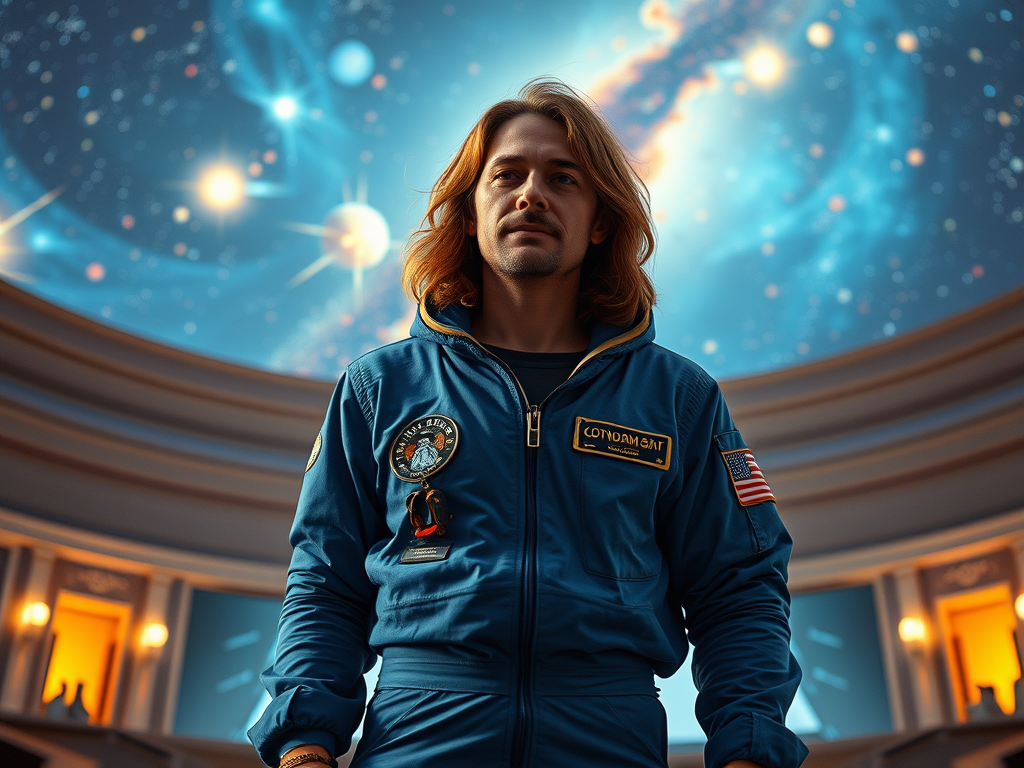
With his long hair, eclectic jewelry, and fondness for wearing a blue astronaut jumpsuit at major events, Emmart often gives the impression of a man who’s stepped right out of a sci-fi story. His office in Manhattan is decorated with an eclectic array of Barbie dolls, which he’s used as scale models in his work. Many of them have traveled with him worldwide, dressed in traditional attire from various cultures.
Millions have attended the planetarium shows over the decades, witnessing stars bursting into supernovae, galaxies in collision, and radiant nebulae swirling in cosmic motion. Audiences have explored distant planetary terrains and delved into the elusive substance known as dark matter. These shows, narrated by notable figures such as Tom Hanks, Robert Redford, Whoopi Goldberg, and the planetarium’s own Neil deGrasse Tyson, have been shared with 60 institutions in 40 different nations.
On quiet afternoons, fortunate visitors might have found themselves lying beneath the planetarium dome, guided by Emmart himself on a private voyage through his vast digital cosmos. During these sessions, he would pause to admire features like the moon’s craters or the sandy ridges of Mars.
His final production for the Hayden Planetarium, titled Encounters in the Milky Way, premiered on June 9. It explores the past and future of our home galaxy. At the end of summer, Emmart plans to retire and relocate to Thailand. “I’m ready for a peaceful life, closer to nature,” he said.
Throughout his career, Emmart has captivated a wide range of visitors — from ordinary guests to celebrities, astronauts, and dreamers. In 2000, Neil Armstrong, the first human to walk on the moon, arranged for the board of the Cincinnati Museum of Natural History to fly to New York just to see one of Emmart’s shows. Armstrong and Emmart later shared a laugh under the dome, marveling at the planetarium’s computing power, which far exceeded that of the Apollo missions.

Children have made up a large part of his audience. Emmart himself was raised in New Jersey and spent his youth taking astronomy classes at the original Hayden Planetarium, which underwent a major renovation in 2000. “I grew up in love with this place,” he said.
Even in high school, Emmart was already a rising star in the field. He won a national competition to design a photometer for measuring the brightness of celestial objects. His prize was an invitation to a Caltech conference — which was later revoked when organizers realized he wasn’t yet 18. Undeterred, he paid his own way to Pasadena, using savings from his paper route. While there, he had lunch with Clyde Tombaugh, the astronomer who discovered Pluto.
That conference opened his eyes to the wider world of space art and science. He later followed this path to the University of Colorado Boulder, where he studied geophysics. In 1981, he helped launch a series of conferences titled The Case for Mars, which continued for over a decade.
With a commercial artist for a father, Emmart grew up sketching and storyboarding. “Drawing came naturally — it was part of the family tradition,” he explained. He wanted to visualize futuristic missions conceived by figures like Buzz Aldrin, imagining how components from space shuttles could be repurposed for new spacecraft.
In his early professional life, Emmart worked for a construction company creating architectural models. Barbies came in handy for demonstrating scale. In 1989, he traveled to Russia twice with the International Association of Astronomical Artists. There, he befriended Dennis Davidson, who had previously been selected for a job Emmart had also applied for — at the Hayden Planetarium.

In 1991, Emmart joined NASA’s Ames Research Center to contribute to a Mars-related book project. Two years later, he moved to Boulder to work at the National Center for Atmospheric Research. As that position was ending, he reached out to Davidson, who informed him of an opening at the Hayden Planetarium. Emmart joined in 1998.
“I arrived here on Valentine’s Day,” he recalled, “and by June, I was officially part of the team.”
At that time, the planetarium was undergoing a major overhaul. The original structure was being demolished and replaced by the Rose Center for Earth and Space, a striking design featuring a giant sphere housed within a glass cube. Many locals opposed the change, including Emmart, who wrote letters supporting a lawsuit against the redesign.
Nevertheless, Davidson envisioned a digital star atlas — dubbed the Digital Galaxy — and the software tools to navigate it. Emmart was appointed director of what would become a revolutionary reimagining of the planetarium experience.
“This was a once-in-a-lifetime opportunity,” Emmart said. To build the foundation, the team made frequent trips to Silicon Valley, including one that resulted in purchasing a $5 million SGI Onyx2 Reality Monster supercomputer. It was paired with a Zeiss Mark IX projector — a powerful combination that enabled the spectacular visuals seen today.
Currently, the system uses Nvidia Quadro RTX computers to create imagery and sound, which are projected by an array of lasers and 24 speakers. The star projector lies hidden beneath the floor. “My virtual-reality headset has room for 400 people,” Emmart joked.

To pilot the digital universe, Emmart’s team utilized Partiview, software created by programmer Stuart Levy. Emmart first saw it in action during a conversation in New Orleans, when Levy showed him dynamic star models on a modest IBM ThinkPad. Emmart was astonished — such visuals didn’t require a supercomputer. That moment inspired him to make the universe accessible to everyone.
He accepted an invitation from science fiction legend Arthur C. Clarke to visit Sri Lanka in 2002. For three days, he guided Clarke through the digital universe. Clarke, ever modest, commented that the cosmos seemed “a bit showy.”
Partiview eventually evolved into Uniview and then OpenSpace, an open-source tool co-developed with NASA. Emmart once operated a New York Girls Club show remotely — from a bar in Bangkok — because it had faster Wi-Fi than local hotels.
His final show, narrated by Pedro Pascal, begins nearly a million miles from Earth, using data from Gaia, a European observatory tracking two billion stars. The journey reaches the Oort Cloud — an icy halo ten trillion miles wide — where new simulations suggest a spiral “tail” structure shaped by the Milky Way’s gravitational pull. “It looks like a dragon,” Emmart said.

When the show maps Oort Clouds around other stars, the galaxy resembles a cosmic bubble bath. A dwarf galaxy pirouettes through the Milky Way, tearing itself apart. Supernovae burst like cosmic fireworks, and familiar constellations dissolve over eons.
After 24 minutes — and 27 years — the journey ends all too soon.
One encounter with Clarke had a lasting impact. When Emmart mentioned he hoped to one day visit Angkor Wat, Clarke exclaimed, “Someday?” and slammed the table, urging immediate action. In 2007, Emmart went — and kept returning. On one trip through Bangkok, he met Songkran, who became his partner.
Now engaged, the couple plans to live in a simple home with four dogs, three water buffalo, two ponds, mango trees, and a dome for stargazing. “We’ll be pretty self-sufficient,” he said. The skies overhead display the Southern Cross and Omega Centauri.
He’s also helped teach astronomy in Cambodia and hopes to support the country’s first planetarium. One of his former students, Vatey Ouy, is now pursuing aerospace engineering at Colorado State University under a prestigious scholarship.
“I never had children,” Emmart said, “but my students are a greater reward than I ever expected.”
“If I’ve achieved anything,” he reflected, “it’s helping others reach Out There — and inspiring them to look back, feel how small we are, and realize how far our collective imagination can stretch.”
To the stars, Captain Emmart.aptain Emmart.





Leave a Reply