
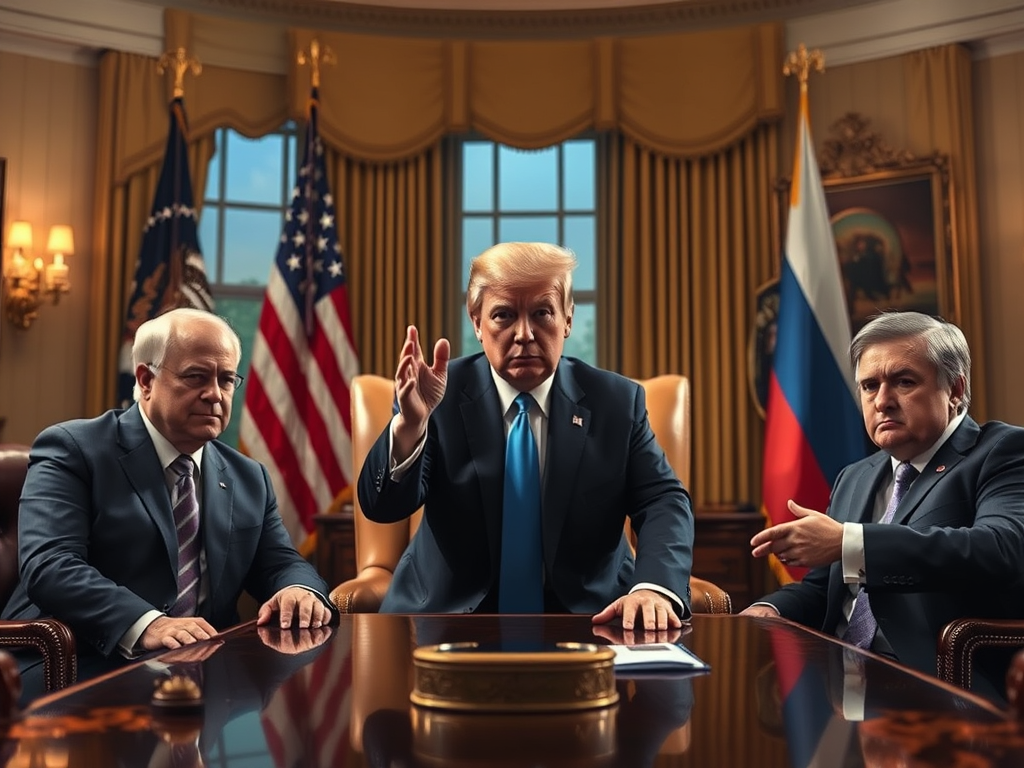

Trump’s New ‘Apprentice’ Boardroom: The Oval Office

President Trump reached his conclusion after a highly theatrical confrontation in the Oval Office this past February, broadcast live on television. Alongside Vice President JD Vance, he took turns admonishing Ukrainian President Volodymyr Zelensky, strongly suggesting that continued American support for Ukraine—despite its ongoing war with Russia—was not guaranteed.
This wasn’t an isolated display of aggressive diplomacy. In another widely publicized meeting in May, President Trump hosted South African President Cyril Ramaphosa. But rather than engage in typical diplomatic dialogue, Trump brought a television into the room and played selected video clips in an effort to support his debunked narrative that white South African farmers were being targeted in a genocide. One of the images he used turned out to be from the Democratic Republic of Congo. The surprise tactic left Ramaphosa visibly unsettled, and the entire exchange was, once again, aired live.
These tense episodes stand in sharp contrast to the traditionally measured and discreet nature of Oval Office diplomacy. Yet for anyone familiar with Trump’s 14-season run as the unpredictable, drama-loving host of NBC’s The Apprentice, none of this was unexpected.

President Trump has turned the Oval Office into the ultimate reality television set—one designed by and for him. Each high-profile meeting becomes a live episode in a never-ending drama, carefully choreographed to capture attention and maximize spectacle. His guests, often foreign leaders or influential figures, find themselves either praised or reprimanded in front of cameras, depending on how the scene unfolds.
The format mirrors The Apprentice closely. In that show, Trump wielded his authority in a customized boardroom meant to amplify his persona—one more polished and theatrical than his actual office space in Trump Tower. In both roles—television host and president—Trump thrives on dominance, unpredictability, and confrontation. The same ingredients that make for gripping reality TV—tension, surprise, a clear power imbalance—have been carried directly into his governing style.
Like a seasoned producer, Trump favors the escalation of conflict over resolution. In television terms, a blow-up guarantees ratings; in politics, it secures headlines. Whether sparring with a world leader or challenging a billionaire like Elon Musk, Trump appears to relish the clash more than any kind of consensus.
During his time on The Apprentice, Trump was known for being mercurial. Contestants never knew what might trigger his ire—being too bold or not bold enough, too deferential or too dismissive. He was like a volatile mythological figure, handing out praise or punishment based on obscure whims. That same energy now permeates his political interactions.

The Oval Office, under Trump, has undergone a visual transformation too. Reflecting the opulence of Mar-a-Lago, the room is now touched with gold accents, lending it a theatrical flair. Trump typically leans forward in a regal, gold-toned chair, projecting dominance, while his guests sit formally across from him. A fireplace separates them, but often, the only heat comes from the verbal sparring initiated by the president.
These staged meetings follow a predictable rhythm. Initial pleasantries are exchanged, Trump’s deputies chime in, and members of the press—always present, always filming—prompt further discussion. Reporters serve a dual function: they are convenient antagonists for Trump to deride as “sick people,” but they also help stir the pot, setting the stage for confrontation.
It is usually at some point midway through the meeting that tensions begin to rise. The energy shifts, the atmosphere becomes taut, and the conversation takes a more combative tone. Perhaps a guest disagrees with Trump, or a reporter brings up a sensitive issue. For example, Zelensky once clarified that the Russian invasion of Ukraine actually began in 2014, not 2022. Trump bristled at the correction, and the temperature in the room immediately changed. In an intense moment, Trump even reached out and touched Zelensky’s arm—an action heavy with implied authority.
The physical cues in these encounters speak volumes. Even without audio, one can discern the tension. Zelensky appeared withdrawn, shoulders tight, as Trump leaned in. Ramaphosa tried to keep his composure with a polite smile and subtle head shakes as the president launched into his rehearsed monologue.
As in The Apprentice, Trump has lieutenants at his side. Vice President Vance frequently plays the role of provocateur. In one memorable instance, he chastised Zelensky with a biting comment: “Have you said ‘thank you’ once this entire meeting?” The remark seemed crafted not only to insult but to energize Trump, who thrives on perceived slights and loyalty tests.
Trump’s guests often find themselves under intense pressure, not just from the host’s scrutiny but from the unblinking eye of the cameras. This tension was particularly visible during a February meeting with Jordan’s King Abdullah II. Trump declared, “We will have Gaza,” and pushed the king to accept Palestinian refugees—a deeply unpopular proposal throughout the Arab world. The king responded carefully, trying to navigate Trump’s demands without committing to anything concrete. Later, he publicly rejected the idea on social media.
Each guest adopts a different strategy in this live-broadcast crucible. Zelensky, a former actor and seasoned public communicator, refused to retreat, even as the conversation grew hostile. His refusal didn’t avert the breakdown of the meeting, but it may have earned him a measure of respect from the combative president. The two were later seen conversing at Pope Francis’s funeral in April.
Ramaphosa tried to redirect the conversation by inviting familiar figures—like South African golf professionals—to the meeting, likely hoping to appeal to Trump’s well-known love of the sport. Despite the confrontational video presentation, Ramaphosa managed to push back on Trump’s false genocide claims with a coherent and forceful rebuttal.
What Trump seems to value most in these performances is affirmation—a mirror reflecting back his worldview. On The Apprentice, contestants who echoed his beliefs were often temporarily favored. One early competitor, Sam Solovey, earned Trump’s approval by praising the supposed strength of Trump’s “genetic pool.” Predictably, he was soon dismissed when his usefulness expired.
Foreign leaders who flatter Trump’s ego tend to emerge unscathed. Salvadoran President Nayib Bukele joined Trump in criticizing the press and downplayed concerns about a wrongfully deported citizen. Italian Prime Minister Giorgia Meloni, whose views on immigration and social issues align with Trump’s, dropped familiar conservative buzzwords like “woke” and “D.E.I.” in English—ensuring her meeting ended smoothly.

Yet even meetings that appear calm on the surface can spark turmoil off-camera. During a televised conversation with German Chancellor Friedrich Merz on June 5, Trump publicly responded to criticism from Elon Musk regarding his legislative priorities. The confrontation didn’t end with the broadcast.
As with any good reality TV series, the drama extends beyond the screen. Musk, angered by Trump’s remarks, launched into a live tirade on his platform, X (formerly Twitter), accusing the president of ingratitude—despite having supported Trump’s campaign financially.
The clash between the two powerful figures also highlighted a broader competition: one between media ecosystems. Trump took to his own platform, Truth Social, to continue attacking Musk, while Musk retaliated from the much larger stage of X. It was more than a feud; it was a contest of influence, brand power, and platform control.
In Trump’s Oval Office, those seeking to navigate the “Apprentice-style” stage would do well to arrive with their own media arsenal. But in the end, television remains Trump’s home turf. With the cameras rolling, the dramatic arc belongs to him.




Leave a Reply