

Sly Stone and the Sound of an America That Couldn’t Last

Some words lose their meaning from overuse. “Landscape” is one of those. Once evocative, it’s now worn down by metaphor and cliché. It’s stretched thin to describe everything from “the landscape of history” to “the landscape of commercial baking.” It’s a word that once painted vast vistas in our minds but now gets tossed around to mean any field, any domain, any collection of things. As a craft, it still retains a touch of grace — think of “landscape painting.” As a verb, it suggests beauty through deliberate arrangement, the way a landscaper transforms a city block into a small Eden.
The word resurfaced this week in an obituary: Sly Stone passed away at the age of 82. In one of the many tributes, he was said to have “redefined the landscape of pop, funk, and rock music.” It’s a familiar turn of phrase. But in Stone’s case, it’s not just accurate — it’s almost insufficient. He didn’t reshape a single landscape; he reimagined landscapes, plural. And more than that, he challenged the very idea of what “landscape” could mean in music and culture.
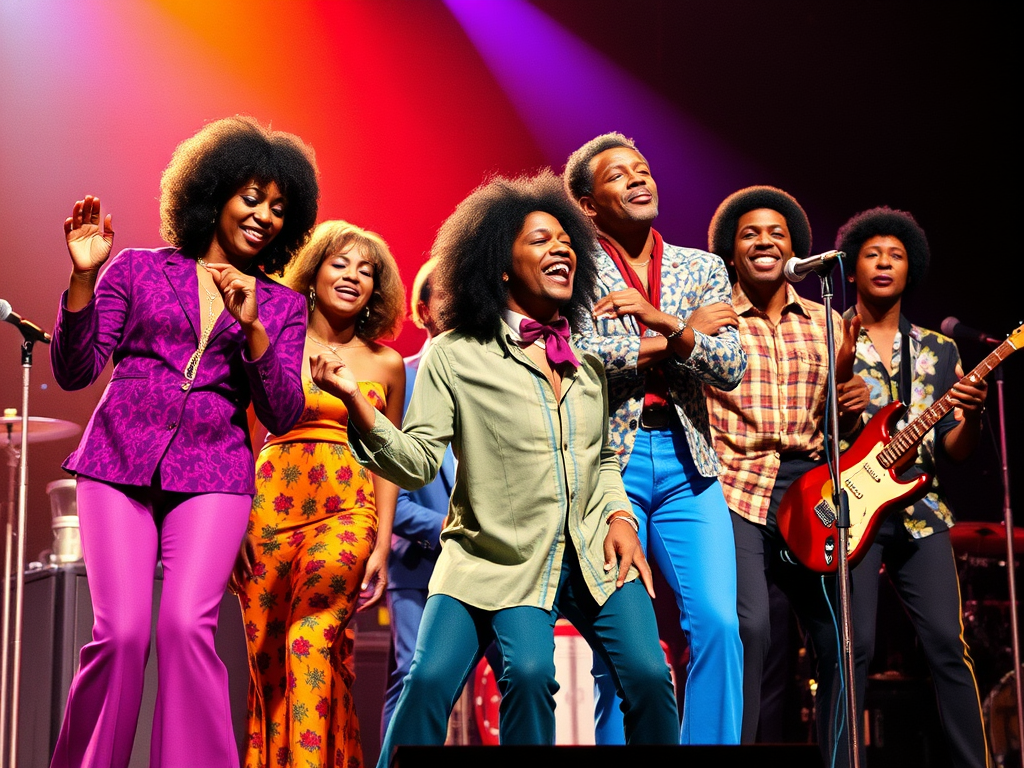
I find myself staring at an old photo of Sly and the Family Stone. The image speaks volumes: seven band members, a mix of races and genders, five Black, two white, two women, five men. In the fractured, racially scarred America of the 1960s, this band didn’t just make music — they made a statement. Their presence on stage was a kind of landscape in itself, a bold visual and sonic declaration of unity and diversity. In this image, “landscape” becomes more than a metaphor; it becomes a provocation.

The band was Stone’s creation, from its lineup to its sound. And what a sound it was. They compressed an astonishing amount of sonic energy into short tracks — sometimes under three minutes. Their first major hit, “Dance to the Music,” opens like a rocket launch. Drummer Greg Errico crashes in with relentless energy, while Cynthia Robinson’s ecstatic shout urges everyone to get moving. The horns blare like they’ve had too much to drink, and Freddie Stone’s guitar wails like it’s responding to a five-alarm emergency.
Then, just as the listener is swept into this frenzy, around the 16-second mark, the song takes a sudden detour. The intensity drops, and a doo-wop-style harmony floats in, accompanied by a gentle tambourine. The contrast is striking — it’s as if the track parachutes down from its own explosive opening. But the energy hasn’t disappeared; it’s just recalibrated. Larry Graham’s bass rumbles in next, promising to “add some bottom so that the dancers just won’t hide,” and his groove lifts the wallflowers right off the dance floor.

On paper, the lyrics don’t say much. They’re mostly calls to action: dance, move, feel. But beneath the simplicity lies something more profound. The band wasn’t just playing music — they were announcing their identity, their vision, their redefinition of popular music. The fusion was breathtaking: rock, gospel, soul, funk, jazz, even the theatricality of marching bands. Each track became a celebration of American sound, filtered through seven musicians daring to imagine a more harmonious country — just as 1968 tested the limits of that dream. For a brief moment in American history, the Family Stone was a mirage of what could be: an inclusive, joyful, multiracial musical utopia.
Earlier this year, a documentary paid tribute to Stone’s life and legacy. It examined not only his rise but his decline. By 1971, his creative and personal peak had begun to falter. The familiar culprits — drugs, fame, ego — took their toll. The infectious joy that had once defined his music gave way to something heavier, more introspective. The rhythms lost their bounce. The sparkle dimmed. The high-gloss funk turned darker and more ambiguous.
Yet artistically, Stone was evolving. His songwriting deepened in tone and meaning. Where his earlier hits had carried undertones of social activism and hope, his later work spoke of disillusionment and personal struggle. No longer in his twenties, Stone — now entering his thirties — could no longer afford the luxury of pretending that joy alone could fix things. The utopia he once performed began to crumble, and the music reflected it.
Take “Family Affair,” a standout track from the 1971 album There’s a Riot Goin’ On. It marked a turning point. The groove is low and murky, the mood subdued. Errico had left the band, and Stone, ever the innovator, replaced him with a drum machine — a choice that gave the track its distinctive, mechanical pulse. The result is both mournful and ingenious. You can hear the dissolution of the group, the fraying of bonds once held tightly. Stone’s voice, once brimming with playful funk, now trembles with weary introspection. The music no longer paints a landscape; it frames a group portrait, capturing a family at the brink, with chaos both within and without.

Still, even in his most isolated moments, Stone’s music never lost its soul. His gift was harmony — not only musical harmony but human harmony. He understood how to weave individual parts into a cohesive whole, and this sensitivity was attuned to the cultural turbulence of his time. America was breaking apart. And while some artists, like Stevie Wonder, transformed pain into beauty, offering musical balm to a wounded nation, Stone didn’t soften the blow. He chronicled the disarray. He acknowledged it. In doing so, he became a reluctant realist. His voice began to sound less like a leader and more like a lonely witness, tucked away in the basement of America’s conscience.
One of the most haunting moments from his later discography is his version of “Que Sera, Sera.” In his hands, the song becomes a gospel funeral dirge — slow, brooding, and saturated with regret. The lyrics, familiar to all, take on new weight: “The future’s not ours to see.” Where the original suggests a kind of cheerful resignation, Stone’s version feels like a mournful surrender. It’s the sound of someone peering into the unknown and seeing only shadows. Childhood questions about the future unravel into adult disillusionment. Possibility, the song seems to say, is a fantasy we can no longer afford.
Unsurprisingly, this wasn’t the kind of work that turned into a civil rights anthem. It was too bleak, too personal. And yet, in its own way, it was a radical act of honesty. The title of “visionary genius” can be a heavy burden, one that obscures as much as it illuminates. But Stone’s later music strips away the myth and leaves the man. His version of “Que Sera, Sera” still rings with brutal clarity. He didn’t write the song — he just made it new. That was his gift: taking something known and transforming it into something profound.
Sly Stone gave us “Life” — quite literally, as one of his songs declared — and his band embodied the raw, unfiltered hope of a better world. But his later work, quieter and more somber, is equally valuable. It tells us what happens when the dream begins to falter. And even then, Stone didn’t give up. He turned disillusionment into music, isolation into insight. He showed us that even when the landscape becomes a wasteland, there’s still a song worth singing.
That, too, is redefinition.imply did what his art excelled at. He redefined it.




Leave a Reply