
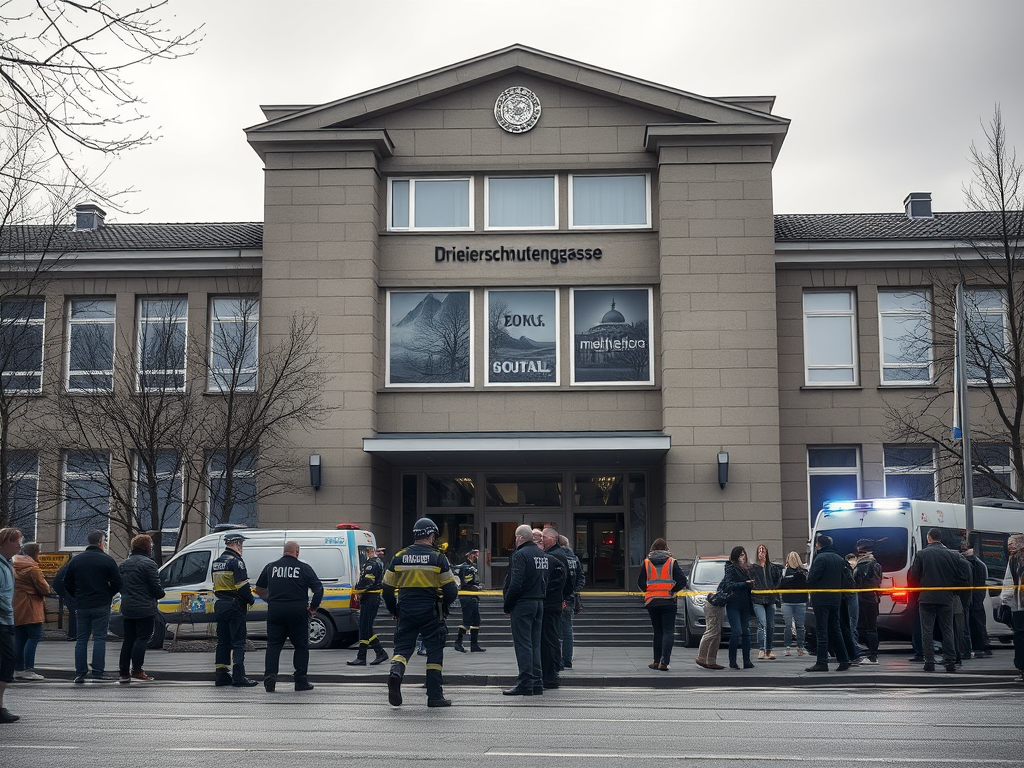

In a deeply disturbing and rare event for Austria, a former student opened fire at his old high school in the city of Graz on Tuesday, taking the lives of ten individuals before apparently turning the weapon on himself. Such violent school shootings are far more commonly associated with the United States than with Europe, making the incident all the more shocking to the Austrian public and government.
At Least 10 Killed in Shooting at Austrian High School, Police Say

The tragic attack occurred at BORG Dreierschützengasse, a school located in Graz, Austria’s second-largest city and a prominent academic hub known for its universities and affluence. The shooting has been described as one of the deadliest episodes of school violence in recent European history and the worst ever recorded at an Austrian educational institution.
Authorities reported that the gunman was a 21-year-old man who had previously attended the school but did not complete his education there. Police said he entered the school premises on Tuesday morning carrying both a handgun and a longer firearm, which has not yet been definitively identified as either a shotgun or a rifle. Both weapons were legally acquired, officials confirmed.
Once inside, the attacker fatally shot six females and three males. A tenth victim, a woman, succumbed to her injuries after being transported to a hospital. The police have withheld further information about the victims—including whether they were students or staff—pending the outcome of initial investigations.
The shooter was discovered deceased in one of the school’s restrooms. Authorities believe he took his own life after carrying out the rampage.
As the news of the attack spread, Chancellor Christian Stocker promptly cleared his agenda and traveled to Graz to meet with local authorities and express solidarity. In a statement shared via social media, he called the event “a national tragedy that has deeply shaken our entire country.” The Austrian government has since declared three days of national mourning.
Emergency responders acted swiftly. Police were alerted to reports of gunfire around 10 a.m. local time and quickly dispatched over 300 officers, including elite COBRA tactical units—Austria’s equivalent of the U.S. SWAT teams—as well as helicopter support. Medical services also responded in force, with more than 160 paramedics and first-aid workers arriving on the scene. The evacuation of the school was completed by approximately 11:30 a.m., and a nearby stadium was converted into a safe space for students and their families to reunite.
Investigators are now piecing together the circumstances of the attack and have requested that anyone with photos or videos from the scene upload them to a secure website to aid the investigation.
Although mass shootings are tragically frequent in the United States—with over 50 school shootings during instructional hours recorded each year since 2021 by the K-12 School Shooting Database—they remain extremely rare in Europe. This rarity only heightened the sense of disbelief and sorrow felt across Austria.

While not completely unheard of, school shootings in Europe are significantly less common. Notable cases include the 2009 attack near Stuttgart, Germany, where a teenager killed 15 people, and the 2023 shooting in Serbia in which a seventh-grade student killed eight children. Still, such events are considered exceptions rather than the norm.
One of the key factors contributing to the lower frequency of school shootings in Europe is the strict regulation of firearms. Unlike the United States, where access to guns is more widespread, European countries impose tighter controls on gun ownership. Researchers who study gun violence note that this difference in availability is strongly correlated with differences in the frequency of shootings.
Dr. Marieke Liem, a professor at Leiden University in the Netherlands who specializes in violence and intervention studies, emphasized this point in an interview. “There’s a strong correlation between firearm availability and the rates of domestic and nondomestic homicides, as well as mass shootings,” she explained. “Where guns are more accessible, homicide rates are generally higher.”
According to data from the Geneva-based Small Arms Survey, Austrian civilians are among the more heavily armed populations in Europe, though still far behind the United States. Austria has approximately 2.6 million firearms in civilian hands, of which only around 837,000 are officially registered. This amounts to roughly 30 guns per 100 people, placing Austria 12th globally for gun ownership per capita. By contrast, the U.S. has an estimated 120.5 guns for every 100 residents.
Despite this relatively high rate of civilian gun possession, Austria has experienced very few mass shootings. According to a 2024 study published by the Rockefeller Institute of Government, only two mass shootings occurred in Austria between 2000 and 2022.
The most recent major act of violence in Graz prior to this school shooting took place about ten years ago, when a man drove his vehicle into a crowd, killing three people and injuring dozens more before attacking others with a knife. That incident left a lasting mark on the city, but the scale and nature of Tuesday’s school shooting has struck a particularly raw nerve.
Graz, home to about 300,000 residents, is a city known more for its culture and education than for violent crime. The sudden outbreak of deadly violence has shattered the city’s sense of security. Helicopters patrolled the skies while heavily armed officers secured the streets, and ambulances sped through neighborhoods with sirens wailing, creating an atmosphere of chaos and fear.
Dr. Liem noted that, in Europe, surges in gun violence are typically linked to organized crime, such as gang conflicts or illicit drug markets. That makes this act of school violence—carried out by a lone individual with no apparent connection to such networks—especially atypical.
Nevertheless, she cautioned against viewing the incident as wholly inexplicable. “As horrifying as such incidents are, they are not entirely beyond comprehension,” she said. “There are always warning signs, underlying social and psychological factors, and access to weapons that make these events possible. While we should do everything in our power to prevent them, as long as there are guns and young people facing turmoil, I wouldn’t go so far as to say we can eliminate the risk entirely.”

The motive behind the Graz shooting remains unclear, and investigators are expected to take time before releasing a more comprehensive account of the shooter’s background and actions leading up to the attack. In the meantime, the country continues to mourn, and questions mount about how such a tragedy could have occurred in a place so unaccustomed to such horrors.
As Austria grapples with the aftermath of this traumatic event, the conversation surrounding gun control and mental health support is likely to intensify. For now, though, the nation remains united in grief, struggling to process the shock of losing so many lives in a place meant to nurture and protect its young people.




Leave a Reply