
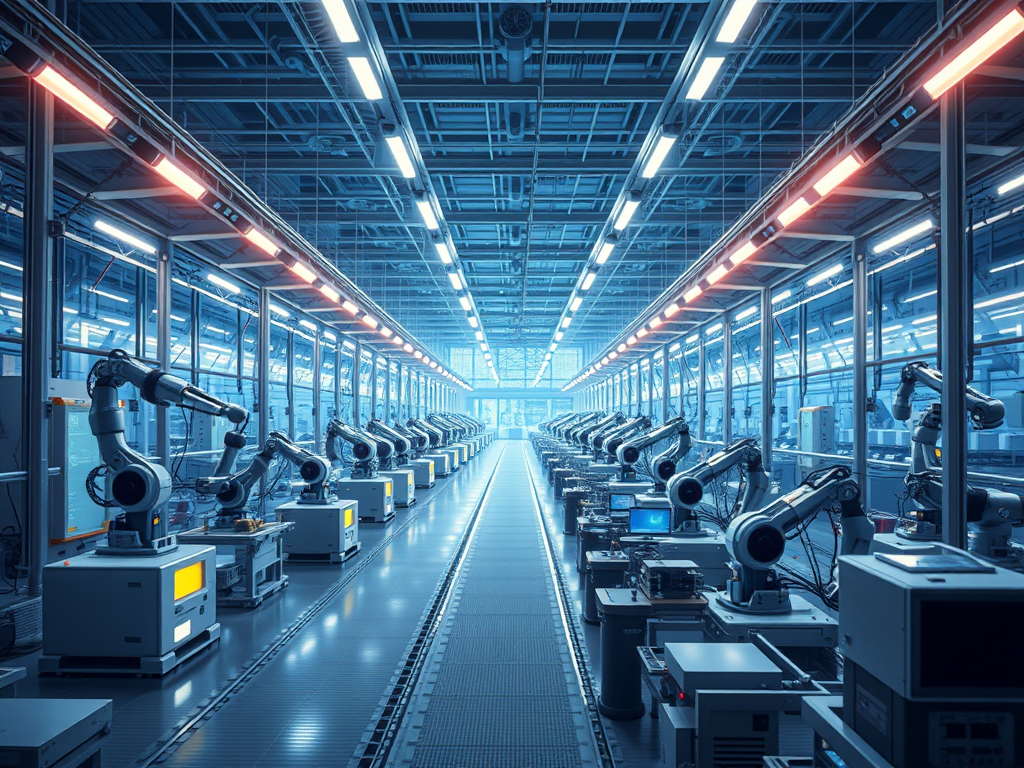

In a significant milestone that underscores its evolving role in the global technology landscape, Hon Hai Technology Group, commonly known as Foxconn, has been named among the 2025 Global Top 100 Technology Companies. The announcement confirms what industry insiders have long anticipated: that Foxconn, once known primarily as the world’s largest electronics contract manufacturer, has successfully transformed itself into a driving force in innovation, artificial intelligence, robotics, and sustainable technology.
Foxconn Recognized Among 2025 Global Top 100 Tech Companies

Foxconn’s inclusion on the prestigious list is the culmination of years of strategic reinvention. Originally recognized for assembling devices such as Apple’s iPhones, Foxconn has diversified its operations with an aggressive focus on its “3+3” strategy: three emerging industries—electric vehicles (EV), digital health, and robotics—combined with three core technologies—artificial intelligence (AI), semiconductors, and next-generation communications. This framework has guided Foxconn’s massive investments in research and development and its transition into a high-tech enterprise capable of shaping global technology trends.
In 2024 alone, Foxconn achieved record-breaking financial results. The company reported annual revenue of approximately NTD 6.8 trillion, or around 202 billion US dollars, marking an 11.4 percent increase from the previous year. This financial surge was primarily driven by explosive demand for AI server infrastructure and advanced computing components. The fourth quarter of 2024 was particularly strong, with revenue reaching NTD 2.1 trillion—fueled by its close partnerships with tech giants like NVIDIA and its ability to manufacture large-scale AI data centers. The success highlighted Foxconn’s ability to not only adapt to the AI revolution but to shape its physical infrastructure globally.

Among Foxconn’s most talked-about innovations in 2025 is the development of its own large language model, named FoxBrain. The AI system, trained in just four weeks using 120 NVIDIA H100 GPUs, reflects the company’s growing capability in AI research and deployment. Built on Meta’s LLaMA architecture, FoxBrain has been optimized for Traditional Chinese and designed for industrial and enterprise usage, particularly in supply chain management, smart manufacturing, and automated customer support. With an open-source release expected later this year, FoxBrain is positioned to enhance Taiwan’s standing in global AI development while enabling Foxconn to remain competitive with other tech titans that are building AI into the core of their offerings.
In parallel, Foxconn has deepened its alliance with NVIDIA, debuting next-generation AI server systems and smart robotics at global technology forums such as CES and NVIDIA’s GTC 2025. At GTC, the company introduced a new generation of AI factory solutions, combining edge computing with robotics and digital twin simulations powered by NVIDIA Omniverse. These smart factories, which use predictive analytics and real-time optimization to improve production efficiency and energy use, represent Foxconn’s vision for scalable and sustainable industrial automation.

Perhaps one of the most transformative developments is Foxconn’s partnership with NVIDIA, TSMC, and the Taiwanese government to build a national-level AI supercomputer. This initiative aims to establish Taiwan as a leader in AI research and cloud infrastructure, leveraging Foxconn’s hardware expertise, TSMC’s chip fabrication capabilities, and NVIDIA’s GPU acceleration. The project not only reinforces Foxconn’s innovation credentials but also underscores its political and economic importance in the Asia-Pacific region at a time when supply chain resilience and technological self-reliance have become national priorities.
The company’s contributions to electric vehicle development are equally notable. Through its MIH Consortium, Foxconn is building open EV platforms in collaboration with global partners like Tata Technologies and PTT. These platforms offer scalable EV architectures that can be adopted by regional automakers to accelerate development and reduce cost. Foxconn’s aim is to become the Android of the EV industry—providing a flexible, open-source-like foundation upon which others can build. In 2025, new prototype models based on the MIH platform are expected to enter production for Asian and Middle Eastern markets, signaling Foxconn’s readiness to compete with traditional automakers and EV giants alike.

Foxconn is also entering the healthcare robotics market. Its development of a hybrid service robot named Nurabot—designed to assist nurses and elderly patients—is set to be piloted in hospitals across Taiwan this year. The robot incorporates vision AI, mobility assistance, and patient monitoring tools, making it an advanced example of how Foxconn integrates its knowledge in manufacturing, AI, and IoT into practical solutions for aging societies. With global demand for elder care technology on the rise, Nurabot could become one of Foxconn’s most important contributions to digital health innovation.
In addition to technological innovation, Foxconn has embraced environmental, social, and governance (ESG) principles. The company has pledged to achieve net-zero emissions by 2050 and has launched multiple green energy initiatives, including a dedicated clean-energy investment fund in partnership with CDIB Capital. Its smart factory models are optimized for energy conservation, and the use of digital twins has helped reduce waste and emissions in its manufacturing processes. In recognition of these efforts, Foxconn has received increased attention from ESG-focused investors and international institutions seeking models of sustainable industrial innovation.
The inclusion of Foxconn in the 2025 Global Top 100 Technology Companies is more than a symbolic accolade—it represents a strategic affirmation of the company’s evolution. Once considered primarily a low-cost, high-volume assembler, Foxconn has steadily moved upstream in the value chain. Today, it designs, manufactures, and deploys advanced technology solutions across some of the most competitive and dynamic sectors in the world economy.
Looking ahead, Foxconn is expected to deepen its role in AI and cloud computing infrastructure, expand its presence in the EV supply chain, and pioneer new applications in robotics, healthcare, and automation. As governments and corporations worldwide race to develop and secure next-generation technologies, Foxconn’s combination of scale, speed, and strategic focus gives it a unique competitive advantage.
Being named among the world’s top 100 technology companies in 2025 reflects both what Foxconn has already accomplished and what it is poised to achieve. It signals that the company’s investments in innovation, talent, and sustainability are not only paying off—but are helping to shape the future of global technology itself.




Leave a Reply