

Helping Save Kyiv From Drones: Volunteers, Caffeine and Vintage Guns

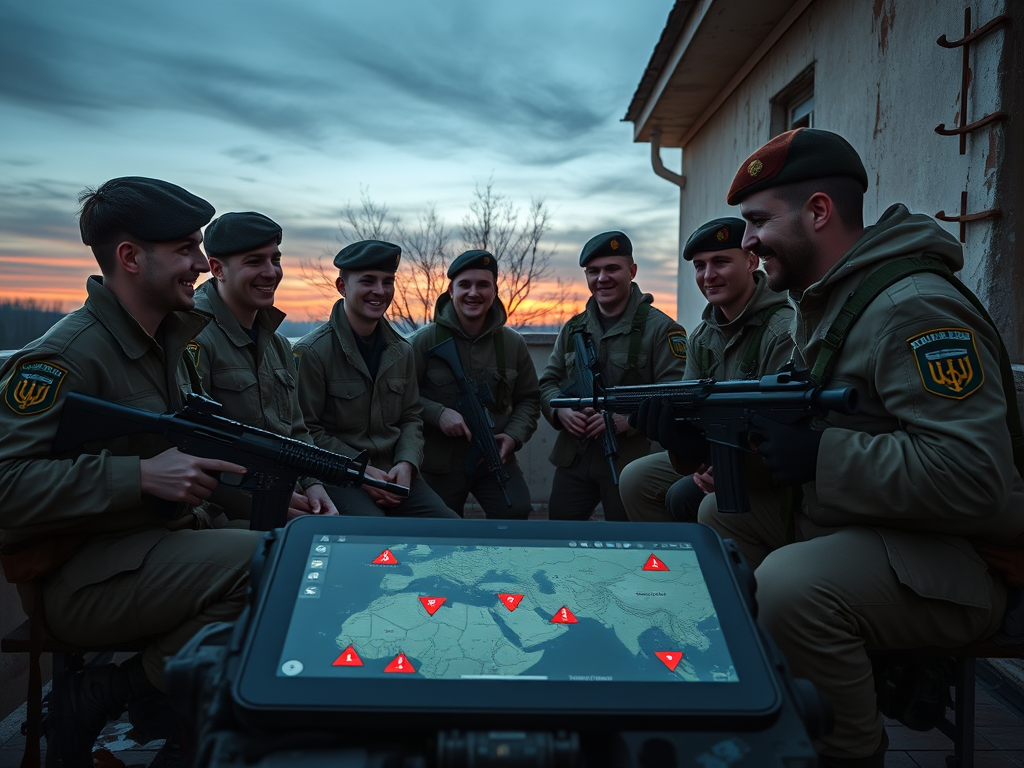
As twilight crept over the fields near Kyiv, a group of Ukrainian volunteers lounged on a weather-worn terrace in Pereiaslav. Dressed in khaki uniforms, they shared quiet laughter, a hint of music drifting from a nearby phone speaker — a rare moment of calm before the long night ahead. They had been warned: it could be another “hot night.”
These civilians, including teachers, construction workers, and shopkeepers, had taken on a critical role — defending the skies around Kyiv from Russian drone strikes. Armed with old Soviet-era machine guns, they prepared to face off against incoming unmanned aerial vehicles (UAVs) launched in waves by Russian forces. It was a routine they knew all too well.
At 11:35 p.m., the silence was broken. Mykhailo’s phone rang. Without hesitation, he picked up, listened briefly, and then barked the command: “Let’s move!”

The three-person crew sprang into action, piling into a gray pickup truck parked nearby. They raced down narrow rural roads, the vehicle’s headlights slicing through the darkness. Within minutes, they reached an open field — one of their pre-selected defense points — and quickly got to work. Two machine guns were mounted on tripods, and a third tripod was fitted with night-vision binoculars and a laser pointer.
Mykhailo, who works as a trade union representative by day, tapped on a tablet resting on the hood of the truck. The screen glowed with a digital map of Ukraine, swarmed with red triangles — each one representing a suspected enemy drone. Some were still dozens of miles away, but a few were approaching fast.
“Three incoming,” he said, eyes locked on the display. “We wait.”
While Russia escalates its campaign of drone attacks, Ukraine has been forced to improvise. Volunteer units like this one in Pereiaslav — about 50 miles southeast of the capital — spend countless nights intercepting drones with limited resources. Their presence highlights the strain on Ukraine’s air defense network, which is simultaneously relying on sophisticated Western-supplied systems like the U.S.-made Patriot missile batteries and the determination of unpaid civilians.
Last Saturday alone, Russia launched a staggering 472 drones and decoy targets. Just five days later, they followed it up with over 400 more, along with cruise and ballistic missiles. The drone attacks are designed not just to cause direct damage, but to exhaust Ukraine’s missile reserves and scramble its defenses before more dangerous threats arrive.
Russia’s tactics have also evolved. Drones now fly higher, often out of reach of traditional anti-aircraft guns, and make unpredictable course changes mid-flight. Many are fitted with deceptive signatures to confuse radar and draw fire away from actual targets.

To combat this, Ukraine uses a patchwork of defenses — from advanced missile systems and radar jammers to crews like Mykhailo’s, relying on decades-old equipment. In Pereiaslav, their modest arsenal consists mainly of World War II-era Maxim machine guns and Cold War-era Czech models, the Uk vz. 59. Despite their age, the weapons are still deadly — and when used effectively, capable of taking down low-flying drones.
“These old guns still have teeth,” said Oleh Voroshylovskyi, the unit’s commander, showing off the weapons inside their makeshift base — a building that also houses the remains of several downed Russian drones. A bust of Lenin, repurposed and now turned toward a corner, served as an ironic reminder of the country’s Soviet legacy.
The Pereiaslav unit was established in the summer of 2023, after residents began spotting drones flying low along the Dnipro River to avoid detection. Sofia, a former journalist who now volunteers full time with the group, recalled the moment that triggered their mobilization. “We saw them with our own eyes. Heard them. We realized we couldn’t wait for someone else to act.”
They gathered willing townspeople, contacted the military for assistance, and received a small cache of firearms and a brief training session. Everything else — flak jackets, uniforms, first-aid kits, even fuel — had to be procured independently. Volunteers cover the costs themselves or rely on donations.

For nearly two years, these citizen-soldiers have balanced their civilian lives with overnight patrols lasting up to 12 hours. Coffee and energy drinks have become essential parts of their arsenal.
Voroshylovskyi explained that Kyiv’s air defenses operate in three concentric rings, with Pereiaslav’s team manning the outermost perimeter. Their task: spot and, if possible, intercept drones before they reach inner defenses or civilian areas. If they fail to shoot them down, they relay the drones’ coordinates to better-equipped teams closer to the city.
The crew’s greatest recent asset is an American-made Browning heavy machine gun mounted on a pickup. However, it requires more training to operate effectively, so for now, they fall back on their old Maxim guns — a weapon that once shot down enemy planes in past wars.
Saturday night’s mission unfolded under a sky scattered with stars. A crescent moon offered faint illumination. The air was thick with tension, broken occasionally by the call of an owl or the distant rumble of rotors — Ukrainian helicopters on patrol.
Then, the stillness shattered. In the distance, gunfire rang out. “It’s starting up to the north,” Mykhailo muttered, pointing to tracer rounds arching through the sky. Searchlights scanned the darkness.
A few moments later, a low, mechanical buzz echoed from the same direction — unmistakable. A drone. It sounded like a lawn mower approaching at high speed.
“It’s close!” Yaroslav, another team member, warned.
The crew rushed behind their guns. Yaroslav, an I.T. professor who had graded exams earlier that day, manned the night-vision system. A grainy black-and-white image of the sky flickered on a small screen. The drone’s buzz grew louder, then veered off toward the west. They never got a visual.

“We used to be able to hit them when they flew at about 1,000 meters,” Yaroslav explained. “Now they’re often up at 2,000. Out of reach for us.”
Frustrated but focused, the crew passed the information to nearby units and stayed vigilant. More than shooting, they now found themselves increasingly acting as spotters and messengers.
The work is not without risk. Russian drones have begun targeting these volunteer units directly, attempting to knock out even their lowest-tier defense systems.
Throughout the night, they tracked drone movements on their tablet — a radius of 120 miles pulsing with shifting red symbols. Red tracers and gunfire sporadically lit up the sky. Yet Mykhailo’s team never fired a shot that night.
By dawn, Kyiv had again come under attack. Social media filled with reports of destruction — fires, collapsed buildings, injured civilians.
As light broke over the fields, the crew packed up their gear. Their shift was over.
“Another normal night,” Yaroslav said, rubbing his tired eyes.
Normal, perhaps, for a country at war. But for Ukraine’s volunteer defenders, every quiet success — every drone spotted, every warning relayed — is a small act of resistance in an exhausting, relentless battle for the skies.cess — every drone spotted, every warning relayed — is a small act of resistance in an exhausting, relentless battle for the skies.




Leave a Reply