
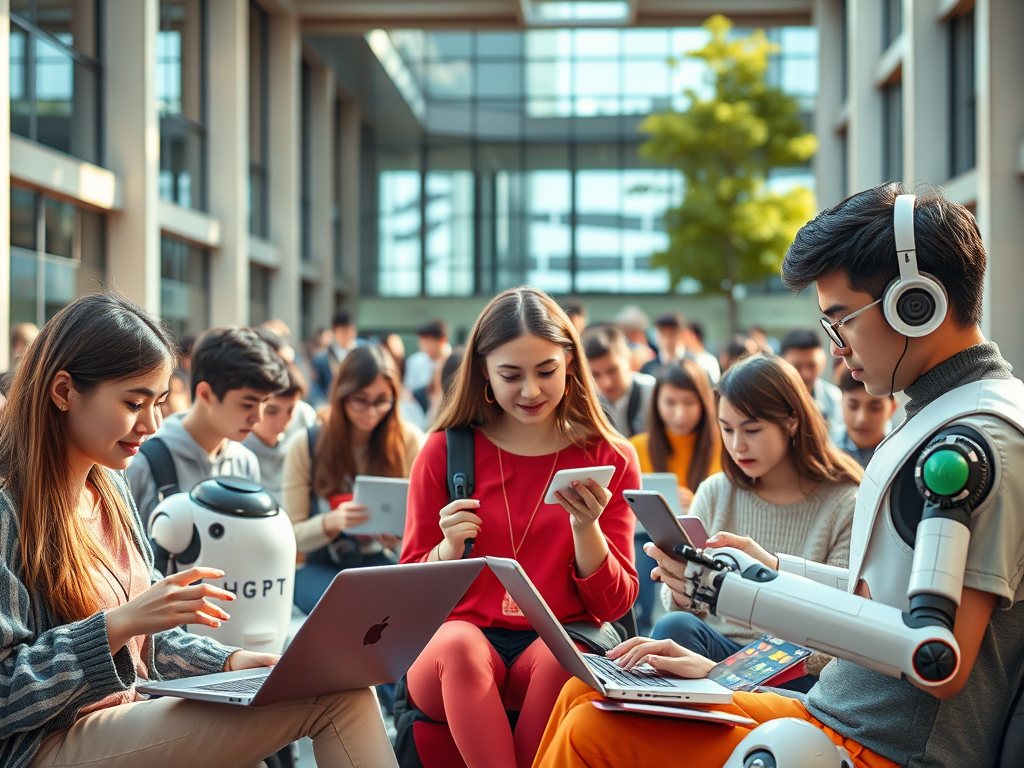

Welcome to Campus. Here’s Your ChatGPT

OpenAI, the company behind ChatGPT, is laying out an ambitious roadmap for revolutionizing the college experience. At the heart of its vision lies the deep integration of artificial intelligence into every aspect of university life—from academic support to career development and campus communication.
If successful, OpenAI’s approach could reshape how students learn and engage with their institutions. Students would gain access to AI companions to assist them from their first day of orientation until they receive their diplomas. Professors could design individualized AI-powered teaching assistants tailored for specific courses. Career centers might deploy chatbots to simulate job interviews, helping students hone their professional skills. Students preparing for exams could even activate voice-based AI tools to quiz them aloud.
OpenAI refers to this strategy as creating “AI-native universities.”
“In the future, we see AI becoming as fundamental to the college experience as school-issued email accounts,” said Leah Belsky, OpenAI’s Vice President of Education. “We envision a future where every student on campus has access to a personalized AI assistant.”
To bring this concept to life, OpenAI is offering premium AI services to academic institutions. At the same time, it is launching targeted promotional campaigns to attract students who may not have previously interacted with AI tools like ChatGPT.

Several universities have already begun integrating AI into student life. The University of Maryland and California State University are among the early adopters actively working to embed AI technologies into the learning environment. In June, Duke University rolled out unlimited access to ChatGPT for its entire academic community—including students, faculty, and staff. Additionally, Duke launched its own proprietary AI platform, branded as DukeGPT, to offer institution-specific tools.
OpenAI’s initiative is part of a broader contest among major tech companies to gain a foothold in higher education. It follows years of efforts by firms like Google and Microsoft to integrate their technologies into schools and capture the attention of students who may become lifelong users.
The competition in this space has become increasingly intense. Earlier this year, OpenAI CEO Sam Altman and Elon Musk—who leads rival AI company xAI—both announced limited-time offers of free premium AI access for students during final exams. Not long after, Google responded by pledging complimentary access to its advanced chatbot service for students through the end of the 2026 academic year.
The race to dominate the educational AI market was largely sparked by OpenAI’s release of ChatGPT in late 2022. The tool’s ability to generate coherent, human-like essays and responses caused widespread concern about AI-facilitated academic dishonesty. These concerns highlighted the risks of misuse, but also signaled the potential of generative AI as an educational resource. ChatGPT and similar tools draw on vast repositories of data to generate their output—though they occasionally “hallucinate” or produce false information, which can mislead users if unchecked.
Despite such drawbacks, AI tools have become common among students. In under three years, ChatGPT has become a staple in the academic toolkit, used by millions of college students to assist with research, writing, programming, and brainstorming.
With this momentum, OpenAI is positioning its offerings as a central pillar of university infrastructure. Its latest product, ChatGPT Edu, is specifically designed for academic settings. This version comes with enhanced features and privacy controls, allowing universities to build customized AI experiences for both students and staff. It also allows institutions to create chatbots trained on their own course materials. Unlike the consumer version of ChatGPT, the education-focused version is not used to train OpenAI’s models, providing an added layer of data privacy.
Still, OpenAI’s campaign amounts to a massive nationwide experiment in higher education. The implications—both positive and negative—are not yet fully understood. Critics point to early findings that suggest overreliance on AI for tasks like writing and research could hinder the development of essential skills such as critical thinking.
Others raise concerns about broader ethical issues. Some argue that universities should tread carefully before fully embracing AI, given concerns about misinformation, bias, exploitation of data workers, and the environmental toll of training large AI models.
Nevertheless, some universities are leaning into the shift with enthusiasm. The California State University system, for example, recently made ChatGPT available to all 460,000 students across its 23 campuses. The university hopes the move will prepare students for an economy increasingly shaped by artificial intelligence. Cal State has even branded itself as “the nation’s first and largest AI-empowered university system.”
University leaders say their involvement in this transformation is motivated not only by a desire to keep up with the times, but also by a sense of responsibility.
“If you’re worried about AI’s social impact, misinformation, or environmental effects—then join the conversation,” said Edmund Clark, CIO of the California State University system, at a recent education conference. “Be part of shaping its future.”
OpenAI began offering ChatGPT Edu in spring 2024, granting institutions access to its latest AI model and features. Universities that sign up receive more robust privacy protections and the ability to build specialized bots for academic purposes.
Leah Belsky, who was brought on in 2023 to lead OpenAI’s education initiatives, brings experience from her previous role at Coursera, where she focused on scalable online learning solutions. Under her leadership, OpenAI is pursuing a dual-track strategy: marketing premium products to institutions while encouraging direct adoption among students through free access and student engagement programs.
One such initiative includes a student advisory group that helps the company understand how learners are using AI on campus. Among its members is Delphine Tai-Beauchamp, a computer science student at the University of California, Irvine. She uses ChatGPT to clarify complex course concepts, debug code, and even create visual diagrams to illustrate relationships between ideas.
“I wouldn’t suggest using AI to bypass the learning process,” Tai-Beauchamp said. “But it’s incredibly helpful as a study aid—ask it to explain something in five different ways, and you’ll really understand it.”
Student input like hers has shaped OpenAI’s recent marketing efforts, including billboard campaigns. One ad spotted in Chicago this spring read: “Can you quiz me on the muscles of the leg?” Another said, “Give me a guide for mastering this Calc 101 syllabus.”
To further evaluate the impact of AI on learning, OpenAI has started sponsoring academic research into how its tools affect student outcomes.
“The big question is: What are the most effective and responsible uses of AI in universities?” Belsky asked during a December talk at Cornell Tech. “And once we identify them, how do we replicate those best practices more broadly?”
Some professors are already experimenting with customized bots for their classes. At Ohio University, Environmental and Plant Biology Chair Jared DeForest developed a bot named SoilSage, trained on his own research and course materials. By limiting the AI to credible, vetted information, he found its responses to be more accurate and academically appropriate.
“It’s like having a tightly controlled digital teaching assistant,” DeForest said.


However, AI isn’t flawless—even when fed reliable information. A recent study called “Can A.I. Hold Office Hours?” examined how well various AI models could answer questions from a law school casebook on patent law. The results were concerning: all models tested—OpenAI’s, Google’s, and Anthropic’s—made major factual errors that could mislead students.
“This kind of mistake could misguide learners,” warned University of Chicago Law Professor Jonathan Masur, a co-author of the study. “We need to slow down and proceed with caution.”
OpenAI responded by noting that the casebook in the study was over 250,000 words—more than double what its GPT-4o model can currently process in one session. Google and Anthropic both said their models have since improved.
To address such issues, OpenAI recently introduced a “memory” feature that allows ChatGPT to retain context from prior interactions. This enhancement enables the chatbot to become more personalized and useful as it gets to know each student over time.
Still, privacy advocates have expressed concerns about the long-term tracking of users, warning of potential surveillance risks if such AI companions follow students into their professional lives.
Despite that, Belsky imagines a future where students continue to use their AI assistants after graduation—just as many keep their university email accounts for years.
“These AIs could become lifelong learning partners,” she said. “They would be the bridge between college and career.”




Leave a Reply