

In San Francisco, Harvey Milk’s Name Isn’t Going Anywhere

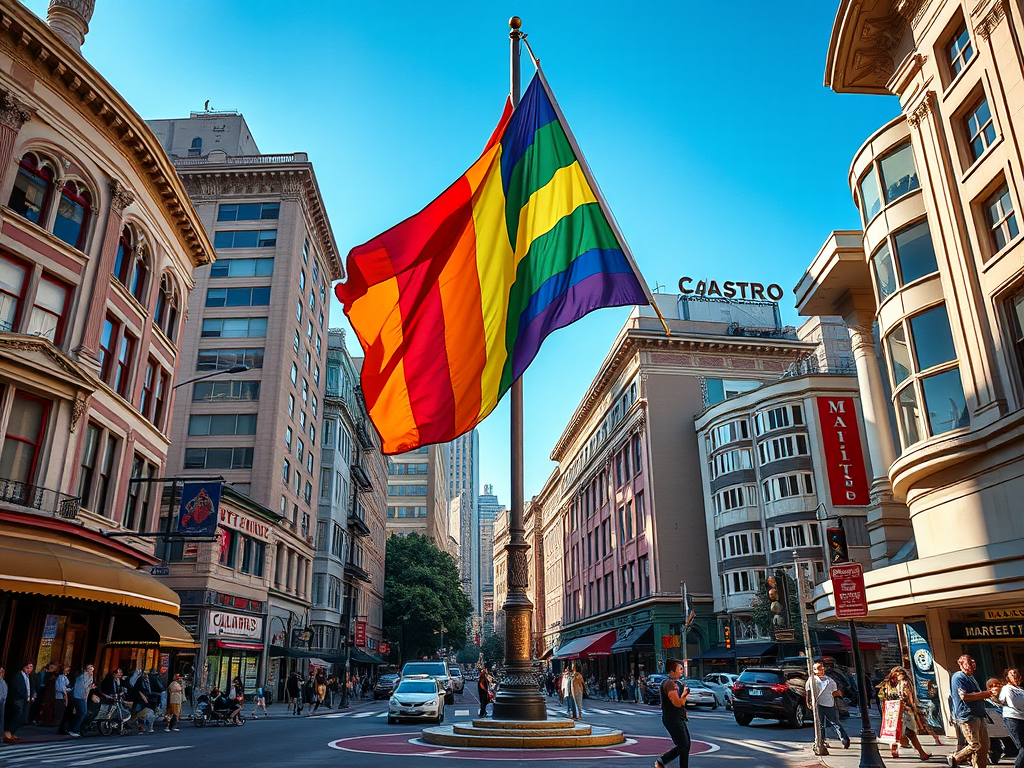
In San Francisco, the legacy of Harvey Milk is deeply embedded in the city’s landscape and culture. Children attend school at the Harvey Milk Civil Rights Academy, and travelers from all over the world pass through the Harvey Milk Terminal at the San Francisco International Airport. At the iconic intersection of Castro and Market Streets, a towering rainbow flag flies proudly in Harvey Milk Plaza, symbolizing the inclusive spirit he championed and serving as a visible tribute to his enduring impact.
Harvey Milk was a trailblazing figure in the fight for LGBTQ+ rights. In 1977, he made history by winning a seat on the San Francisco Board of Supervisors, becoming the first openly gay person to be elected to public office in California. Tragically, less than a year after his election, Milk was assassinated in his City Hall office, a violent end that shook the nation and the LGBTQ+ community. His life and legacy were later immortalized in the 2008 film Milk, where he was portrayed by Sean Penn, and every year on May 22—his birthday—California commemorates his contributions with Harvey Milk Day.
Thousands of miles away from San Francisco, in a body of water that former President Donald Trump has controversially referred to as the “Gulf of America,” another homage to Milk floats—though its future is now uncertain.
The USNS Harvey Milk, a naval replenishment oiler currently docked in Mobile, Alabama, may soon be stripped of its name. According to the Pentagon, a broader review of naval vessel names is underway to ensure they better align with the nation’s “warrior ethos.” The possible renaming of this ship raises questions about the values the government chooses to uphold—and whom it chooses to honor.
Harvey Milk’s service in the United States Navy is a lesser-known part of his biography. He served during the Korean War on a submarine rescue vessel and later became a diving instructor. In 1955, his military career came to an abrupt end when his commanding officers discovered his sexual orientation. As a result, he received an “other than honorable” discharge, a designation used at the time to dismiss gay service members. Despite this injustice, the U.S. Navy chose in 2021 to name a ship in his honor—the first vessel in Navy history to bear the name of an openly gay person.

At the christening ceremony, Navy Secretary Carlos Del Toro emphasized the importance of righting past wrongs, acknowledging the military’s historical mistreatment of LGBTQ+ individuals and expressing a commitment to greater inclusivity moving forward. His words were meant to signify progress—a promise that LGBTQ+ service members, past and present, would be recognized and respected.
That promise, however, appears to be unraveling.
Defense Secretary Pete Hegseth, under the Trump administration, has initiated a reassessment of several ship names, including the USNS Harvey Milk. Others under scrutiny include vessels named after Supreme Court Justices Thurgood Marshall and Ruth Bader Ginsburg, as well as civil rights activist Medgar Evers. These individuals, each symbolic of the nation’s broader commitment to justice and equality, now face the possibility of being erased from the Navy’s fleet due to what the administration claims is a return to a more “traditional” military image.
The White House has remained silent on the matter, offering no official comment.
Back in the Castro District—San Francisco’s historic LGBTQ+ neighborhood—the news has been met with sorrow and anger. For many residents, this development feels like another deliberate attempt by the Trump administration to marginalize minority communities, divert public attention from more pressing issues, and dismantle the progress made in civil rights.
Harry Breaux, an 80-year-old resident of the Castro, expressed his deep frustration. Wearing a sequined sunhat, he knelt in a plaza opposite Harvey Milk Plaza, carefully painting a progress pride flag on the pavement. This newer flag design incorporates not only the traditional rainbow stripes but also colors that represent transgender individuals and people of color—communities that still face disproportionate levels of discrimination.
Breaux vividly recalls meeting Milk during his 1977 campaign for the Board of Supervisors and casting his vote for him. Moving to San Francisco in the 1970s gave Breaux the freedom to live openly as a gay man, something that had been impossible in other parts of the country. He shared painful memories of having a beer bottle thrown at him and being physically assaulted simply for being gay.
“I know what it’s like to live in a closet—or, as I prefer to call it, a cage,” he said, his voice shaking with emotion. “Harvey helped unlock that cage for so many of us.”
Harvey Milk, who would have turned 95 last month, was born in Woodmere, New York. He studied mathematics in college and initially planned to become a teacher. However, he enlisted in the Navy after graduation. Following his discharge, Milk traveled across the United States and worked in various professions, including as a stock analyst and insurance actuary. In his younger years, he held conservative political views and even volunteered for Barry Goldwater’s 1964 Republican presidential campaign.

It was in the early 1970s that Milk found his political voice. He relocated to San Francisco with a romantic partner and opened a camera shop on Castro Street. As a business owner, he quickly became involved in local issues and gained popularity through his passionate speeches and fierce advocacy. He forged alliances with labor unions and civil rights organizations and proudly took on the moniker “Mayor of Castro Street.”
After multiple failed campaigns, Milk was finally elected to the Board of Supervisors. During his brief time in office, he helped enact one of the most comprehensive gay rights ordinances in the country and played a key role in defeating the Briggs Initiative—a proposed law that would have banned LGBTQ+ individuals from teaching in California public schools.

Milk once famously declared that if he were ever assassinated, he hoped the bullet would “destroy every closet door in the country.” His message was clear: visibility and authenticity were forms of resistance.
Cleve Jones, now 70, was one of Milk’s interns. He vividly remembers being sent on an errand by Milk on the morning of November 27, 1978. When he returned to City Hall, chaos had erupted. Former supervisor Dan White had murdered both Mayor George Moscone and Harvey Milk in cold blood. That night, Jones led a candlelight vigil that began at Castro Street and ended at City Hall—a procession that became an iconic moment in LGBTQ+ history. Jones would later found the AIDS Memorial Quilt, another monumental tribute to lives lost and voices silenced.
Reflecting on the recent announcement, Jones expressed his belief that the potential removal of Milk’s name from the ship is part of a broader, vindictive pattern. “I had a feeling after Trump’s re-election that this would happen,” he said. “It’s the kind of petty, spiteful move that defines his administration.”

He added that the action is unlikely to address any real concerns of the American public. “I sincerely doubt there are families sitting around the dinner table right now saying, ‘Removing Harvey’s name from a ship really makes me feel safer.’”
Jones pointed out other recent hostilities aimed at California and San Francisco. In the past few weeks, Trump has threatened to cut funding for the city’s Presidio park and even floated the idea of restoring Alcatraz as an active federal prison. Notably, San Francisco’s city attorney is currently involved in several lawsuits against the Trump administration.
The decision to review the ship’s name during Pride Month has particularly angered local officials. According to a senior defense official, the timing was intentional and part of a broader campaign to dismantle federal diversity, equity, and inclusion programs.
San Francisco Mayor Daniel Lurie condemned the decision, saying that Harvey Milk served his nation and his city with bravery and honor. Similarly, Supervisor Rafael Mandelman, who represents the Castro and is himself gay, called the decision deeply ironic. He emphasized that if there were ever individuals who exemplified the true essence of a “warrior ethos,” it was Harvey Milk and the countless LGBTQ+ activists who dared to live authentically in the face of fear and hatred.
“That generation who came out, who organized, who demanded rights—they were warriors in every sense of the word,” Mandelman said. “They paved the way for people like me. Now, it’s our responsibility to keep pushing forward and protecting what they fought so hard to achieve.”




Leave a Reply