

He Created the Original Zombie. His Family Wants to Define What’s Next.

When George A. Romero passed away in 2017 after a battle with lung cancer, he left behind more than just a trail of cult-classic horror films. He also left behind scripts, ideas, and the skeleton of what would have been his concluding chapter in the zombie saga that began nearly half a century earlier. Among those unfinished works was a screenplay titled Twilight of the Dead, which his widow, Suzanne Desrocher-Romero, described as his intended finale — a closing act to the story that started with 1968’s Night of the Living Dead and evolved over six films spanning decades.
Romero was one of the rare filmmakers who didn’t just make movies—he invented a cultural phenomenon. Zombies, as we now know them, owe their modern form to his imagination. While ghost stories and vampire legends have long haunted human history, Romero’s slow-moving, flesh-eating undead emerged as a wholly modern monster, one that now permeates television, cinema, video games, and pop culture alike. From HBO’s The Last of Us to the renewed excitement for the upcoming addition to the 28 Days Later franchise, it’s clear: the zombie craze is far from over. After all, their very essence is to never truly die.
But with Romero gone, what becomes of his zombies—the originals? What future awaits the undead creatures he conjured into the public consciousness?
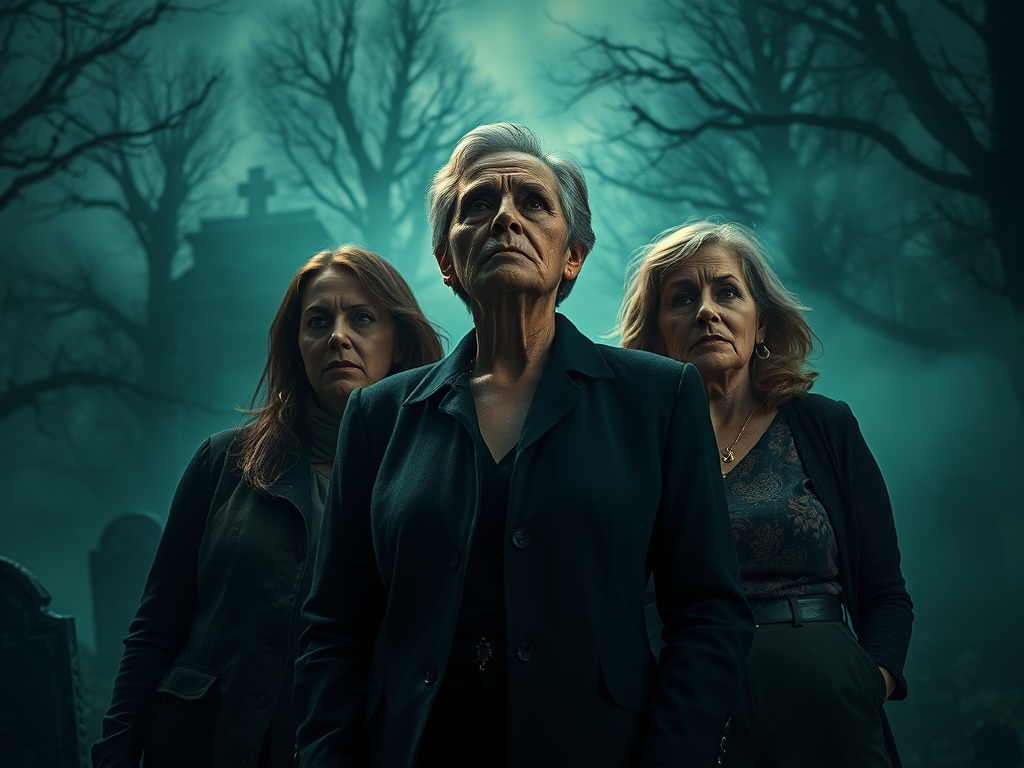
That question is now being tackled by three women, all closely tied to Romero himself: his daughter, his ex-wife, and his widow. Each of them is working on their own interpretation of the zombie mythos, carving out separate paths for the monster that defined Romero’s legacy. Their visions differ, sometimes sharply, but one thing is certain: the Romero zombie is still very much alive—and delightfully complicated.


The Accidental Creator of a Horror Icon
Although George Romero is now regarded as the godfather of the modern zombie genre, he often claimed that zombies were never his original artistic aim. Early in his career, he had tried to gather financial support for a medieval drama influenced by the stark storytelling of Ingmar Bergman. When that project failed to attract investors, he pivoted to something more likely to sell—an eerie tale of the undead.
His gamble paid off. Romero’s low-budget debut, Night of the Living Dead, found its audience in the midnight movie circuit and quickly became a cult hit. What set it apart wasn’t just its graphic content, but its sociopolitical undercurrents. As his zombie films continued, so did the intensity of their commentary—on racism, consumerism, militarism, and more. Romero transformed what could have been mere exploitation horror into biting critiques of American life, all packaged in blood and guts.
Though zombies weren’t his first choice, they kept pulling him back. Romero often expressed his desire to break away from the genre, even joking that his final film should be called Enough of the Dead. (The producers settled instead on Survival of the Dead.) But as anyone familiar with his monsters would agree—zombies have a way of sticking around.

Three Romero Women, Three Undead Visions
At the age of 66, Suzanne Desrocher-Romero is working to complete Twilight of the Dead, which she believes will bring the original saga to a satisfying close. Meanwhile, Christine Romero, George’s ex-wife and creative partner for nearly three decades, is developing her own film. Her project returns to the beginning of the zombie outbreak and takes place parallel to the events of Night of the Living Dead, but from a different perspective.
Both projects remain in the development phase with no confirmed release date. But one Romero creation is making its debut—Queens of the Dead, directed by Romero’s daughter Tina, premieres at the Tribeca Festival. Unlike her father’s gritty, black-and-white apocalyptic tone, Tina has injected vibrant color and camp into her film. Set in a fractured queer dance scene in Brooklyn, her version of the zombie apocalypse is drenched in glitter, drag, and flair—very different, yet still tethered to the essence of the Romero legacy.
In her Brooklyn apartment, Tina, 41, reflects on her upbringing. “Zombies weren’t scary to me,” she says. “They were just part of the family business.” Tina literally learned to walk on the set of Day of the Dead, but her personal tastes leaned toward musicals and dance rather than horror. At Wellesley College, she choreographed a Michael Jackson-inspired performance referencing Thriller—a music video itself influenced by her father’s work.

Later, at NYU’s film school, she avoided mentioning her famous last name, unwilling to rely on any form of nepotism. Instead, she carved her own creative identity through dance parties and performances in New York, eventually becoming DJ TRx, a persona marked by her signature rabbit mask—a symbol that now appears in Queens of the Dead.
Her inspiration for the film came during a moment of introspection and conflict within the queer community. After a controversy erupted at one of her dance parties, a sharply worded manifesto titled When will the queer community stop devouring its own? was published online. That was her “lightning bolt” moment. What if zombies represented divisions in the community—devouring themselves?
Before his death, she discussed the idea with her father, who gave her his blessing to pursue it.
Unlike her father’s grim and brooding zombies, Tina’s undead are mischievous and playful. “I wanted something candy-colored, almost joyful,” she said. Her film blends horror and humor, starting with a drag queen’s strut and ending with stiletto heels turned into weapons. While Queens is less focused on overt political messaging, it still nods to its roots, quoting lines like “They’re coming to get you, Barbara,” and centering a Black protagonist.

Still, Tina upholds one non-negotiable: the zombies must be slow. “Fast zombies? Absolutely not,” she says with a smirk. “They’d be a betrayal.” The sluggish pace, she explains, adds a touch of absurdity—and humanity. “They could be your neighbor. Your mom. Your kid. That’s the horror and the humor.”
Old Wounds and New Beginnings
Christine Romero, Tina’s mother, was not just George’s wife but also a creative collaborator, acting and co-writing in several of his films. Their nearly 30-year marriage ended abruptly when George moved to Toronto to film Land of the Dead and never returned. “He left shoes in the closet,” Tina recalls. “Pens in the drawer.” Christine added, “I never got closure. I still don’t know why he left.”
Despite the emotional fallout, Christine inherited several of George’s unfinished works, including rights to the 1990 remake of Night of the Living Dead. When producer Roy Lee approached her about a new film, she sold the rights to MGM/Amazon, which is now planning a $35 million project set during the same time as the original—but told from the viewpoint of the protagonist’s wife, whose husband is killed by police at the end.
Although slow zombies were eventually confirmed for this movie, there were early discussions about speeding them up. Christine remains skeptical of the direction. Her project is currently mired in legal disputes, as Night of the Living Dead is now public domain, complicating claims of creative ownership.
One issue: Desrocher-Romero holds the rights to most of George’s estate. “She doesn’t understand the film industry,” Christine says flatly. “It’s unfortunate. But that’s the situation.”

A Legacy Without Answers
Desrocher-Romero met George while working as a bartender during post-production on Land of the Dead. She didn’t know who he was, but their connection was instant. Now she oversees the George A. Romero Foundation, which seeks to preserve his legacy both inside and beyond the horror genre. Tina Romero serves as the foundation’s vice president.
She hopes to begin production on Twilight of the Dead soon, with The Machinist director Brad Anderson at the helm. The film promises to close the loop, offering the final word on the Romero zombie—without explaining too much.
And maybe that’s fitting. Romero always believed that ambiguity added to the horror. He once told a reporter that what made zombies scary wasn’t how they came to be—it was that they were. No nuclear fallout. No virus. No neat answers.
Sometimes, we don’t need to know why. Sometimes, the scariest thing is that there’s no explanation at all.
And in that mystery, the Romero zombie lurches on—slow, relentless, and immortal.




Leave a Reply