
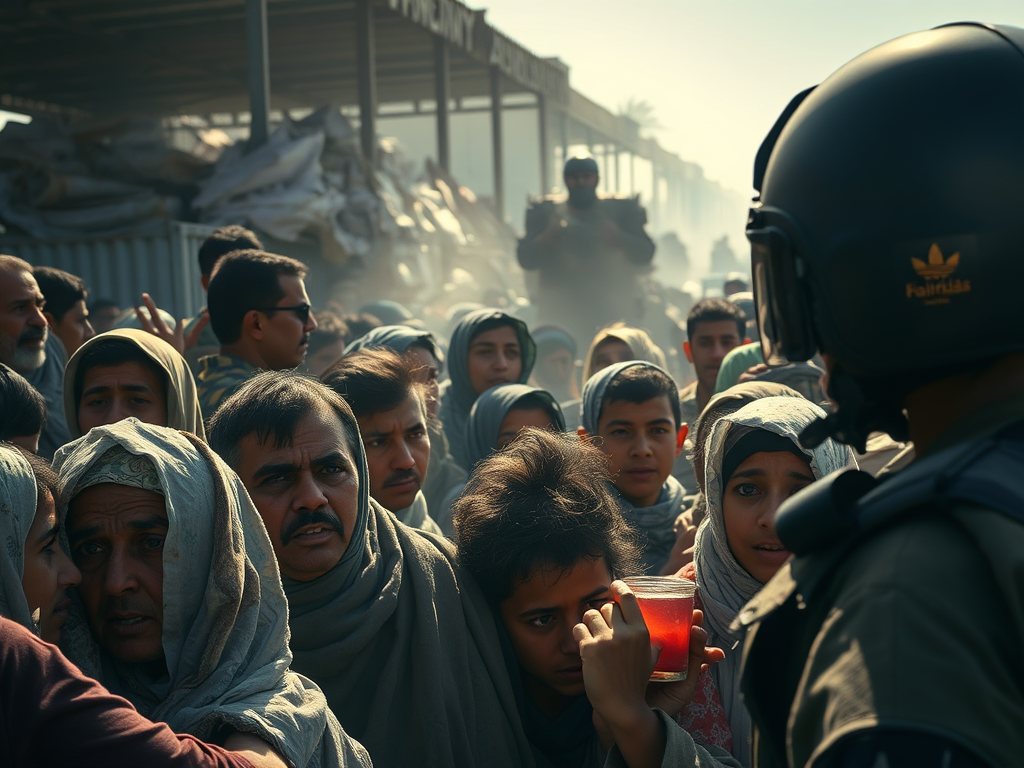

In the early hours of Tuesday morning, Israeli forces opened fire near a crowd of Palestinians making their way to a newly established food distribution center in southern Gaza, according to an official statement from the Israeli military. The tragic event, confirmed by the International Committee of the Red Cross and the Gaza Health Ministry, resulted in the deaths of at least 27 individuals.
Israeli Soldiers Open Fire Near Gaza Aid Site. Gaza Officials Say 27 Are Killed.

This marks the second fatal shooting in three days at the same location in Rafah, where thousands of Palestinians—many suffering from extreme hunger—have been gathering at dawn in hopes of receiving aid. On Sunday, Israeli troops also fired upon civilians near the same center. The Palestine Red Crescent Society reported that at least 23 people were killed during that earlier incident.
Tuesday’s shooting has cast further doubt on the viability of the Gaza Humanitarian Foundation, a controversial aid distribution system initiated by Israel just last week. Since its inception, the foundation has encountered numerous logistical failures and significant criticism from international organizations. In a statement, the organization acknowledged that “a number of civilians were injured and killed” after straying from the “safe corridor” designated by Israeli authorities to reach one of the aid stations.

With much at stake, the new initiative was seen as a critical lifeline for the region. Humanitarian groups have been warning for weeks about the risk of mass starvation in Gaza following an 80-day Israeli blockade that severely restricted food deliveries until it was lifted in mid-May.
The Israeli military defended its actions by stating that its troops fired warning shots near individuals who had moved off the authorized path and who failed to comply with verbal orders. The army referred to these people as “suspects” who allegedly posed a threat to Israeli forces, though it did not elaborate on the nature of the perceived danger.
United Nations agencies have refused to cooperate with the new distribution system. In statements, U.N. officials have claimed that the process exposes civilians to unnecessary harm by requiring them to walk long distances through militarized zones. Critics also say that the placement of the aid centers—mostly located in Israeli-controlled areas of southern Gaza—appears to support a broader Israeli strategy to force the displacement of northern Gaza residents.

A U.N. briefing document circulated before the program’s launch last week warned that overcrowding and inadequate planning could lead to chaos. The memo also cautioned that force might be used to manage crowds and raised concerns about potential looting.
Many of those fears have already become reality. The Gaza Humanitarian Foundation has only opened four distribution sites to date—down from the 400 operated previously under the U.N.’s system. Even those few centers have been inoperative on multiple days due to disorder or security issues.
Every morning, enormous crowds of Palestinians arrive in the predawn darkness, many having walked several miles just for a chance to receive food. According to witnesses, the scene at the aid centers often devolves into chaos, with people pushing, grabbing, and scrambling for supplies.

Ahmed Abid, a 28-year-old resident of Mawasi, said he set out on foot in the early morning hours. As he neared a roundabout on the way to the aid station, gunfire erupted. He threw himself into a ditch to escape the shooting. Once it quieted, he continued on to the center, only to find a massive, disorderly crowd. “Whoever got there first received something,” he said. “Those who were late went home with nothing. People were fighting each other for food.”
Brigadier General Effie Defrin, chief spokesperson for the Israeli military, disputed the casualty numbers reported by aid groups and local health workers, suggesting they were inflated. However, he did not offer an alternative count. “Warning shots were fired,” he said, “but from our understanding, they didn’t cause as many injuries as has been reported.”
The United Nations strongly denounced the violence. In a formal statement, U.N. High Commissioner for Human Rights Volker Türk called the killings a violation of international humanitarian law, labeling them a potential war crime.

Humanitarian organizations echoed this condemnation. Claire Manera, an emergency response coordinator with Doctors Without Borders, stated on Sunday, “Today’s events are a tragic reminder that this new aid delivery mechanism is unsafe, degrading, and largely ineffective.”
Israel’s ongoing military campaign against Hamas in Gaza has drawn increasing scrutiny worldwide, including from long-standing allies. Just last month, the governments of the United Kingdom, France, and Canada released a joint statement condemning Israel’s proposed large-scale offensive and its lengthy blockade on humanitarian supplies, describing these actions as “disproportionate.”
Israeli officials maintain that the new system is necessary to prevent Hamas from diverting aid supplies or exploiting the humanitarian crisis for financial gain. They argue that under previous frameworks, Hamas seized food shipments and resold them at inflated prices to the local population. However, U.N. representatives have insisted that no credible evidence supports these claims.

The Gaza Humanitarian Foundation is a fledgling, private organization contracted to manage the delivery of food aid in Israeli-patrolled regions of southern Gaza. The group employs American firms to operate its distribution network. According to its own figures, it has successfully distributed more than 100,000 boxes of food. Nevertheless, the foundation has faced significant internal turmoil.
Just hours before its first official operations began, Executive Director Jake Wood resigned, citing concerns about the organization’s ability to operate autonomously and uphold core humanitarian values. He warned that the group’s current model was unworkable.
In another setback, Boston Consulting Group, a U.S.-based advisory firm that helped establish the initiative, announced it would withdraw from its involvement. The firm placed a partner associated with the project on leave pending an internal investigation.
On Tuesday, the organization appointed Reverend Johnnie Moore, an evangelical leader, as its new executive chairman. That same day, the foundation announced that all food distribution would be temporarily suspended on Wednesday for a logistical review. According to a spokesperson, operations are expected to resume Thursday, pending adjustments to crowd management strategies and road access evaluations by the Israeli military.

The International Committee of the Red Cross reported that its field hospital in Rafah had received 19 bodies and treated eight additional individuals who later died from their wounds. “Most patients had gunshot injuries,” the statement read. “They all reported that they had been attempting to reach the food distribution center.”
Jamal Azzam, a nurse working at the Rafah clinic, described the influx of patients in a phone interview. “It was like a warzone,” he said. “The floors were covered with blood. People were lying everywhere, screaming in pain.”
Dr. Ahmad al-Farra, a senior medical official at Nasser Hospital in nearby Khan Younis, also spoke by phone. He said many of the casualties were children aged between 10 and 13, all suffering from gunshot wounds.
Some voices in Israel have claimed that Hamas is orchestrating chaos to undermine the aid initiative. Former Prime Minister Naftali Bennett alleged in a social media post that Hamas was inciting violence to disrupt the program and maintain its control over food distribution. “Hamas wants to monopolize aid in order to control the people. Israel is taking that control away,” he wrote.
Regardless of who is to blame, the recent violence raises urgent questions about whether this new aid mechanism can provide relief without endangering those it aims to help.




Leave a Reply