

Unveiling the Doudna Supercomputer: A New Era in AI and Science

Once divided by fundamental differences in both purpose and architecture, the worlds of scientific computing and artificial intelligence are now moving rapidly toward convergence. This growing synergy is exemplified by an ambitious new computing system set to be installed in Berkeley, California. The project promises to redefine how large-scale scientific research and AI model training can be harmonized through shared computational infrastructure.
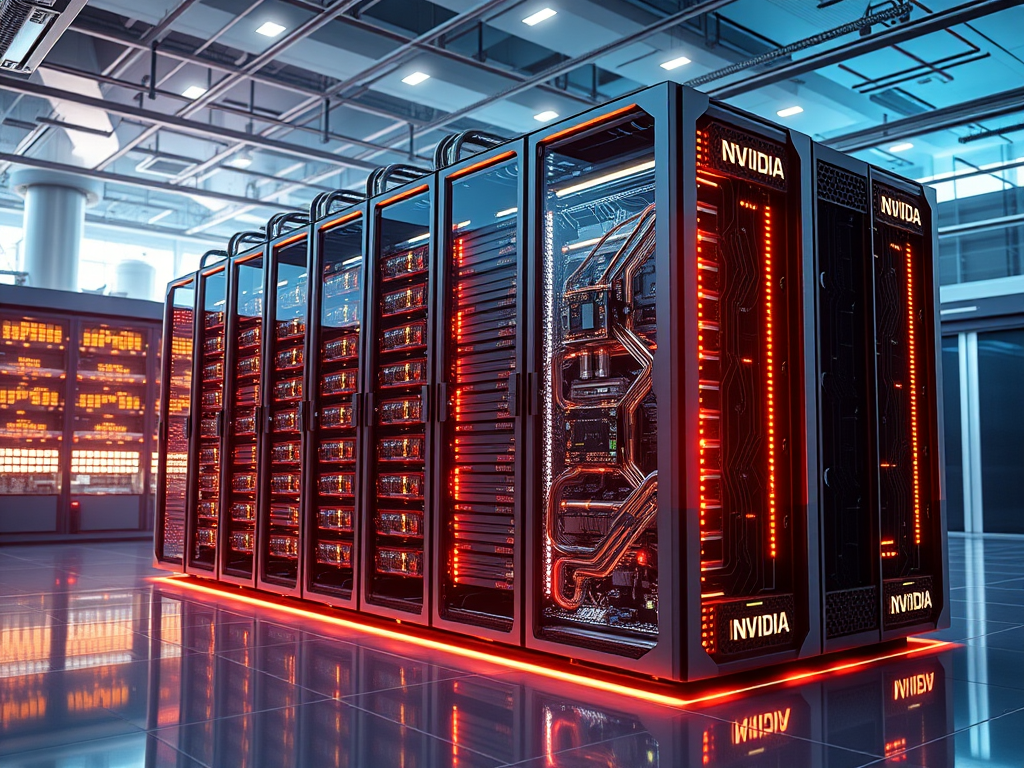
The U.S. Department of Energy’s Lawrence Berkeley National Laboratory announced on Thursday that it had chosen Dell Technologies to develop its next-generation flagship supercomputer, which is slated for deployment in 2026. This new system will integrate Nvidia’s advanced processors—hardware designed to accelerate both traditional scientific simulations and AI tasks. This hybrid approach illustrates a fundamental shift in how research institutions are thinking about high-performance computing.
The new supercomputer, to be named “Doudna” in honor of Jennifer Doudna, a biochemist at the University of California, Berkeley, and co-recipient of the 2020 Nobel Prize in Chemistry for her work on CRISPR gene editing, is expected to offer more than a tenfold increase in performance over the lab’s current most powerful computing system. According to Jonathan Carter, Associate Laboratory Director for Computing Sciences at the Berkeley Lab, Doudna could become the Energy Department’s most capable asset for handling the computational demands of training sophisticated AI models and running intricate scientific simulations.

What makes the Doudna system particularly notable is its architectural strategy, which reflects a broader trend among public research labs to embrace the hardware configurations commonly found in commercial AI data centers. In a departure from previous practices, this machine will heavily rely on Nvidia technology. While Nvidia’s GPUs are widely used by major cloud computing companies and have featured in supercomputing projects before, they were not part of the Energy Department’s three prior top-tier supercomputers, all of which were built by Hewlett Packard Enterprise (HPE).
The selection of Dell Technologies represents a significant change in the competitive landscape. While Dell has not traditionally been a dominant force in the ultra-high-end supercomputing sector, it has successfully implemented large-scale AI systems in commercial environments. Addison Snell, CEO of Intersect360 Research, a firm specializing in high-performance computing market analysis, remarked, “HPE has been dominant in the Department of Energy’s contracts for years. This is a considerable victory for Dell.”
Historically, supercomputers have served as benchmarks of national technological capability. From modeling nuclear reactions to solving complex cryptographic problems, these machines have symbolized scientific ambition and computational excellence. The U.S. Department of Energy has consistently invested in building some of the world’s fastest and most powerful supercomputers. For instance, it poured $1.8 billion over eight years into reaching “exascale” performance—a milestone signifying a system capable of performing at least one quintillion (10^18) calculations per second. The pinnacle of that effort is the El Capitan supercomputer at Lawrence Livermore National Laboratory, developed for approximately $600 million.
While the exact cost of the Doudna system has not yet been made public, it is clear that this machine is part of a larger strategic effort to maintain U.S. competitiveness in artificial intelligence. Energy Secretary Chris Wright, who has previously likened AI development to the Manhattan Project, underscored the importance of Doudna in remarks prepared for the official announcement ceremony. He referred to the system as a critical component in the United States’ bid to lead in the global AI race.
One of the fundamental challenges in bridging traditional scientific computing with AI is the difference in the types of numerical precision required. Traditional simulations, such as those modeling weather patterns or nuclear reactions, often rely on 64-bit floating-point precision, which ensures high accuracy. By contrast, modern AI workloads frequently use 16-bit or even 8-bit operations. While these shorter instructions are less precise, they enable much faster computation and are often sufficient for tasks like image recognition or natural language processing.
Nvidia’s graphics processing units (GPUs), which have become the cornerstone of commercial AI platforms, offer flexibility in supporting a mix of these different types of computations. According to Dion Harris, Nvidia’s Head of Data Center Product Marketing, this adaptability is opening up new frontiers in the types of work that can be tackled by supercomputers.
The Berkeley lab already has experience with Nvidia’s hardware, having incorporated the company’s GPUs in its existing Perlmutter system. The forthcoming Doudna system will take this further by utilizing Rubin, Nvidia’s next-generation GPU platform, and notably, a general-purpose processor developed using Arm architecture—a significant departure from the conventional reliance on Intel or AMD CPUs in high-performance computing.
Jonathan Carter explained that this architectural shift was informed by the laboratory’s obligation to meet the diverse computational needs of its more than 11,000 users. Traditional workloads like nuclear fusion modeling remain critical, but there is a growing emphasis on leveraging AI to enhance simulations. For example, researchers are using AI to better understand how fluids behave in geothermal energy systems, including how water circulates and dissipates heat.
Another compelling factor in the lab’s decision to partner with Nvidia was the breadth of the company’s software ecosystem. Nvidia offers a suite of AI tools tailored to specialized scientific applications, including simulations for quantum computing and advanced material science. According to Mr. Carter, these software capabilities provide significant value on top of the raw processing power.
Dell’s success in winning the contract for the Doudna system also speaks to broader shifts in how such computing platforms are conceived and constructed. In the past, government labs often commissioned heavily customized machines, tailored to very specific research goals. But as computational needs become more generalized and cross-disciplinary—spanning physics, biology, climate science, and artificial intelligence—there is increasing value in building more flexible, modular systems.

Paul Perez, Dell’s Senior Vice President and Senior Technology Fellow, emphasized that Dell approached the project as an opportunity to challenge the status quo. “This market had become somewhat predictable,” he said. “What we did was take it off autopilot. We brought a fresh perspective on how these systems should be designed to be adaptable and future-proof.”
As scientific computing continues to evolve, projects like the Doudna supercomputer symbolize more than just technological upgrades. They reflect a transformation in how researchers approach complex global challenges—from climate change to clean energy to healthcare. The merging of AI and high-performance computing offers powerful new methods for discovery and innovation, potentially accelerating breakthroughs that could shape the future of science and society.
In short, the Doudna supercomputer is not merely another step in the arms race of computational performance; it is a representation of a new era in scientific exploration—where data-driven models and deep learning algorithms are becoming as essential as traditional equations and simulations. The machine stands at the intersection of these two worlds, embodying the next phase of progress in both science and artificial intelligence.




Leave a Reply