

Ben Shahn’s Social Realist Art Feels Relevant Again in Landmark Survey

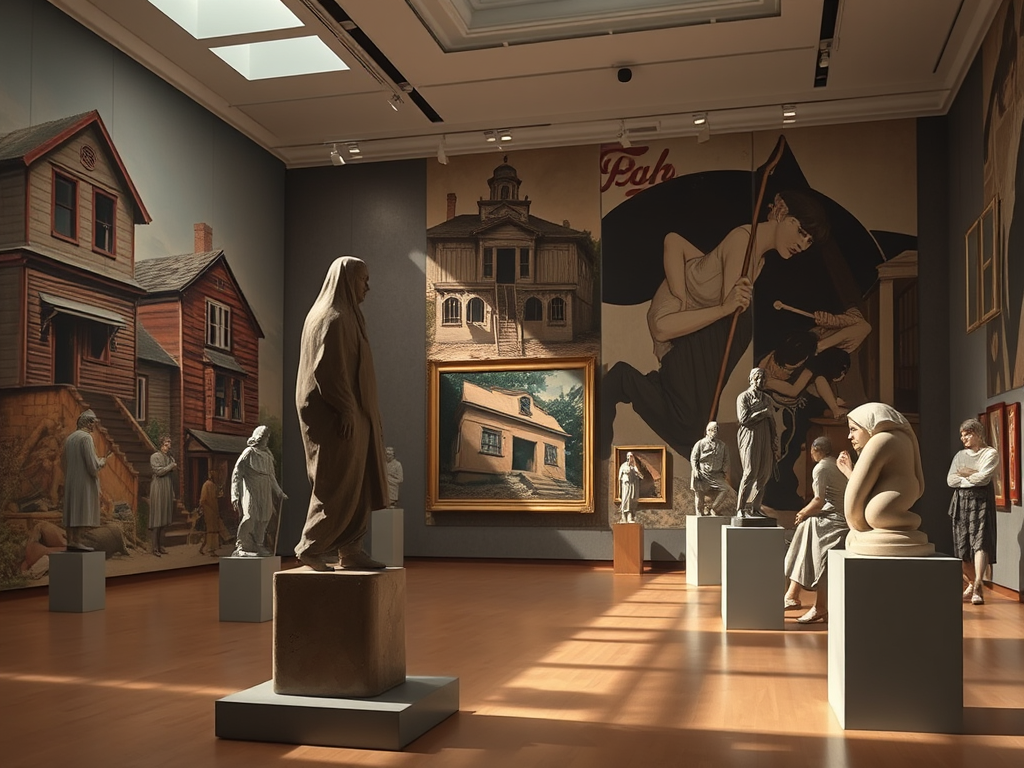
For many artists, a single masterpiece can crystallize the essence of their life’s work. In the long-overdue retrospective currently on view at the Jewish Museum in New York, one painting in particular reveals the heart of American artist Ben Shahn’s creative mission. Titled Contemporary American Sculpture (1940), the piece cleverly encapsulates Shahn’s artistic philosophy and historical concerns in a single, compelling visual statement.
In this painting, Shahn recreates an exhibition space at the Whitney Museum of American Art, depicting a room filled with contemporary sculptures from the museum’s annual survey. However, rather than simply replicating the scene, he takes a rebellious twist: he imagines the walls of the gallery covered not with sculpture, but with his own paintings — realist works that bring the harsh realities of the Great Depression into the curated confines of the museum. These paintings portray scenes such as dilapidated workers’ homes, a weary farmer standing beside his ramshackle dwelling, and African American women seeking medical care in an underfunded welfare hospital.

The effect is startling. It’s as if the sleek, abstract sculptures of the Whitney are being eclipsed by a sudden and powerful intrusion of real life — a rupture in the gallery wall that opens a window onto suffering and social struggle. The technique is reminiscent of Renaissance frescoes, where the walls of churches were “pierced” by paintings that made divine stories feel palpably present. Shahn’s work similarly breaks through aesthetic barriers to make room for truth — raw, uncomfortable, and immediate.
This tension — between modernist style and social realism, between formal innovation and human suffering — is the central force of Ben Shahn: On Nonconformity, the Jewish Museum’s stunning exhibition. The show spans the full scope of Shahn’s output, with 175 pieces including paintings, prints, photographs, and archival materials. But Contemporary American Sculpture stands out as a bold declaration of Shahn’s purpose: to use the traditional medium of painting not as escapism, but as a tool to confront the pressing issues of the modern world.
For a brief time — roughly the decade before and after World War II — Shahn was considered one of the foremost American artists. He earned a solo exhibition at the Museum of Modern Art, participated in the 1954 Venice Biennale, and was celebrated alongside modernist giants like Willem de Kooning. But as Abstract Expressionism began to dominate postwar American art, and as the Cold War intensified ideological divides, Shahn’s leftist politics and social themes fell out of favor. Unlike his abstractionist peers, Shahn never turned inward. He remained committed to portraying people, injustices, and stories — a commitment that eventually led critics to sideline him.


The Jewish Museum’s show is the first major retrospective of his work in the United States since 1976. It was initially developed at the Reina Sofía Museum in Madrid, where it received enthusiastic acclaim in 2023. Bringing it to an American institution was a challenge, reflecting the enduring neglect of Shahn’s legacy. Curator Laura Katzman worked diligently to secure a venue willing to host the exhibition. Now, decades later, American audiences are being reintroduced to a visionary whose work feels startlingly contemporary.
Ben Shahn’s journey began in Lithuania, then under Russian imperial rule. Born in 1898 to a Jewish family, Shahn experienced persecution and hardship from a young age. His father, a political dissident, was exiled to Siberia. In 1906, the family fled to Brooklyn, where young Ben quickly had to shoulder adult responsibilities. To help support the household, he left high school and found work in a lithography studio. There, he began to hone the visual skills that would define his art — not just the technical craft of drawing and composition, but also a deep sensitivity to mass-produced images and the narratives they carry.
Though largely self-taught, Shahn took courses at several institutions — including New York University, the City College of New York, and even the Marine Biological Laboratory in Massachusetts — pursuing knowledge with tenacity. He married Tillie Goldstein, a hardworking partner who supported his artistic ambitions. In the 1920s, the couple traveled through Europe, studying the work of both Renaissance masters and modern artists. Shahn even arranged a meeting with Picasso — but reportedly backed out, overwhelmed by nerves.

Back in New York by the early 1930s, Shahn served as an assistant to Diego Rivera during the creation of the controversial Rockefeller Center mural, which was eventually destroyed because it included a portrait of Lenin. Although Shahn shared Rivera’s passion for social justice, he remained independent from communist orthodoxy, aligning instead with broader democratic ideals.
In his 1933 solo show at New York’s Downtown Gallery, Shahn debuted a series centered on Tom Mooney, a labor activist wrongly imprisoned for a 1916 bombing. These paintings, rooted in journalistic photography, walked the line between documentation and artistic interpretation. Shahn’s images often bear the imprint of their photographic sources — cropped frames, skewed angles, and newspaper-like compositions give his works a sense of immediacy. His depiction of the witnesses who testified against Mooney, for instance, echoes a distorted wide-angle lens, a choice that underlines both the surreal quality of injustice and the visual language of mass media.
The show also includes his earlier work on the infamous case of Sacco and Vanzetti, two Italian immigrants executed for murder amid flimsy evidence and xenophobic hysteria. One painting shows the men tightly framed, handcuffed, echoing the way their photograph had been crudely cropped in a newspaper — a visual decision that underscores the manipulation of public perception.

By the mid-1930s, Shahn began using a camera himself, as part of a New Deal project to document the effects of the Depression. His photographs, shown alongside those by peers like Dorothea Lange and Walker Evans, are deeply empathetic and compositionally strong. He later used these images as studies for his murals and paintings, particularly those commissioned under New Deal programs. These photos — though originally small and monochrome — became the foundation for larger, vividly painted works that conveyed the same unflinching realism at full scale.
In his World War II posters for the Office of War Information, Shahn translated that realism into government propaganda — albeit with his own tragic, humanistic tone. Some of his most powerful images from this period depict victims of Nazi violence, drawn with the gravitas and pathos of Christian martyrs in Renaissance art. One painting, 1943 A.D., turns barbed wire into a crown of thorns — a striking visual metaphor that merges biblical suffering with modern atrocity.
Ironically, the U.S. government was wary of the emotional power in Shahn’s work. Only two of his OWI posters were ever released. Yet he continued to make advocacy art, creating materials for the Congress of Industrial Organizations that promoted racial equality and workers’ rights. His depictions of interracial solidarity — such as a poster showing Black and white welders standing side by side — feel uncannily relevant today.

In his later years, however, Shahn’s focus shifted. The directness of his earlier work gave way to a more abstract, symbolic style. He drew on the aesthetics of artists like Paul Klee and Picasso, creating works dense with allusions but sometimes lacking the urgency and clarity of his earlier output. These later paintings, often centered on spiritual or moral ideas, can feel detached — less grounded in lived experience, more like meditative exercises in visual philosophy.
Yet what Shahn could not have foreseen was that the very issues he depicted — social inequality, racial injustice, political persecution — would resurface with renewed force in the 21st century. His once-marginalized realism now reads as prophetic. His works, dismissed by mid-century critics as didactic or sentimental, offer a mirror for our present.
In 1933, Diego Rivera described Shahn’s work as a “complete portrait” of the world he came from. Nearly a century later, standing in the galleries of the Jewish Museum, viewers might find that portrait uncannily resembles the world they live in now. Shahn’s paintings may be from another time, but their truths are enduring — and, in moments of crisis, urgently alive.




Leave a Reply