
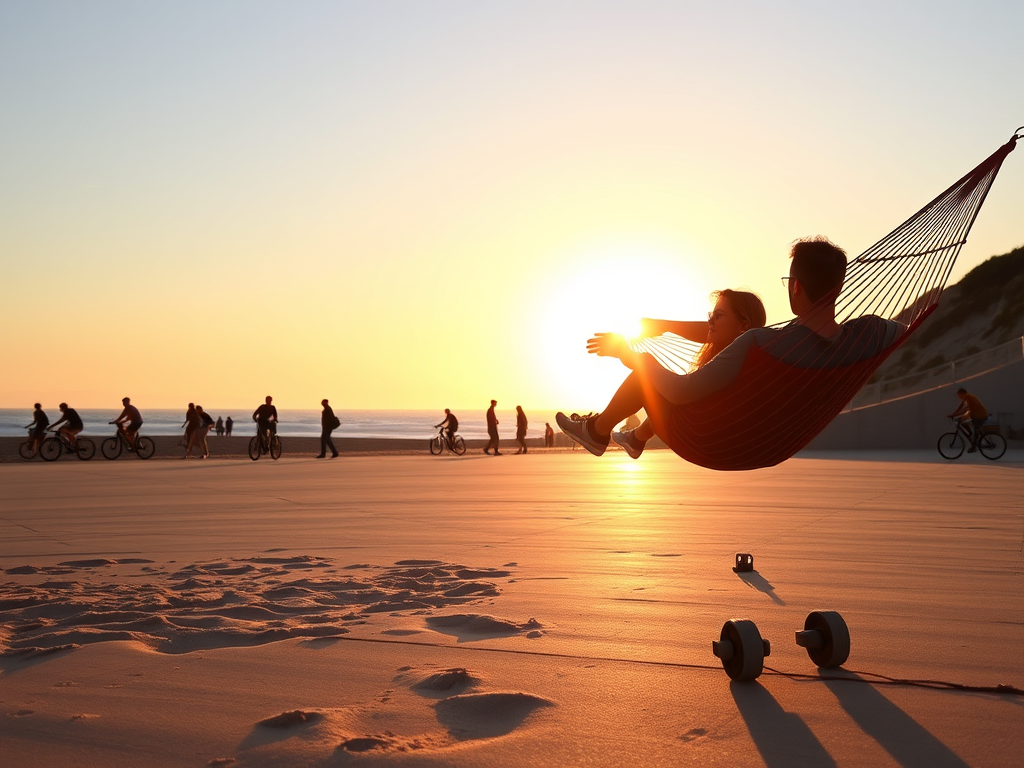

At the far edge of San Francisco, where the Pacific Ocean laps at the city’s western boundary, a couple reclines in a hammock, their Rollerblades resting idly on the sand-speckled pavement. It’s 3:15 p.m. on a Monday, and though the workweek hums on, there’s no sign of urgency in the air.
Sunset Dunes: San Francisco’s Controversial Park Transformation

“This counts as a lunch break,” jokes Ryan LaBerge, 52, who works in sales when not enjoying the sun-drenched serenity of the coast.
Welcome to Sunset Dunes, San Francisco’s newest—and perhaps most controversial—public park. Once a bustling stretch of asphalt known as the Great Highway, the area has now been transformed into a car-free haven where cyclists, rollerbladers, surfers, and sunseekers find refuge. But beneath the park’s carefree vibe lies a deep civic divide.
Parks vs. Pavement: A City at a Crossroads

In California, two passions often stand at odds: the love of green spaces and the love of the open road. Sunset Dunes has become the epicenter of this collision, as efforts to permanently close part of the Great Highway to vehicles have sparked political outrage, lawsuits, and even a recall campaign.
The conflict reflects a broader pattern in San Francisco’s urban planning history. The city has long experimented with reclaiming car-dominated spaces for public use. After the 1989 Loma Prieta earthquake, the damaged Embarcadero Freeway was demolished and replaced with a scenic boulevard. In Hayes Valley, a collapsed freeway off-ramp gave way to Patricia’s Green, now a vibrant neighborhood park filled with art and activity. And during the pandemic, John F. Kennedy Drive in Golden Gate Park was closed to cars, transforming into a promenade for skaters, walkers, and families.
Despite initial backlash, many of these changes became widely embraced over time. But whether Sunset Dunes will follow the same trajectory remains uncertain.
“Change is always a challenge,” noted Phil Ginsburg, General Manager of the city’s Recreation and Parks Department. “But in terms of urban design, these shifts have been among our most impactful accomplishments.”
From Roadway to Refuge

For nearly a century, the two-mile stretch along Ocean Beach was known as the Great Highway—a gateway to the once-thriving Playland-at-the-Beach amusement park and a favorite for car enthusiasts and surfers alike. But the pandemic brought a dramatic change. In spring 2020, the city closed the road to vehicles to allow residents to safely exercise while maintaining social distancing.
As normal life resumed, a compromise was struck: cars could use the road on weekdays, while weekends were reserved for pedestrians and cyclists. This temporary arrangement was due to expire this year, but environmental issues—including increasing sand accumulation and structural erosion—prompted city officials to take decisive action.
Citing climate threats and public support for green space, five members of the Board of Supervisors proposed a ballot measure to permanently close the road to traffic. The proposal passed narrowly in November, with nearly 55% of voters in favor. Yet the vote highlighted a geographic and socioeconomic rift: residents farther from the coast embraced the idea of a seaside park, while those living nearby—many of whom rely on the road for commuting—voiced strong opposition.
Speed vs. Process

San Francisco is notorious for its sluggish bureaucracy. A public restroom once made headlines for being projected to cost $1.7 million and take years to build. But Ginsburg adopted a different approach for Sunset Dunes.
Determined to avoid bureaucratic paralysis, he pushed forward with an uncharacteristically swift and cost-effective implementation. The city officially closed the road to cars on March 14. Although the space still resembles a traditional roadway—with its asphalt lanes and median—key changes have transformed its function.
Traffic signals were removed. Part of the median was demolished to make room for fitness equipment. The city launched a naming contest, receiving over 4,000 creative submissions, including “Sandy Bottom,” “The Tan Line,” and “Karl’s Corner”—a nod to the famously foggy weather personified by a popular Twitter account, Karl the Fog.
Community volunteers installed benches, an octopus-shaped climbing structure, and a pump track for bikers. Murals funded by private donations now adorn the space. All told, the project cost approximately $1 million, split between public and private funds.

The newly named Sunset Dunes was officially dedicated on April 12. In its first month, the park welcomed more than 150,000 visitors, according to cell phone data and sensors. Weekend visitation reached 7,800 people per day; weekdays averaged 3,400 visitors.
These numbers catapulted Sunset Dunes into third place among San Francisco parks in weekday attendance, trailing only JFK Promenade and Marina Green. At one point, it even outperformed the popular Dolores Park, though that streak ended after Easter Sunday’s annual “Hunky Jesus” contest.
Economic Boon, Political Blowback
Businesses near Ocean Beach have seen a noticeable uptick in customers. Black Bird Bookstore, just blocks from the dunes, reports a 35% increase in sales. “It feels like the neighborhood has finally been discovered,” said owner Kathryn Grantham. Traditionally overshadowed by hotspots like the Haight or the Castro, the Outer Sunset is suddenly drawing crowds.
Andytown Coffee Roasters, a local favorite, reports a 20% boost in sales at its beachside location. CEO Lauren Crabbe says she enjoys the park but acknowledges the fierce neighborhood divide it has created. “There’s a real sense of loss among some people,” she said. “They’re mourning the road.”

Opposition came to a head on a recent Thursday, when critics submitted over 11,000 signatures to City Hall in an effort to recall Supervisor Joel Engardio, the architect of the ballot measure. If at least 9,911 of those signatures are verified, a special election will be triggered within three months. Early counts suggest the recall will likely proceed.
The irony is not lost on observers. Engardio rose to office as a moderate reformer, buoyed by support for the 2022 recall campaigns that ousted the city’s progressive school board and district attorney. Now, those same constituents may remove him for his role in reshaping the Great Highway.
“He betrayed our trust,” said Selena Chu, a social worker and former Engardio supporter. “He turned his back on the very people who elected him.”
Fellow Sunset resident Alyse Ceirante echoed those sentiments, criticizing the city’s priorities. “They’re making it harder for families to get to work and school—all in the name of ‘art,’” she said, making air quotes. “This whole city has become anti-car. We’ve had enough.”

What Comes Next?
Even if Engardio is recalled, Sunset Dunes itself will likely remain intact. His replacement would be appointed by Mayor Daniel Lurie, but reversing the park would require a broader political effort.
A lawsuit has also been filed, with opponents asking the court to reinstate vehicle traffic. A hearing is scheduled for June 2. Meanwhile, Supervisor Connie Chan, who represents the adjacent Richmond District, has suggested placing a citywide measure on the ballot to reopen the Great Highway if the recall proceeds.
Engardio, for his part, remains unapologetic. He says creating Sunset Dunes is among his proudest accomplishments. He and his husband plan to spend much of their retirement there, regardless of the political fallout.
“How could anyone be angry about something so joyful?” he asked. “What’s there to be upset about?”
As for LaBerge, who swayed gently in his hammock that Monday afternoon, the answer was obvious. “Driving that stretch used to be great,” he said with a shrug, “but this—this is the coolest thing that’s ever happened.”story.”




Leave a Reply