
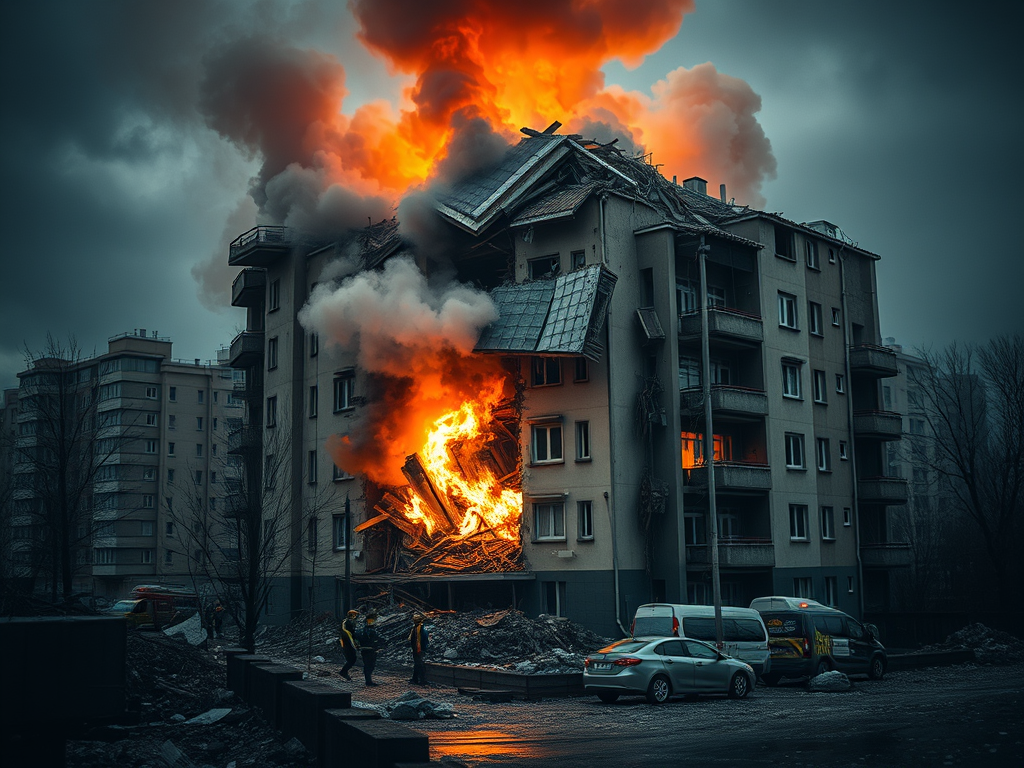

In one of the most devastating bombardments since the start of the war, Russia launched a sweeping overnight offensive on Ukraine, involving a barrage of missiles and drones that killed at least 12 civilians and wounded scores more. Ukrainian officials condemned the attack, stating it was yet another sign that the Kremlin had no sincere intention of pursuing peace.
Russia Bombards Ukraine With One of Largest Air Assaults of the War

The latest strike marked the second consecutive night of heavy bombardment and the third such assault within a single week—an escalation in hostilities that has resulted in a sharp increase in civilian casualties. Despite ongoing diplomatic efforts to establish a cease-fire, Russia has intensified its attacks, while Ukraine has launched its own retaliatory strikes inside Russian territory, though these have been smaller in scale and caused fewer civilian deaths.
Ukraine’s air force reported that during the latest attack, Russia unleashed 69 ballistic and cruise missiles along with an overwhelming wave of 298 drones. Although Ukrainian defense systems managed to intercept nearly all of the drones and about two-thirds of the missiles, according to Air Force spokesperson Yuriy Ihnat, the magnitude of the strike was unprecedented in terms of the number of weapons deployed. These figures could not be independently confirmed, but if accurate, they point to the largest single aerial assault since the conflict began.
This dramatic escalation reflects a shift in Russia’s military strategy. The deployment of hundreds of drones in a single attack—something unimaginable at the war’s outset—has become a grim new norm, enabled by Russia’s ramped-up weapons production capabilities. Drone swarms are tactically designed to saturate air defense systems, forcing Ukraine to stretch its limited resources even thinner. This latest offensive also targeted Ukraine’s western and southern regions, which lack the fortified air defenses of cities like Kyiv, increasing the likelihood of devastating civilian casualties.
Hopes that the peace talks initiated by former U.S. President Donald Trump in February would reduce assaults on non-military targets have so far not materialized. On the contrary, violence has escalated. United Nations data shows that Ukrainian civilian deaths have risen steadily since February, with April recording 209 fatalities—one of the deadliest months in the last two years.

Grim visuals released by Ukrainian emergency services on Sunday morning illustrated the scale of the destruction. Footage showed firefighters battling flames on a partially collapsed apartment building in the southern city of Mykolaiv. The structure’s roof had caved in, exposing shattered beams like bones jutting into the sky. In Markhalivka, a small village near Kyiv, emergency personnel navigated roads lined with smoldering houses and charred debris. In the western region of Zhytomyr, photographs captured rescuers pulling the bodies of three children from homes reduced to rubble.
Local authorities confirmed multiple fatalities across several regions: four deaths occurred in the Kyiv region, another four in Khmelnytskyi in western Ukraine, and one in Mykolaiv in the south. The total death toll was further compounded by injuries to over 60 individuals and damage to more than 80 residential buildings, according to Ukraine’s Interior Minister Ihor Klymenko. He added that 13 different regions were affected by the attacks.
By Sunday afternoon, Markhalivka had become a landscape of sorrow and wreckage. Residents wandered through the debris of what had once been their homes. Police reported that three missile strikes had hit this area, possibly aimed at a nearby military base. Roughly half the street was annihilated.
One resident, 49-year-old Anzhelika Krasovets, described the harrowing experience of surviving the missile strike. Her family—herself, her husband, and their three children—were buried under rubble but miraculously escaped with only cuts and bruises. “We pulled the children out ourselves; I don’t even know how we did it,” she recalled. “The shelling was still going on while we tried to get out.”

Her husband, still in his sleepwear, was seen digging through the remains of their home, searching for salvageable items like documents and clothing. Several of their pets were still trapped beneath the ruins.
Another resident, 72-year-old Henadii Shvets, managed to survive the attack as well, though his son sustained serious injuries. Blood stained the floor of their home, and their neighbor wasn’t as fortunate—he died in bed, reportedly torn apart by the blast.
President Volodymyr Zelensky of Ukraine pointed to the latest strikes as further evidence of Russia’s duplicity in cease-fire negotiations. In a social media post, he criticized the global community—particularly the United States—for remaining too quiet in the face of mounting aggression. “The world may enjoy its weekend, but the war does not rest,” Zelensky wrote. “Russia kills every day. The silence of America, the silence of others around the world only emboldens Putin.”
Recent Russian strikes have increasingly focused on urban areas. Just last month, an attack near a children’s playground and another in a crowded city square killed 53 civilians, including children. These incidents underscore the growing disregard for civilian life.
Even amid the ongoing violence, one fragile line of communication remains open between the warring nations: the exchange of prisoners. Hours after the latest assault, both countries announced the completion of a major prisoner swap that had begun two days earlier. Each side released 303 individuals, bringing the total number of exchanged prisoners to 1,000—marking the largest exchange since the war began.

The prisoner deal was the only tangible result of cease-fire talks held earlier this month in Istanbul, where Russian and Ukrainian officials met face-to-face for the first time in months. After those discussions, Trump appeared to shift his stance on Ukraine. Following a phone conversation with President Vladimir Putin, Trump dropped his previous demand for an immediate cease-fire and instead voiced support for direct negotiations between Kyiv and Moscow.
Many Ukrainians see Russia’s participation in peace talks as little more than a delay tactic, intended to buy time while continuing military operations. Foreign Minister Sergey Lavrov stated that Russia would present Ukraine with a draft agreement outlining its conditions for peace after the prisoner swap was completed, according to Russian state media Interfax.
As of Sunday evening, it was unclear whether any formal document had been submitted to Ukrainian negotiators. However, officials in Kyiv suspect that Moscow will simply reiterate its earlier demands from the Istanbul talks—terms such as withdrawing Ukrainian forces from regions still under their control. Such stipulations remain completely unacceptable to Ukraine.
Back in the devastated village of Markhalivka, Oksana Ivenuk stood beside the remains of her house, visibly exhausted and emotionally overwhelmed. “We’re extremely exhausted after all these years of war,” she said quietly before breaking down into tears.




Leave a Reply