
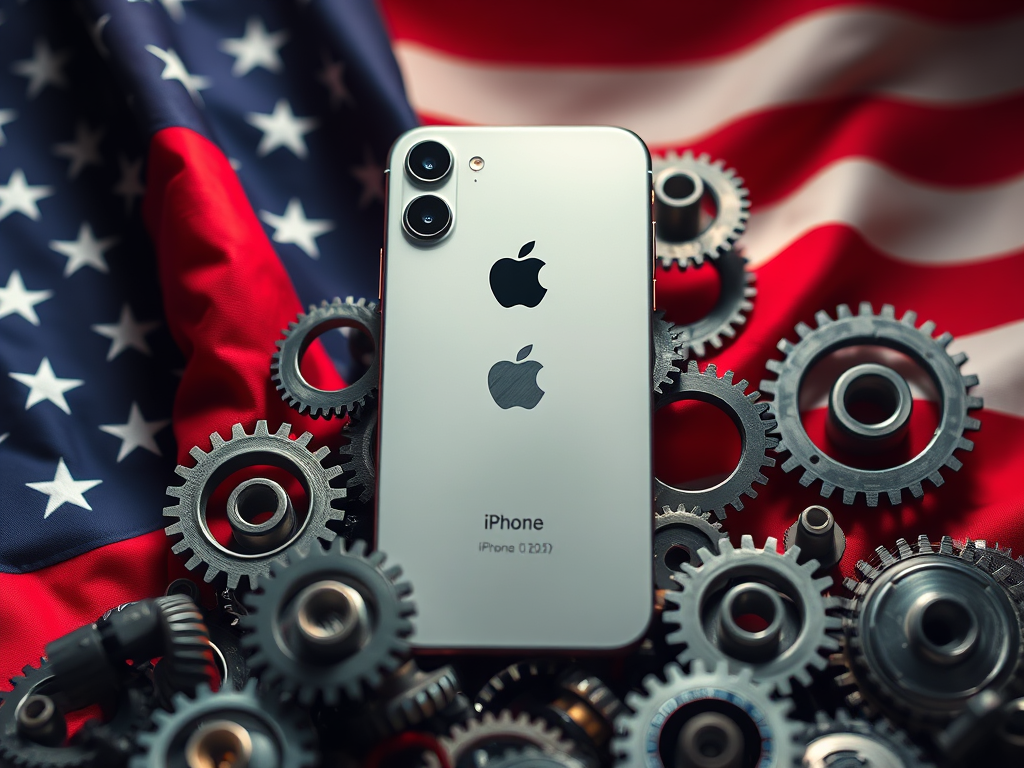

Is Trump’s ‘Made in America’ iPhone a Fantasy?

On Friday, former President Donald Trump reignited his long-standing campaign against Apple’s overseas manufacturing practices, calling on the tech giant to relocate iPhone production to the United States. He warned that failure to comply could result in tariffs of at least 25% on iPhones produced abroad.
This latest demand is consistent with Trump’s broader effort, dating back to his 2016 presidential campaign, to push American corporations—especially tech firms—to bring manufacturing jobs back home. At the time, he vowed to compel Apple to start making its “damn computers and things in this country instead of other countries.”
However, despite this rhetoric, Apple has not reshored production to the U.S. In fact, it has strategically diversified its supply chain away from China, expanding manufacturing into countries such as India, Vietnam, and Thailand. Yet, the overwhelming majority of iPhones—estimated at around 80%—are still produced in China. In contrast, virtually no iPhones are assembled within the United States.
Is Domestic iPhone Production Possible?
Technically speaking, Apple could produce iPhones domestically. But according to Wayne Lam, a senior analyst at TechInsights, doing so would come at an extraordinary financial and logistical cost. The company would be required to make massive capital investments in specialized machinery and adopt high levels of automation due to the relatively small size of the U.S. labor force.
Lam explained that if Apple were to bring its entire iPhone assembly operation stateside, the cost per unit would skyrocket—potentially doubling the retail price of an iPhone to over $2,000. “It’s simply not feasible in the short term,” he said. “It’s an unrealistic proposition.”

There are some potential advantages to reshoring, including reduced environmental impact from shorter shipping distances and improved control over quality assurance. However, former Apple manufacturing design manager Matthew Moore noted that these benefits are relatively minor when compared to the massive challenges of establishing a new, large-scale supply chain in the U.S.
Why Hasn’t Apple Made the Shift?
Experts in supply chain logistics and manufacturing argue that trying to move iPhone production to the U.S. at this stage in the product’s life cycle would be a strategic mistake. The iPhone is approaching its 20th anniversary, and Apple’s executives have openly speculated that the iconic device may one day be replaced by entirely new technologies—particularly those driven by artificial intelligence.
Wayne Lam pointed out that investing billions of dollars to build out a U.S.-based manufacturing infrastructure for a product that may soon be obsolete is simply bad business. “It would be throwing money into a black hole,” he said. “Honestly, I’d be surprised if there’s an iPhone 29.”
Apple is already working to shift consumer attention toward new categories of products, including augmented reality devices like the Vision Pro, which may eventually supplant smartphones entirely.
There’s also historical precedent that has discouraged Apple from expanding its U.S. manufacturing footprint. In 2013, Apple attempted to assemble Mac Pro desktop computers in Texas. However, the experiment ran into operational difficulties. Employees occasionally left shifts before their replacements arrived, causing production interruptions. Additionally, Apple struggled to source enough of the small, custom screws essential to the Mac Pro’s design, highlighting the limited capabilities of the American manufacturing ecosystem.
Although CEO Tim Cook once gave President Trump a tour of the Texas facility, more recent versions of the Mac Pro list Thailand—not the U.S.—as the country of origin.

What Makes China So Attractive?
China’s manufacturing dominance in the electronics sector is no accident. It is rooted in a combination of logistical advantages, skilled labor, and sheer scale. According to analysts, several key factors make China irreplaceable for iPhone production—at least for now.
For one, many of the factory workers responsible for assembling iPhones are young women with small, dexterous hands. This physical trait makes them particularly efficient at handling the tiny screws and components inside modern smartphones.
Additionally, China has cultivated a vast, flexible labor force that can scale production quickly. Each year, millions of migrant workers flock to industrial zones in cities like Zhengzhou to support peak production cycles tied to new iPhone launches. These workers live in factory dormitories, work long hours, and are typically only paid for the months they are employed—usually from summer until the Chinese New Year.
Moreover, the engineering talent pool in China is extraordinarily deep. When asked about the country’s manufacturing prowess, Tim Cook once remarked that China had enough tooling engineers to fill multiple football fields, while the U.S. couldn’t fill a single room. These engineers specialize in the design and maintenance of the precision equipment used to manufacture high-tech components.
“These are not just factories,” said Matthew Moore. “They are complex ecosystems filled with tens of thousands of engineers and technicians. It’s not something you can just replicate overnight somewhere else.”
Why Is Apple Increasing Production in India?
Apple’s move into India was largely driven by economic incentives and market strategy. India is now the second-largest smartphone market in the world, trailing only China. To avoid hefty tariffs on imported devices, Apple began assembling iPhones locally through its contract manufacturing partners.

India also resembles China two decades ago, offering a growing base of skilled engineers and a young workforce. The Indian government has offered subsidies and policy incentives that further reduce Apple’s manufacturing costs. This makes India an attractive alternative, especially as Apple seeks to reduce its dependency on China amid rising geopolitical tensions and pandemic-era supply chain disruptions.
Does This Mean Apple Is Reducing Its Reliance on China?
In reality, Apple remains deeply intertwined with China. While final iPhone assembly may increasingly take place in India, many of the most complex components—such as displays and Face ID modules—are still manufactured in China. These parts undergo an intermediate process called subassembly before being shipped to India, where they are pieced together to form a complete device.
This strategy allows Apple to label the finished products as “assembled in India,” helping it sidestep some tariffs and appeal to Indian consumers. However, the company’s core manufacturing infrastructure—and its reliance on Chinese labor and expertise—remains largely unchanged.
In other words, while Apple is making high-profile moves to diversify its supply chain, the backbone of iPhone production continues to rest in China.




Leave a Reply