
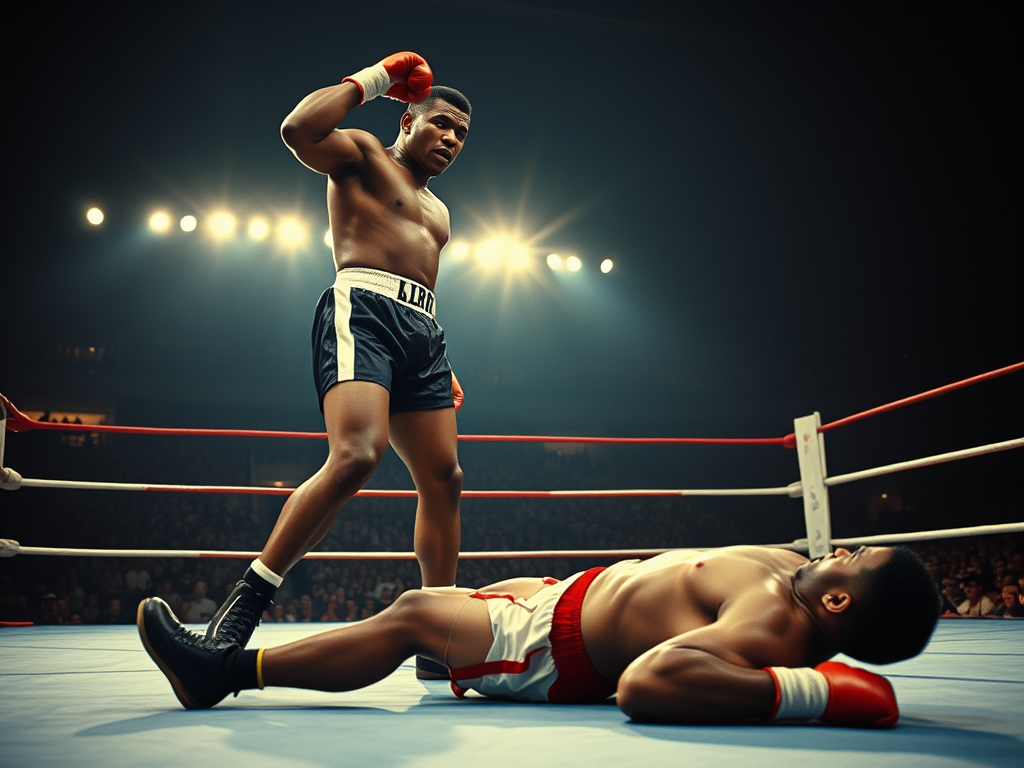

60 Years Since Ali’s Iconic Knockout: Leifer’s Legendary Shot

When Muhammad Ali landed a swift right hand just 1 minute and 44 seconds into his world title bout against Sonny Liston on May 25, 1965, a cascade of unforgettable events unfolded. Liston crumpled to the canvas. Ali towered above him, shouting, “Get up and fight, sucker!” as flashes from cameras lit up the arena. Among those capturing the moment was 22-year-old freelance photographer Neil Leifer, working for Sports Illustrated. He pressed the shutter at exactly the right moment, capturing what many now regard as the most iconic photograph in sports history—Ali in a powerful stance, his arm cocked, expression fierce, over the fallen Liston.
Ironically, that image—now legendary—was not used on the cover of Sports Illustrated. It wasn’t even selected as the lead photograph in the article; instead, it was tucked away on the final page of the spread and largely ignored at the time. Fast-forward six decades, and Leifer’s photograph has emerged as a definitive image not just of Ali’s career, but of sports photography itself.
What adds to the wonder of this image is its setting: it was taken in a small hockey arena converted into a boxing venue in Lewiston, Maine, with fewer than 4,000 spectators present. Ali, one of the most widely photographed figures in sports history, is immortalized in a shot taken far from the limelight of Madison Square Garden or Las Vegas. That such an image was initially overlooked only makes its eventual rise to fame more remarkable.

Now 82, Neil Leifer—who first contributed to Sports Illustrated at age 16—reflects on the photograph’s unexpected journey to immortality.
How did a young photographer like Leifer get the chance to shoot such a major fight?
Despite being only 22 at the time, Leifer was no rookie. By 1965, he had already amassed 15 covers with Sports Illustrated, a rare feat in an era when many covers featured illustrations or paintings rather than photographs. He had also photographed the first bout between Cassius Clay (as Ali was then known) and Sonny Liston in Miami, where five of the most respected photographers—Hy Peskin, Marvin Newman, Ralph Morse, and Bob Gomel—were also covering the fight. Leifer’s shot from that night had made the cover. For the rematch in Lewiston, only two prized ringside spots were allocated to the magazine’s photographers. One went to Herbie Scharfman. The other to Leifer.
In the now-famous image, Scharfman is visible in the background—between Ali’s legs—clearly missing the decisive moment. How were their positions decided?
Scharfman picked his spot by choice. He preferred sitting near the judges in the center of the ring, where space was more open, rather than being squeezed shoulder to shoulder with other photographers. But Leifer knows the truth about sports photography: it’s not just skill—it’s luck. That night, fortune placed him in the exact spot to capture an image for the ages. And when luck offers that kind of opportunity, a great photographer doesn’t miss.

Was Leifer aware of the cultural significance of the rematch at the time?
Not at all. For Leifer, it was simply another assignment—a job. Having watched Ali thoroughly dominate Liston in their first bout in Miami, he anticipated an easy win and didn’t expect the fight itself to be memorable. “Honestly,” Leifer admits, “I thought this would be a forgettable event.”
What preparations did he make for the shoot?
Leifer arrived in Lewiston three days before the fight, mainly to coordinate with the electricians responsible for hanging the lighting gear. He had brought two sets of strobe lights to be installed above the ring, about 20 feet overhead. Getting their cooperation often involved a little financial encouragement. “Maybe not bribery,” he says, “but offering money definitely helped.”
Why did he choose a Rolleiflex camera for the event?
For Leifer, it was about image quality and framing flexibility. The Rolleiflex produced square-format photos, which were ideal for editorial work. The square frame meant he didn’t need to decide in a split second whether to shoot in portrait or landscape mode. A square image could be cropped either way for the magazine’s layout—cover or two-page spread.
How did he achieve the clean, vivid contrast and striking visual clarity in the image?

Lighting was key. Leifer approached it like a studio shoot, placing his strobes to highlight the fighters, making their physiques stand out and giving the photograph a dramatic, sculptural quality. The canvas of the ring was a plain off-white, the fighters’ trunks and gloves were unadorned, and there were no ads plastered in the background—unlike today’s sports arenas filled with branding. This lack of visual noise kept the viewer’s attention firmly on the action.
The dark background adds a cinematic quality. How did that happen?
Back then, indoor smoking was common. The majority of the spectators—mostly men—smoked cigarettes and cigars, creating a haze that caught the light from the strobes. This added a subtle blue tint to the background rather than leaving it pitch black, enhancing the photo’s dramatic tension.
Some say the punch that knocked Liston down was barely visible—the so-called “phantom punch.” Did Leifer actually see it?
“No,” he says plainly. Like everyone else, he didn’t expect the fight to end so quickly. He was focusing on his equipment at the time. Liston did get back up briefly, which challenges the idea that the match was rigged. If he had stayed down just a bit longer, it would have been over right there.
In the photograph, it looks like Ali stood over Liston for several seconds—but in reality, the moment was fleeting. How did Leifer manage to capture it?
It came down to sheer luck. His strobe lights needed three seconds to recharge between shots. He had one chance—and he took it. Had Ali struck a more dynamic pose a second later, Leifer wouldn’t have been able to capture it. “I’m not being modest when I say this: it was absolute luck,” he insists.
Did he realize he had captured something extraordinary?
Not at the time. Everything happened so fast. He believed he had a strong photograph, and was disappointed it didn’t get more attention in that week’s magazine issue. It didn’t win any awards. Not even a mention. Leifer filed it away, not realizing it would gain legendary status decades later.
What changed over time?
Ali changed. As his fame and influence grew, so did the resonance of the photo. This was his first fight after changing his name from Cassius Clay to Muhammad Ali. Over time, his political stances—on civil rights, on Vietnam—transformed from controversial to celebrated. As the man became iconic, so too did the image that symbolized his defiance, power, and charisma.
Does Leifer believe this is the greatest sports photograph ever taken?
Surprisingly, no. He appreciates the image’s significance, is grateful for the recognition it brought him, but insists its greatness lies in the subject, not in the shot itself. “If I had taken the same exact photo of another fighter in a lesser match, no one would care,” he admits. His personal favorite remains another Ali photo he took during the Ali-Williams fight, which required more planning and less luck. That’s the one that hangs in his home.
Leifer would go on to photograph 40 covers for Time magazine and build a storied career. But this one lucky frame, shot in a smoky hockey arena in Maine, continues to define the legacy of a man—and a moment—that changed the face of sports forever.




Leave a Reply