

5 Years After George Floyd’s Murder, the Backlash Takes Hold

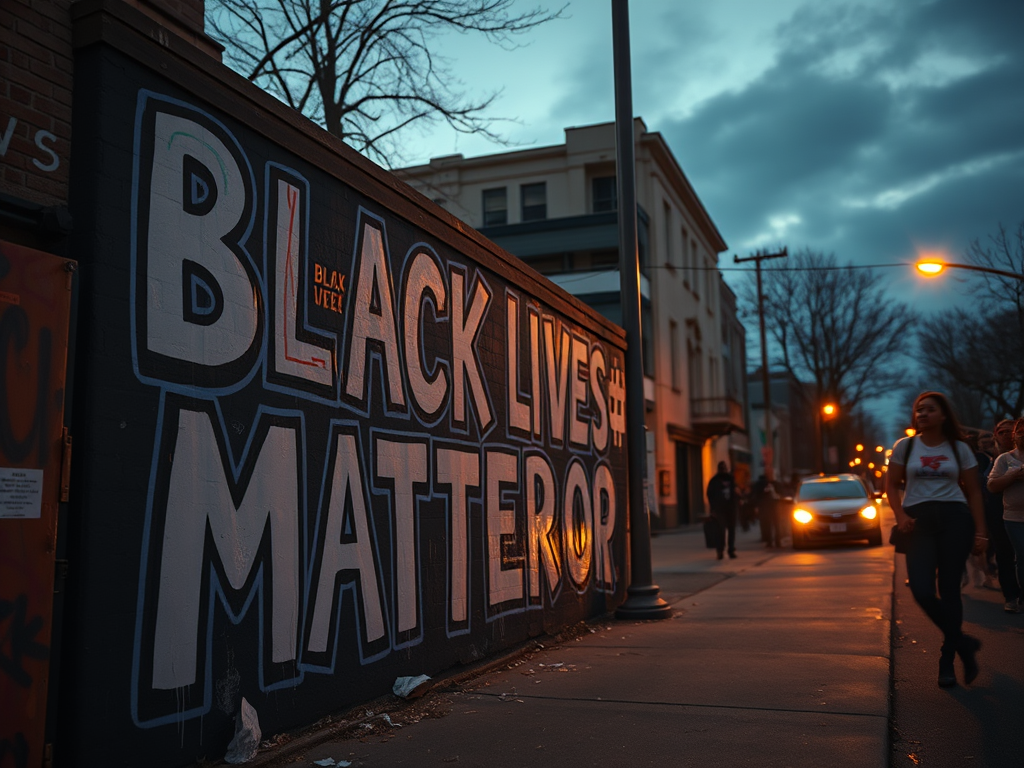
The massive yellow letters spelling out “Black Lives Matter” that once stretched boldly across a central Washington, D.C. street have now vanished. Once a potent visual symbol of the nationwide protest movement against police brutality, the Black Lives Matter Plaza has been paved over. Ironically, even as this symbol fades, police killings across the United States have actually increased.

Federal oversight of police departments accused of racial discrimination is being scaled back. The Justice Department has quietly ended several agreements intended to monitor police forces with histories of racial bias. Meanwhile, the refugee resettlement program in the U.S. remains largely inactive—yet exceptions have been granted for white South Africans, raising concerns about double standards in immigration policy.
This Sunday marks five years since the murder of George Floyd by a Minneapolis police officer, a horrific incident that shook the conscience of a nation and sparked what may have been the largest social movement in American history. Yet, just half a decade later, the movement inspired by his death seems to be losing ground.

Historically, American social justice movements have experienced a push-and-pull dynamic—progress followed by resistance. The victories of the abolitionist movement gave way to Reconstruction’s violent end and the rise of the Ku Klux Klan. The momentum of the civil rights era dissipated as politicians like Richard Nixon rallied the “silent majority.”
But even within this historical context, the current reversal feels particularly abrupt. In the summer of 2020, Americans of all political leanings—Democrats and Republicans alike—stood together in solidarity, protesting systemic racism and calling for police reform. Today, however, the national dialogue on race seems largely shaped by Donald J. Trump, whose political rhetoric continues to emphasize white grievance and reverse what he perceives as advantages given to minorities.

To conservative commentators and politicians, the shift is seen as a necessary response to what they view as lawlessness and overreach. White House spokesperson Harrison Fields, under President Trump’s leadership, stated that the administration’s goals include ensuring safety, enforcing justice, and empowering law enforcement at all levels.
But others view this as a deliberate return to older systems of power and exclusion. Dr. Manisha Sinha, a historian at the University of Connecticut, argues that regression is not inevitable or natural. “History does not unfold on its own,” she noted. “What we are seeing now is a result of intentional choices.”
The Black Lives Matter movement existed well before George Floyd’s death. It began in 2013 following the acquittal of George Zimmerman in the fatal shooting of Trayvon Martin and grew with public outcry over the police killings of Michael Brown in Ferguson and Eric Garner in New York in 2014. But Floyd’s death was a catalyst. On June 6, 2020, half a million people demonstrated in over 500 communities across the country. In the weeks that followed, up to 26 million people participated in or supported protests. Even high-profile Republicans, like Mitt Romney and Nikki Haley, expressed support.

Since then, however, public sentiment has cooled. A Pew Research Center survey conducted earlier this month showed that 72 percent of Americans believe the racial reckoning following Floyd’s death failed to lead to meaningful improvements for Black Americans. Support for the Black Lives Matter movement has dropped by 15 percentage points since June 2020, although a slim majority still express approval.
For individuals like Selwyn Jones, George Floyd’s uncle, the shift has had a deeply personal cost. Jones, now 59, continues to speak publicly about his nephew’s death. Living in a small South Dakota town, he finds himself increasingly isolated. “People I’ve known for over 20 years don’t speak to me anymore,” he said.
Even academics closely associated with the racial justice movement have come under fire. Dr. Ibram X. Kendi, a leading voice in antiracist thought, established the Center for Antiracist Research at Boston University in 2020 with $55 million in funding. Since then, his public profile has declined, and the center has faced internal criticism. Yet Dr. Kendi remains committed. “Progress was never going to be uninterrupted,” he said, emphasizing that historical progress is rarely linear.

Meanwhile, public pressure on figures like Kendi has come from both sides. While conservative voices criticize his framework as divisive, some progressives argue his strategies are ineffective. Kendi maintains that many of his critics have either misinterpreted or misrepresented his work.
The movement’s funding has also dried up significantly. In 2021, the Black Lives Matter Global Network Foundation reported over $79 million in revenue. By 2022, that had dropped to just under $8.5 million, and in 2023 it declined further to around $4.7 million, with expenses more than doubling that amount. Investigations into financial mismanagement, both real and alleged, have damaged the credibility of some leaders and undermined public trust.

Still, historians argue that no social movement’s progress is ever fully undone. Although the Reconstruction era was marked by violence and voter suppression, slavery was not reinstated. Black activism has always played a foundational role in American democracy, notes Dr. Steven Hahn of New York University. “Without Black struggles, we wouldn’t have democracy as we know it,” he said. “They’ve always been at the forefront of demanding full inclusion.”
Yet Professor Hahn also expressed concern about the current political climate. “Silencing people can happen gradually,” he warned, “until we find ourselves back in a dangerous place.”
There have been some lasting reforms. The use of body cameras by police has become more widespread. Several jurisdictions have banned no-knock warrants. Data on police use of force is now being collected more systematically than before.
Nonetheless, Trump’s efforts to dismantle diversity, equity, and inclusion (DEI) initiatives remain a powerful force. DEI has increasingly become shorthand among conservatives for policies seen as favoring women and people of color. These efforts have started to draw resistance. For instance, retail giant Target recently reported a dip in sales and customer traffic, a drop partly attributed to its retreat from diversity-centered initiatives. Its sales declined 3.8 percent compared to the same quarter last year.
At the same time, individuals inspired by the protests of 2020 have taken up the cause in new ways. Michael Green, who describes himself as a “flag nerd,” founded a company called Flags for Good to create banners for progressive causes, including Black Lives Matter. What began as a side project in a spare bedroom is now a thriving business. He says sales of Black Lives Matter merchandise have surged again—driven, in part, by Trump’s campaign for reelection.

In recent years, Trump has not shied away from divisive racial rhetoric. As far back as 1989, he claimed that being a well-educated Black person offered an advantage in America. In the 1990s, he worried aloud about white people losing majority status. More recently, in a meeting with South African President Cyril Ramaphosa, he falsely claimed that white South Africans were being “executed,” and referred repeatedly to “dead white people.” These statements underscore his long-standing narrative of white victimhood.
Despite the political headwinds, many racial justice advocates remain committed to the cause. They understand that progress is often slow and comes at a cost. But history has shown that while movements may falter, the ideals behind them endure. The road to racial equality in America has never been smooth, but the struggle for justice continues—one generation at a time.




Leave a Reply