

Corey O’Connor: A Legacy of Service in Pittsburgh Politics

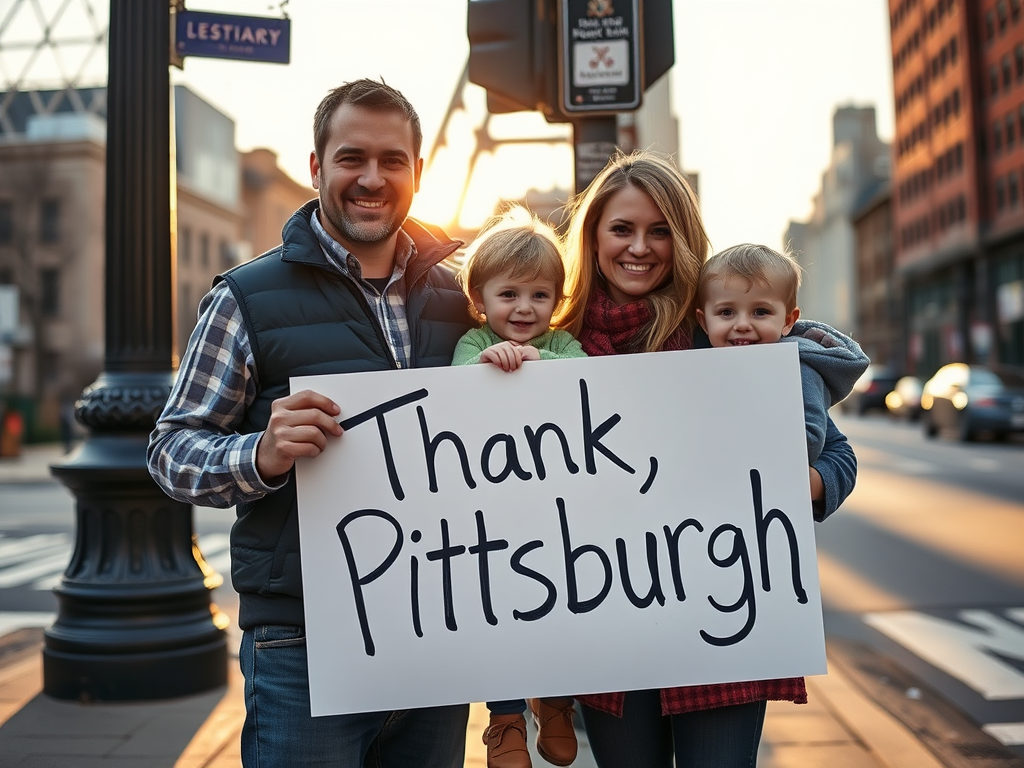
On a cool morning in Pittsburgh, just one day after the Democratic primary election, Corey O’Connor stood on a familiar street corner with his wife, Katie. In each of their arms was one of their young children — Katie holding Molly, and Corey with Emmett. With their free hands, they lifted a simple, hand-drawn sign that read, “Thank you, Pittsburgh.” Drivers honked in appreciation, and neighbors passing by smiled and waved, acknowledging the heartfelt gesture.
This scene wasn’t just a spontaneous act of gratitude. It was a touching homage to a tradition rooted in family history. Nearly two decades earlier, Corey’s father, Bob O’Connor, had stood on a similar corner with a comparable sign after finally winning the Democratic primary for mayor in 2005, following two previous unsuccessful bids. It was his moment of triumph — one that would be tragically short-lived.
For many Pittsburgh residents, Corey’s win was more than just a political event. It was a deeply emotional chapter in a long story — a continuation of a legacy left behind by a father who passed away far too soon. Bob O’Connor had barely begun his term when he was diagnosed with brain cancer, and he died within weeks. His love for Pittsburgh, however, remained immortal in the memories of many.
Now at 40, Corey O’Connor is stepping into a role that seems both predestined and hard-won. “He has the heart for it,” said Bruce A. Kraus, a former City Council colleague. “Corey was raised on the values his father lived by. He has a genuine moral compass and a real sense of service.”

Given Pittsburgh’s long-standing Democratic tradition — the last Republican mayor held office by appointment in 1932 — Corey is widely expected to secure victory in the upcoming general election, where he faces Republican challenger Tony Moreno. However, his primary win also marks a significant shift in the city’s political landscape. Just four years ago, Ed Gainey had emerged as a symbol of progressive momentum, defeating incumbent Bill Peduto amid calls for pandemic-era reforms and inclusive recovery.
While Gainey emphasized support for underserved communities and economic equity, his administration was often marked by gradual change and occasional missteps. Corey’s campaign, in contrast, focused on efficiency and stability — a pledge to bring competent, steady governance to the city. As Allegheny County’s controller since 2022 and a longtime City Council member, Corey brought to the race a record of public service and administrative know-how.
Though Gainey garnered even more votes this cycle than during his first primary victory, the head-to-head format worked in Corey’s favor. With 52.8% of the vote, he narrowly edged out Gainey’s 47.2%, drawing substantial support from liberal enclaves like Squirrel Hill — where Corey lives — and the increasingly gentrified Lawrenceville. The Democratic primary saw its highest turnout in over 20 years, with final counts expected to exceed 60,000 votes.
At his election night celebration, Corey bounded onto the stage to Bon Jovi’s Who Says You Can’t Go Home, embracing both his city and his past. “We’re going to make this city work,” he declared to an energized crowd. “We will ensure Pittsburgh has the police presence it needs, affordable housing for all, and thriving businesses in every neighborhood. We will deliver.”
Yet, the road to this moment wasn’t always clear.

When Corey’s father passed away, Corey was finishing his undergraduate degree at Duquesne University. Just a year later, unsure about his next steps, he happened to attend the U.S. Open in nearby Oakmont. There, he ran into a staffer from Congressman Mike Doyle’s office, who encouraged him to apply for a community development role. That encounter reignited something within him — a recognition that those countless hours spent at his father’s side during campaign stops and neighborhood meetings had shaped him in profound ways.
“My dad used to say, ‘I won’t leave you with wealth, but I’ll give you a name you can build your own life with,’” Corey recalled in a recent interview. “Everywhere I go, people tell me these beautiful little stories — like how their child didn’t have money for ice cream one day, and my dad quietly handed them five dollars. It’s those moments that stay with people.”
Public service runs deep in the O’Connor family. Corey, the youngest sibling by over a decade, grew up surrounded by examples of compassion and dedication. His brother Terry is a priest. His sister Heidy works actively with the Bob O’Connor Foundation and supports other local charities. Their mother, Judy, who passed away a year ago, volunteered for many years at the Caring Place, a nonprofit that helps children cope with grief.
Katie O’Connor, now an employment attorney, first knew Corey as a teenager and later reconnected with him in their thirties. “There’s no doubt in my mind this is what he was meant to do,” she said. “It’s in his blood.”

Despite his background, Corey wasn’t immediately certain about jumping into the mayoral race. When he floated the idea to political strategist Ben Forstate — who had recently run a successful congressional campaign — he was met with hesitation. “He had a great job, a young family, and politics is brutal,” Forstate said. “I told him not to do it at first. But Corey knew what he wanted.”
Of course, leadership comes with scrutiny. Some critics question whether Corey, known for his agreeable nature, has the conviction to make tough decisions. Barney Oursler, director of the Mon Valley Unemployed Committee and a Gainey supporter, said Corey often seemed too eager to please during his time on the council. One example, Oursler claimed, was when Corey hesitated on a paid sick leave proposal after meeting with local restaurant owners, though he ultimately supported it. Corey has firmly rejected this criticism, saying he was simply making sure the policy would stand up to legal challenges.
“He tries to find consensus, and that’s not always a bad thing,” Oursler admitted. “But when push comes to shove, can he draw a line?”
Nonetheless, political tensions didn’t stop the two men from exchanging polite greetings and a handshake at a recent minimum wage rally. For Corey, at least for now, those disputes were a distant concern.
On election night, Corey’s thoughts drifted to years past — to moments spent nervously waiting with his family, watching returns trickle in during his father’s campaigns. “Vote. Wait. Fidget. Pray,” he said with a smile, describing the timeless election night ritual. He even asked his brother Terry to lead the family in prayer again, just as they had done 20 years ago.
“I think we all felt it,” Terry said later. “Being in that room, waiting for the results, we were back there again. We’ve all changed, but this really brought things full circle. My dad’s dream was to serve this city, and now Corey is carrying that forward. He’s holding the same torch.”
With a name tied to both personal tragedy and civic pride, Corey O’Connor’s journey is more than a political comeback — it’s a return to unfinished business. As he steps into the spotlight his father once held, the city of Pittsburgh watches closely, hopeful that this time, the O’Connor legacy will not only be remembered — but fulfilled.




Leave a Reply