
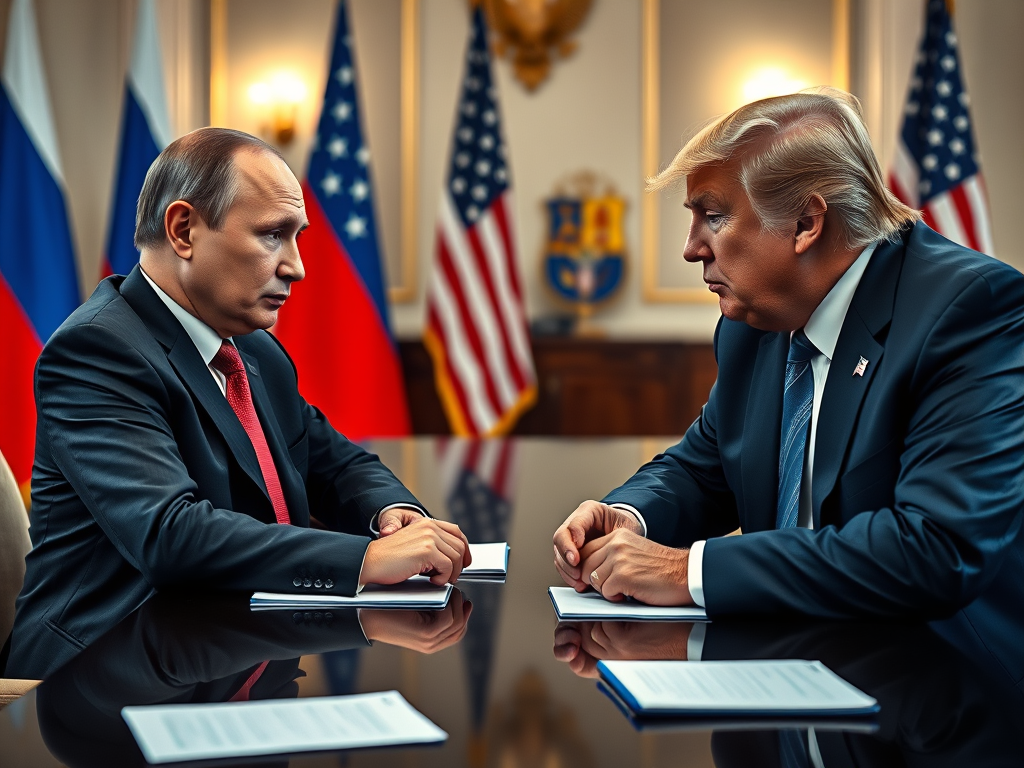

In Trump Call, Putin Notches a Diplomatic Win, With an Economic Caveat

Since launching his invasion of Ukraine in 2022, Russian President Vladimir V. Putin has been determined to end the conflict on his own terms. Recent diplomatic developments suggest that Putin has successfully maintained his strategy: advocating for peace negotiations while continuing military operations he believes are currently in his favor.
Despite international pressure — including calls from Ukraine, the European Union, and until recently the United States — for an immediate cease-fire, Putin has stuck to his uncompromising stance. Following a phone conversation with Putin on Monday, U.S. President Donald Trump expressed support for direct peace talks between Russia and Ukraine. This marked a notable shift away from Trump’s earlier pledge to quickly end the war.
However, while this diplomatic win may appear to benefit Moscow in the short term, it could hinder Putin’s broader ambition to restore normal economic ties with Washington.

President Trump emphasized after the call that any progress in U.S.-Russia economic relations would be contingent upon a resolution to the conflict in Ukraine. Should Trump insist on linking the two issues, Russia may remain stuck in a state of economic isolation — with limited prospects for relief from Western sanctions or for attracting U.S. investment, which Trump had previously suggested could be a possibility.
“Russia is eager to establish significant trade relations with the United States once this tragic war ends — and I agree,” Trump noted in a statement on Monday following his discussion with Putin.
Vice President JD Vance echoed these sentiments in even more direct language. “There are clear economic advantages to improving Russia’s relations with the rest of the world,” he said after meeting with Ukrainian President Volodymyr Zelensky in Rome, “but those benefits won’t materialize as long as innocent civilians are being killed.”
According to the Kremlin, the Ukraine conflict was just one of several topics covered during the two-hour conversation between Putin and Trump. The Russian side characterized the talks as a mutual reaffirmation of interest in a broader rapprochement.
Yuri Ushakov, one of Putin’s top foreign policy advisers, told Russian reporters after the call that “both presidents discussed the current state of bilateral relations and expressed support for a gradual normalization.” He added, “President Trump considers Russia to be one of America’s most crucial potential partners in trade and economic cooperation.”
The only specific agreement cited by Ushakov was a proposed exchange of nine Russians imprisoned in the United States for nine Americans currently incarcerated in Russia — a relatively small gesture compared to the lofty hopes many in Moscow had held earlier in the year.
At that time, optimism among Russian business leaders and pro-government intellectuals was high. They believed Trump’s pragmatic, deal-oriented worldview might usher in a new era of engagement between Russia and the world’s largest economy.
Their vision included lifting sanctions against Russian state-owned energy companies and financial institutions, as well as restoring access to the SWIFT international banking system — actions that would make global commerce far more accessible for Russia. Officials also hoped that détente with the U.S. would encourage American corporations, particularly in the high-tech sector, to return to the Russian market, helping to close the innovation gap caused by sanctions.
More strategically, many in the Kremlin’s orbit hoped a renewed U.S.-Russia relationship, grounded in geopolitical realism and mutual self-interest, would help reestablish Russia as a dominant global player.

Nonetheless, Sam Greene, a political science professor at King’s College London who specializes in Russian affairs, warned that Putin may be overestimating his ability to decouple the Ukraine war from broader U.S.-Russia diplomacy. “If Trump is unable to achieve progress in Ukraine but refrains from holding Russia accountable, he may still be tempted to move ahead with normalization efforts,” Greene said during a phone interview on Tuesday. Putin’s objective, he suggested, is to persuade Trump that Russia’s abundant natural resources are a sufficient prize — one worth overlooking the moral weight of failing to halt the violence in Ukraine.
In prioritizing Ukraine’s capitulation over immediate economic rewards, Putin appears to be betting that time will work in his favor.
Global oil prices — critical to Russia’s revenue — have stabilized around $65 per barrel following an initial plunge after Trump announced new global tariffs in April. With Trump now delaying those tariffs, the Kremlin has been spared from making significant budget cuts to its defense expenditures. Although Russia’s economic growth has slowed, analysts expect the economy to expand by about 1.5% this year, reducing the risk of a financial crisis.
Meanwhile, Russian officials have dismissed the latest sanctions from the European Union — including a ban on nearly 200 Russia-linked oil tankers and penalties targeting the state-owned energy giant Surgutneftegaz — as ineffective. Trump, for his part, has suggested that the U.S. might pause additional sanctions in light of possible diplomatic progress.
In a broader sense, sanctions have been used by Putin to reinforce a narrative that Russia is engaged in an existential confrontation with the West over Ukraine. “Russian entrepreneurs have adapted to operating under sanctions,” Putin said in a meeting with wealthy business leaders in March. “Even if these sanctions are eased, new obstacles will be introduced. Sanctions aren’t merely temporary tactics — they’re instruments of long-term strategic pressure.”

Recent Russian budget figures indicate that efforts to attract military recruits by offering large bonuses and increased salaries are proving successful. Recruitment numbers have consistently exceeded monthly targets for 2025, according to Jack Watling, an analyst with the Royal United Services Institute, a London-based defense think tank.
On the battlefield, Russian advances have recently accelerated after months of stagnation. In May, Russian forces gained an average of 3.3 square miles of Ukrainian territory per day — up from 2.3 square miles in April — according to Deepstate, a monitoring group aligned with the Ukrainian military. Notably, Russian troops have breached Ukrainian defenses near the city of Pokrovsk, a critical stronghold in the eastern Donbas region.
Military analysts suggest that even these relatively modest gains have further reduced Moscow’s incentive to compromise before completing a planned summer offensive. In a report published this week, Watling argued that the current wave of attacks is intended to persuade Ukraine’s allies that victory is unattainable, potentially pressuring Kyiv to accept peace talks under unfavorable terms.
Ultimately, Putin’s actions suggest he is playing a long game — one that relies on incremental military success, sustained economic resilience, and the hope that international patience with Ukraine’s struggle will eventually erode.




Leave a Reply