
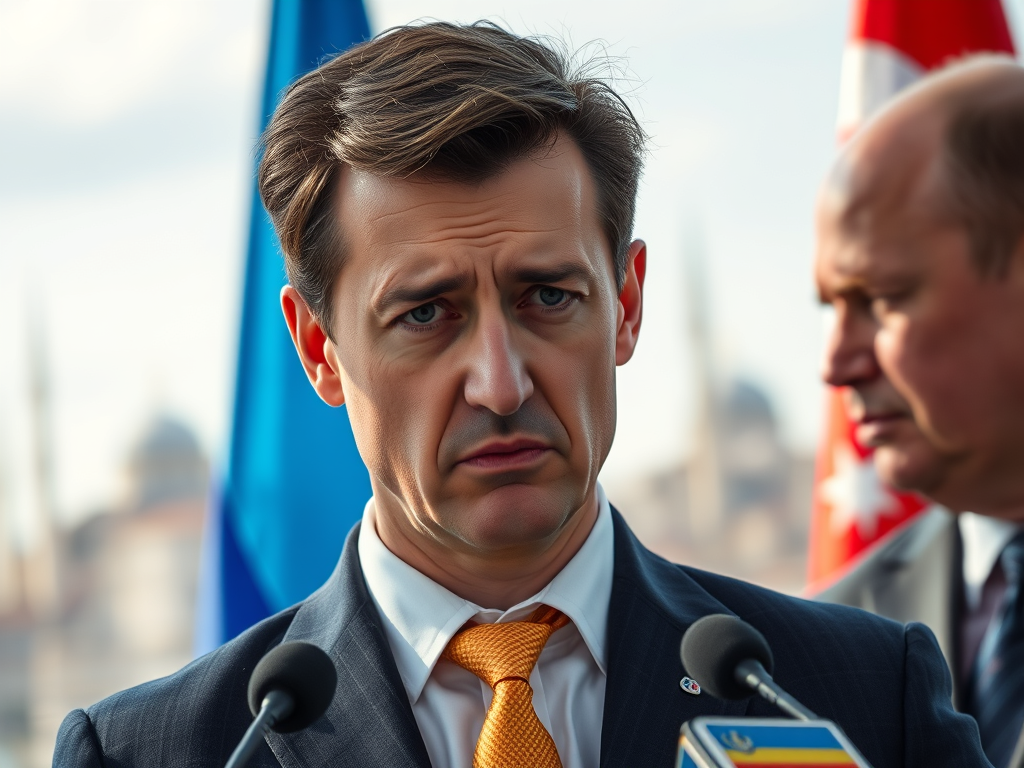

On Thursday, a highly anticipated round of peace negotiations between Ukraine and Russia in Turkey devolved into confusion and uncertainty. Delegations from both nations arrived in separate cities, spending much of the day questioning whether a meeting would even take place.
No Peace Talks (Yet) After Ukrainians and Russians Arrive in Turkey

By the end of the day, there was still no definitive confirmation of a formal meeting, though both sides indicated that discussions might resume on Friday. Ukrainian President Volodymyr Zelensky, visiting Ankara, expressed frustration over Russia’s decision to send a mid-level delegation to Istanbul, where the Kremlin preferred to hold the talks.
Speaking at a press conference after a meeting with Turkish President Recep Tayyip Erdogan, Zelensky criticized the Kremlin’s approach, calling it “unserious” and accusing Russia of showing a lack of respect. He added, “There is no scheduled time, no agenda, and no high-level representatives. This is not how serious negotiations are conducted.”
Despite the uncertainty, Zelensky agreed to send a scaled-down delegation led by Defense Minister Rustem Umerov to Istanbul. He emphasized that Ukraine was willing to explore even the faintest hope of peace, following President Vladimir Putin’s refusal to meet Zelensky personally in Turkey.

Meanwhile, former U.S. President Donald Trump added to the diplomatic chaos, telling reporters aboard Air Force One that “nothing’s going to happen until Putin and I meet.” Trump, who was in the Middle East on Thursday, hinted at a possible visit to Turkey on Friday, though no official plans had been announced.
Last weekend, Putin had proposed direct talks with Ukraine, a move that would have marked the first face-to-face negotiations between the two nations since the early months of the war in 2022. In response, Zelensky called on Putin to attend the talks himself, but Putin declined and sent a delegation identical to the one that participated in the 2022 negotiations, which collapsed after two months.
Vladimir Medinsky, a former Russian culture minister who led the 2022 delegation, resumed his role on Thursday. He characterized the new talks as a continuation of the 2022 peace efforts, stating, “The delegation remains committed to a constructive approach aimed at identifying points of agreement.”

While both sides refrained from confirming a specific time for the talks, Zelensky tempered expectations, saying, “Russia does not genuinely want to end this war.”
Turkey, despite being a NATO member, has maintained a neutral stance in the conflict, fostering diplomatic ties with both Russia and Ukraine. A Turkish official reported that Keith Kellogg, Trump’s special envoy for Ukraine, had arrived in Istanbul, with Steve Witkoff, the special envoy for the Middle East and Russia, expected to join him on Friday.
U.S. Secretary of State Marco Rubio, who was in Antalya for unrelated meetings, voiced impatience with the ongoing impasse. He stated that the United States was open to “any mechanism” that could bring about a lasting peace, emphasizing Washington’s commitment to resolving the conflict.
The diplomatic confusion underscored the deep divisions between Moscow and Kyiv over the terms of a potential peace deal. Zelensky continues to demand an immediate and unconditional ceasefire, while Putin appears to be holding out for major concessions before agreeing to a truce.

Medinsky, representing the Russian delegation, signaled on Thursday that Moscow was unwilling to consider a ceasefire without addressing what the Kremlin refers to as the “root causes” of the conflict — a broad phrase often used to question Ukraine’s sovereignty and its Western alliances.
On Thursday, reports suggested that the talks would take place at Istanbul’s Dolmabahce Palace, the same venue that hosted the 2022 negotiations. However, as the day wore on, journalists and bystanders gathered outside the palace saw no sign of the negotiators.
The latest round of diplomacy comes amid a rapidly evolving international landscape. Trump, who began his efforts to mediate the conflict in February, initially attempted to pressure Ukraine to make concessions, even suggesting that Kyiv was responsible for provoking the war.
During a February visit to Washington, Zelensky met with Trump in the Oval Office, only to face criticism from the U.S. president and Vice President JD Vance for allegedly being ungrateful for American support. The Trump administration briefly withheld military aid and intelligence sharing, further straining the relationship.
Meanwhile, Trump sought to persuade Putin to agree to a ceasefire by dangling the prospect of lifting economic sanctions, but those efforts proved unsuccessful. Putin instead proposed a brief three-day truce to coincide with a Russian national holiday, which Kyiv rejected.
As diplomatic efforts stalled, the conflict continued to escalate, with civilian casualties and military losses mounting at a rate far higher than during the same period last year, according to United Nations reports.





Leave a Reply