
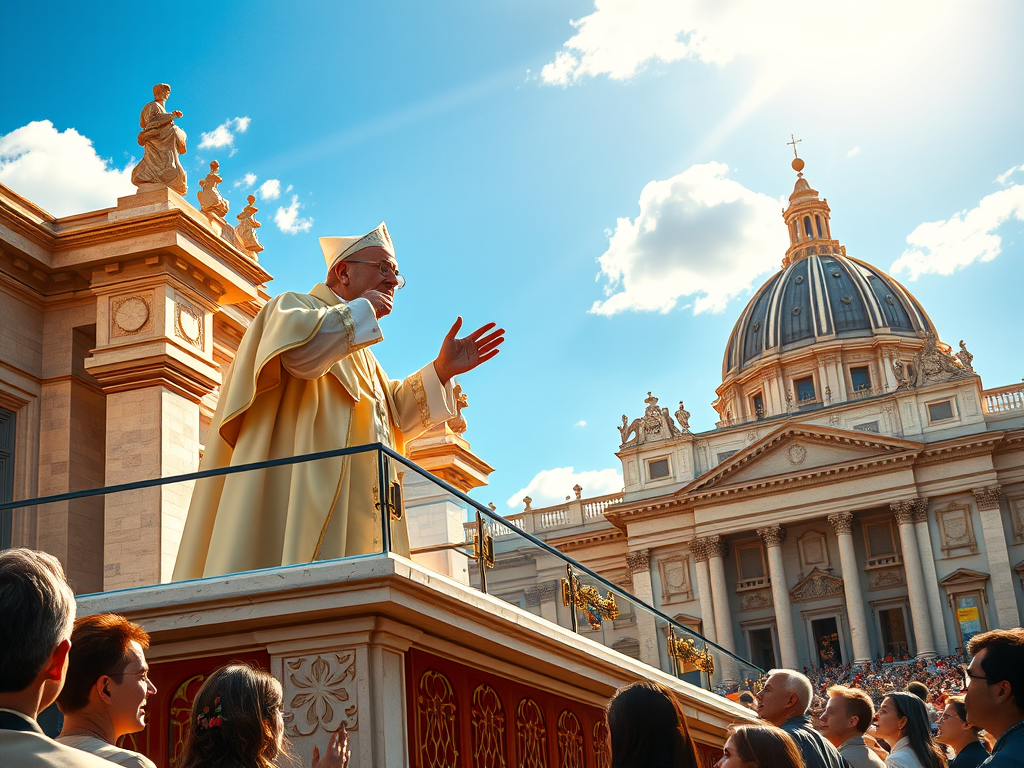

On Thursday, Robert Francis Prevost made history by becoming the first pope from the United States, chosen to lead the world’s 1.4 billion Roman Catholics. He adopted the name Leo XIV.
Who Is Pope Leo XIV?

Standing on the balcony of St. Peter’s Basilica, the newly elected pope addressed the public for the first time, urging people worldwide to seek peace and remember those in need.
Here’s a closer look at Pope Leo XIV, his path to the papacy, and the challenges that lie ahead as he steps into the role previously held by Pope Francis, who passed away last month at the age of 88.
Who Is Pope Leo XIV?
Robert Francis Prevost, 69, was born in Chicago and spent over two decades in Peru, where he became a bishop and a naturalized citizen. Before his election as pope, he led one of the most influential offices in the Vatican, overseeing the appointment and management of bishops worldwide.
Prevost is a member of the Order of St. Augustine and is known for his commitment to marginalized communities, echoing Pope Francis’s focus on the poor and migrants. Last year, he remarked to the Vatican’s news site that “a bishop is not meant to be a prince ruling over his kingdom.”
Throughout his career, Prevost has spent extensive time outside the United States. He was ordained in 1982 at 27 and later earned a doctorate in canon law from the Pontifical University of St. Thomas Aquinas in Rome. His time in Peru saw him working as a missionary, parish priest, educator, and bishop. Fluent in Spanish and Italian, he also served as the global leader of the Augustinians, visiting various countries to support the order’s missions.
What Are His Views on Key Issues?

Known for his reserved and discreet demeanor, Pope Leo XIV is expected to adopt a less flamboyant approach compared to his predecessor. Supporters anticipate that he will maintain Francis’s consultative approach, continuing efforts to involve laypeople in church discussions.
However, it is unclear how open he will be to L.G.B.T.Q. Catholics. In 2012, he criticized Western media for promoting “beliefs and practices that contradict the Gospel,” mentioning “the homosexual lifestyle” and “alternative families comprised of same-sex partners and their adopted children.”
As an American, Pope Leo XIV is in a unique position to counter the increasingly conservative Catholic movement in the U.S., which gained momentum during the Trump era. He previously criticized the administration’s stance on immigration through a social media account associated with him.
However, like many church leaders, he has also faced scrutiny for his handling of sexual abuse allegations involving clergy members.

How Was He Elected?
The process of electing the new pope began on May 7 in a conclave attended by cardinals, often referred to as the “princes of the church.” These cardinals, who rank just below the pope, are part of the College of Cardinals, currently consisting of 252 members. Only those under 80 years old, a group of 135 cardinals, are eligible to vote. Notably, about 80 percent of these electors were appointed by Pope Francis.
The conclave continues with successive rounds of voting until a candidate secures a two-thirds majority. After each vote, the ballots are burned, and the color of the smoke emitted from the chimney of the Sistine Chapel indicates the outcome. Black smoke signifies no decision, while white smoke signals the election of a new pope.
How Long Did the Conclave Last?
Historically, the duration of conclaves has varied significantly. The conclave that elected Pope Leo XIV concluded in just two days, marking the fifth time since 1900 that a pope was chosen within this timeframe.
The longest conclave in recent history, which elected Pope Pius XI in 1922, lasted five days and required 14 ballots. Meanwhile, the shortest conclave, in 1939, ended after just three ballots, selecting Pope Pius XII. In contrast, the election of Pope Gregory X in 1271 infamously took nearly three years to conclude.
What Issues Await Pope Leo XIV?
The cardinals faced a critical decision in choosing the new pope: whether to follow in Francis’s path of inclusivity or steer the church in a more conservative direction. Pope Francis’s 12-year tenure was marked by significant declarations, including permitting blessings for same-sex unions and advocating for migrants.
Within the Vatican and the broader church, however, divisions remain. Debates about the role of women and L.G.B.T.Q. Catholics, the potential for married priests, and accountability for sexual abuse by clergy members continue to stir contention.
The new pope’s challenge will be to navigate these complex dynamics while maintaining unity in a global church that remains ideologically divided.
And as Pope Leo XIV concluded his first public address, he called for compassion and understanding, setting the tone for a papacy that promises both continuity and change.





Leave a Reply