

National African American Museum Faces Uncertainty Without Its Leader

Since its grand opening on the National Mall eight years ago, the National Museum of African American History and Culture has established itself as a standout attraction within the Smithsonian Institution. With its award-winning design that evokes the shape of a traditional Yoruban crown and exhibits that chronicle the struggles and triumphs of African Americans, the museum welcomed its 10 millionth visitor in 2023, solidifying its status as one of the Smithsonian’s most frequented sites.
However, the museum now finds itself in a contentious political climate due to an executive order signed by President Trump in March. The order criticizes the Smithsonian for allegedly promoting narratives that portray American and Western values as inherently harmful and oppressive, with a specific emphasis on the African American museum.

The directive has placed the museum in a challenging position, especially as it currently lacks a permanent director. Kevin Young, who had been serving as director since 2021, was on leave when the order was issued and subsequently announced his departure. His exit has left some concerned about the museum’s future direction.
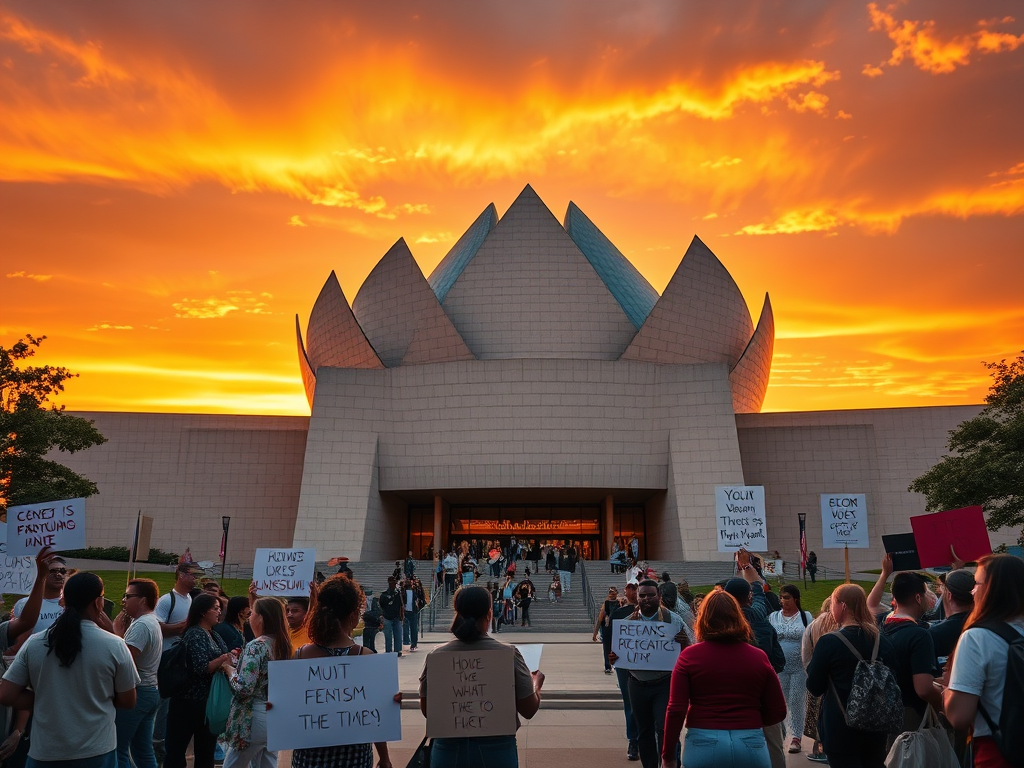
Hundreds of protesters gathered outside the museum on Saturday, rallying to protect the institution from what they perceive as political interference. Beatrice Turpin-Peek, 59, from Maryland, attended the protest with a sign that read “I ♥ NMAAHC.” She expressed her concerns, saying, “We’ve fought so hard to preserve Black history. To see it under attack like this is heartbreaking.”

Young, a renowned poet and essayist, was appointed as director in 2021 after a distinguished tenure at the Schomburg Center for Research in Black Culture in New York. Despite his accomplishments, including overseeing major exhibitions and a $350 million fundraising campaign, his leadership at the museum was reportedly under scrutiny by some Smithsonian officials who questioned whether he was the right fit for the role. Young’s workload also included his ongoing role as poetry editor at The New Yorker and his personal writing projects, which may have contributed to his decision to step down.

In an email to staff announcing his departure, Young expressed pride in his work at the museum and stated, “I have embraced this role wholeheartedly, but now it is time to return to writing full time.”
Since Young’s departure, Shanita Brackett, the museum’s associate director of operations, has stepped in as interim director. Brackett, a respected figure in the museum community, has been with the institution since 2016 and previously served as acting director of the Anacostia Community Museum. Despite the leadership transition, some observers remain optimistic. Vedet Coleman-Robinson, CEO of the Association of African American Museums, said, “The work continues. The mission endures as long as the team stays committed.”
President Trump’s executive order specifically referenced a graphic titled “Whiteness and White Culture,” which was posted on the museum’s website in May 2020 before Young assumed his role. The graphic, part of a larger initiative called “Talking About Race,” described certain values such as the Protestant work ethic, individualism, and the nuclear family as aspects of white culture. The graphic drew backlash from conservative circles, including Donald Trump Jr., and was removed after six weeks. Since then, other content from the “Talking About Race” portal has also been relocated as part of broader website updates.
Despite the controversy, the museum has continued to open impactful exhibitions, including a showcase on Afrofuturism and a major display titled “In Slavery’s Wake,” which explores the global legacy of the slave trade and will travel internationally. These exhibitions align with Young’s creative vision and commitment to making Black history accessible and engaging.
For some, Trump’s executive order has raised alarms about the potential for broader suppression of Black history in federal institutions. Kimberlé Williams Crenshaw, a law professor and executive director of the African American Policy Forum, emphasized the gravity of the situation: “Our opponents are trying to erase Black history, Black voices, and Black lives.”

Michael M. Kaiser, chairman of the DeVos Institute of Arts Management and former president of the Kennedy Center, echoed these concerns. “This is a museum dedicated to a subject that the president seems uncomfortable with,” he said.
Nevertheless, Smithsonian officials maintain that the museum’s mission remains unchanged. Despite swirling rumors, the Smithsonian has clarified that key artifacts, including Nat Turner’s Bible and the Woolworth lunch counter, remain part of the collection and have not been removed.
Lonnie G. Bunch III, the Smithsonian’s secretary and the museum’s founding director, has yet to publicly address the executive order. However, the museum’s attendance figures, which currently stand at 1.6 million visitors annually, suggest that public support for its mission remains robust.
At Saturday’s rally, Tyler Brown-Dewese, a 21-year-old student from American University, expressed his fears: “There’s a lot at stake. This isn’t just about one museum — it’s about America and the integrity of our history.”




Leave a Reply