
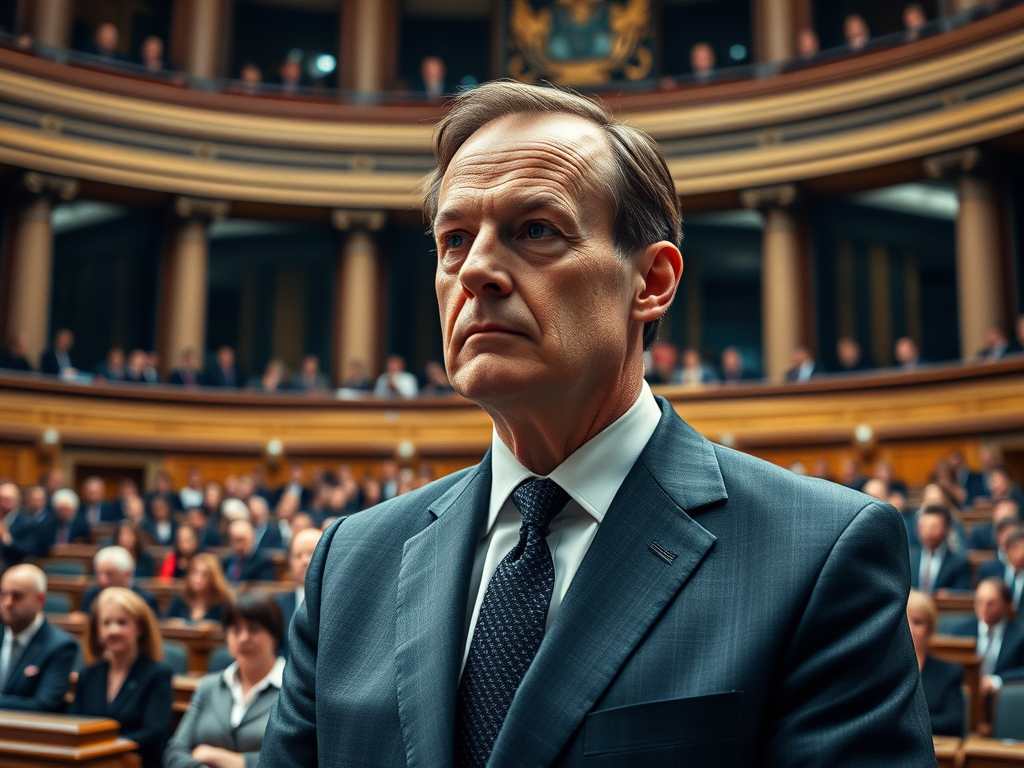

Friedrich Merz was officially inaugurated as Germany’s 10th postwar chancellor on Tuesday, marking a historic yet tumultuous start that may pose challenges for his ambitious plans to revitalize the economy, bolster national security, and address immigration concerns. With Europe increasingly looking to Germany for decisive leadership, Merz’s shaky start has raised questions about his ability to effectively govern amid rising political and economic pressures.
Germany Gets a New Chancellor, in Unexpectedly Dramatic Fashion

Following his party’s electoral victory in February, Merz was widely expected to secure a straightforward confirmation in the Bundestag. However, the initial vote resulted in a surprising defeat, with Merz falling six votes short of the necessary majority. The failure was unprecedented in modern German history, casting a shadow over Merz’s leadership on the very day he was to assume office.
The vote was conducted via secret ballot, leaving the reasons for the unexpected outcome ambiguous. Despite the coalition having a comfortable majority, speculation arose that individual protest votes from within Merz’s own camp may have inadvertently undermined his candidacy. Political analysts suggested that dissenting lawmakers from the Christian Democrats, the Christian Social Union, and the Social Democrats may have sought to express dissatisfaction with Merz’s policy compromises during coalition negotiations.
Undeterred, Merz rallied his coalition allies and managed to secure victory in a second round of voting later that afternoon, gaining 15 additional votes and clinching the chancellorship. Nonetheless, the political misstep did not go unnoticed. Both domestic and international observers noted that Merz’s credibility had been dented, potentially complicating his efforts to project strength on the global stage and to advance his legislative agenda at home.

“Germany and Europe are in need of strong and stable leadership in these volatile times,” said Cathryn Clüver Ashbrook, senior vice president of Bertelsmann Stiftung, a nonpartisan German think tank. “Merz’s stumble on such a pivotal day could be an ominous sign of the challenges to come.”

For Merz, the stakes are particularly high. Germany’s economy has been in steady decline for several years, with the manufacturing sector — the backbone of the country’s export-driven economy — facing mounting threats from U.S. tariffs and global supply chain disruptions. President Trump’s ongoing trade war poses a significant risk to German exports, while his threats to reduce America’s military presence in Europe add further pressure on Berlin to assume greater defense responsibilities.
Domestically, Merz must also contend with public discontent over immigration. The decade-long influx of migrants from the Middle East and Africa has fueled a surge in support for the far-right Alternative for Germany (AfD) party, which now rivals Merz’s Christian Democrats in national polls. The AfD has capitalized on widespread voter dissatisfaction, promising tougher immigration controls and portraying itself as the defender of traditional German values.
Adding to Merz’s political headaches is the resurgence of Russia as a security threat. Following the Kremlin’s continued aggression in Ukraine and allegations of orchestrating cyberattacks against European infrastructure, Merz faces calls to strengthen Germany’s military capabilities and enhance defense cooperation with NATO allies.
Despite these formidable challenges, Merz has wasted no time in assuming the reins of government. On Tuesday evening, he and his cabinet were formally sworn in, and his first cabinet meeting was convened later that night. Plans for immediate diplomatic outreach were also announced, with Merz scheduled to travel to Paris and Warsaw on Wednesday, followed by visits to Ukraine, Brussels, and Washington in the coming weeks.

The political turbulence surrounding Merz’s inauguration has sent ripples through Europe, with several European leaders expressing concern about the implications for regional stability. “Germany’s leadership is crucial in maintaining cohesion within the European Union,” said Kaja Kallas, the EU’s high representative for foreign affairs. “What happens in Berlin will undoubtedly affect the entire continent.”
Financial markets also reacted nervously to the uncertainty. The German stock index slid after the first vote, reflecting investor fears that Merz’s shaky start could hinder his ability to implement economic reforms and investment plans. However, markets partially rebounded following his eventual victory, signaling cautious optimism.
Despite the tumultuous start, Merz received a warm congratulatory handshake from outgoing chancellor Olaf Scholz, who had repeatedly urged a swift and orderly transfer of power. Scholz’s gesture underscored the critical importance of unity in a time of heightened geopolitical tensions and economic instability.
Now, with the immediate political crisis averted, Merz must swiftly pivot to the daunting task of governing. His administration faces an uphill battle in restoring economic growth, managing immigration, countering far-right extremism, and navigating an increasingly hostile international landscape. The coming weeks will serve as a litmus test for Merz’s leadership, as Germany and Europe watch closely to see whether he can rise to the occasion or whether Tuesday’s stumble was a harbinger of deeper troubles ahead.




Leave a Reply