
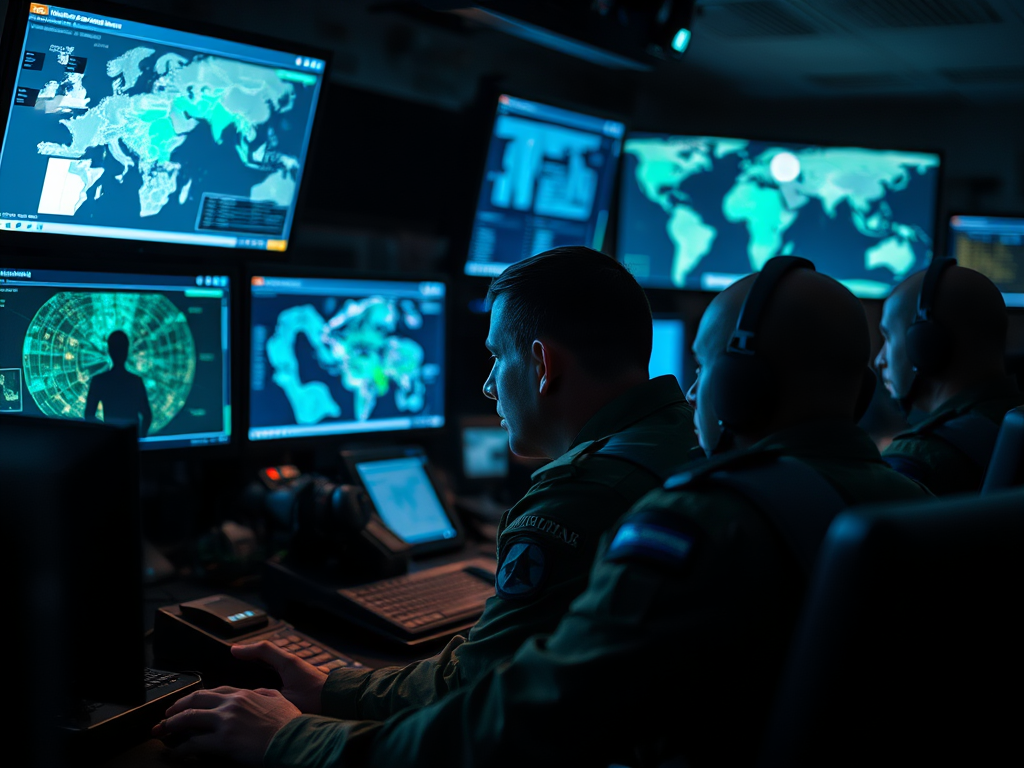

Israel’s A.I. Experiments in Gaza War Raise Ethical Concerns

In late 2023, Israeli forces were determined to eliminate Ibrahim Biari, a senior Hamas commander in northern Gaza who was heavily involved in orchestrating the October 7 attacks. However, despite intense efforts, Israeli intelligence struggled to track him down, convinced he was hiding within Gaza’s extensive underground tunnel systems.
Facing this challenge, Israeli officials turned to a new weapon: a military technology enhanced by artificial intelligence, according to three Israeli and American officials familiar with the situation. Originally developed nearly ten years earlier, this technology had yet to be deployed in actual combat. The pressing need to locate Biari prompted engineers in Israel’s Unit 8200 — the country’s equivalent to the U.S. National Security Agency — to enhance the system with cutting-edge A.I. capabilities.

Soon after, Israeli intelligence intercepted Biari’s phone calls and applied the updated A.I.-powered audio tool. This technology provided an estimated location for where the calls originated. Acting on the information, Israeli forces launched airstrikes on October 31, 2023, successfully killing Biari. Tragically, more than 125 civilians also lost their lives during the operation, according to London-based conflict monitor Airwars.
This audio tool represents just one instance of how Israel has rapidly tested and deployed A.I.-driven military technologies during the Gaza conflict, based on interviews with nine American and Israeli defense officials who requested anonymity due to the sensitive nature of their work.
Over the past 18 months, Israel has merged artificial intelligence with facial recognition technology to identify individuals even when faces are partially obscured or injured. It has also harnessed A.I. to compile lists of potential airstrike targets and developed a sophisticated Arabic-language A.I. model capable of analyzing text messages, social media content, and other Arabic-language data, two sources familiar with the initiatives revealed.
Much of this innovation stemmed from collaborations between active-duty soldiers in Unit 8200 and reservists employed at leading tech companies such as Google, Microsoft, and Meta. According to three informed individuals, Unit 8200 established an innovation hub known as “The Studio,” where A.I. projects could be matched with experts from Israel’s thriving tech sector.

Nonetheless, despite these advancements, the deployment of A.I. technology was not without flaws. Officials acknowledged instances where mistaken identifications, wrongful arrests, and civilian casualties occurred. Some within the defense community expressed deep concern about the ethical consequences of employing A.I. in warfare, particularly regarding increased surveillance and potential loss of innocent lives.
European and American defense officials observed that no other country had embraced A.I. experimentation in live combat to the extent Israel had, offering a glimpse into how future conflicts might unfold — and the risks associated with them.
“The urgent demands of the crisis accelerated innovation, much of it fueled by artificial intelligence,” said Hadas Lorber, head of the Institute for Applied Research in Responsible A.I. at Israel’s Holon Institute of Technology and a former senior official at the Israeli National Security Council. According to Lorber, these innovations provided Israel with significant tactical advantages but also brought serious ethical dilemmas to the forefront. She stressed the importance of establishing clear checks and balances and emphasized that humans, not machines, must ultimately make life-and-death decisions.

A spokeswoman for the Israeli military declined to comment on specific technologies, citing their classified nature. However, she reaffirmed Israel’s commitment to the legal and responsible use of technological tools and confirmed that an investigation into the airstrike that killed Biari was ongoing, with no further information available until its completion.
Meta and Microsoft did not respond to requests for comment. Google issued a brief statement explaining that while some employees participate in military reserve duties globally, their reserve work is separate from their employment at the company.
Israel has a history of using conflicts, particularly in Gaza and Lebanon, as testing grounds for advancing military technologies. Past innovations include the development of drones, phone hacking tools, and the famed Iron Dome missile defense system.
Following Hamas’s cross-border attacks on October 7, 2023 — which resulted in the deaths of more than 1,200 people and the taking of 250 hostages — Israeli officials quickly authorized the deployment of A.I. technologies. This urgency led to greater collaboration between Unit 8200 and reservists in “The Studio,” who worked rapidly to build and enhance new capabilities.
Avi Hasson, CEO of Startup Nation Central, an Israeli nonprofit connecting investors to local companies, noted that reservists from tech giants like Meta, Google, and Microsoft were instrumental in advancing innovation, especially in drones and data integration.
“These reservists brought essential knowledge and access to technologies that were otherwise unavailable within the military,” Hasson explained.

One significant area of application was Israel’s drone fleet. Aviv Shapira, CEO of drone company XTEND, which collaborates with the Israeli military, said that A.I. algorithms were used to allow drones to autonomously identify and track targets from afar.
“Previously, targeting required locking onto a specific image,” Shapira said. “Now, A.I. can recognize and pursue an object — whether it’s a moving vehicle or a person — with deadly accuracy.”
Shapira added that both the Israeli military and the U.S. Department of Defense, XTEND’s primary clients, were keenly aware of the ethical considerations tied to the use of A.I. in combat and actively discussed responsible usage.
Among “The Studio’s” notable projects was the creation of a large Arabic-language A.I. model. According to three Israeli officers familiar with the program, previous attempts to build such a model were hindered by the lack of available spoken Arabic data. Most accessible datasets featured formal Arabic, which differs significantly from the numerous dialects used across the Middle East.
However, Israel’s military possessed a trove of intercepted messages, transcribed phone calls, and social media posts in a range of Arabic dialects, accumulated over decades. Leveraging this resource, they trained a new A.I. model during the first few months of the war and developed a chatbot capable of querying Arabic-language materials across images, videos, and texts.
When Hezbollah leader Hassan Nasrallah was assassinated in September, Israeli intelligence used the chatbot to analyze Arabic-speaking reactions worldwide. The system distinguished between Lebanese dialects to gauge the public’s appetite for retaliation, aiding Israeli strategic decision-making.
Still, the chatbot occasionally stumbled, particularly when processing modern slang or transliterated English words. In such cases, human intelligence officers would intervene to correct errors. There were also technical mishaps; for example, the system sometimes misinterpreted images — mistaking pipes for guns, for instance. Despite these shortcomings, Israeli officials praised the A.I. tool for dramatically speeding up their research and analysis processes.

Following the October 7 attacks, Israel also began equipping temporary checkpoints in Gaza with high-resolution cameras linked to A.I.-based facial recognition software. This system sought to rapidly identify individuals passing between northern and southern Gaza. However, its effectiveness varied, particularly when faces were obscured, leading to instances where Palestinians were wrongly detained and interrogated after being flagged by the software.
Additionally, Israel employed A.I. to sort through vast datasets collected on Hamas operatives. Before the war, the military had developed a machine-learning algorithm known as “Lavender,” designed to analyze databases of known Hamas members and predict other likely affiliates. Although Lavender’s predictions were not perfect, it played a role in selecting targets during the early phases of the war.
Capturing or eliminating Hamas’s top leadership remained a priority throughout the conflict. Ibrahim Biari was among the most wanted figures due to his involvement in planning the October 7 attacks. While Israeli intelligence successfully intercepted Biari’s conversations, pinpointing his location remained elusive until they applied the A.I. audio tool, which analyzed environmental sounds, including airstrikes and sonic booms, to approximate his whereabouts.
Military intelligence officers cautioned that Biari’s suspected location — several densely populated apartment blocks — would require extensive airstrikes to guarantee a successful operation. Despite the high risk to civilians, the mission was approved and carried out.
Since then, the audio tool has been further refined. Israeli forces now use it alongside maps and photographic evidence of Gaza’s tunnel networks to locate hostages and key individuals more precisely, two Israeli officials confirmed.
Israel’s aggressive real-time adoption of A.I. in warfare offers a revealing glimpse into the future of armed conflict — showcasing both the extraordinary potential and the profound dangers of integrating artificial intelligence into the battlefield.




Leave a Reply