
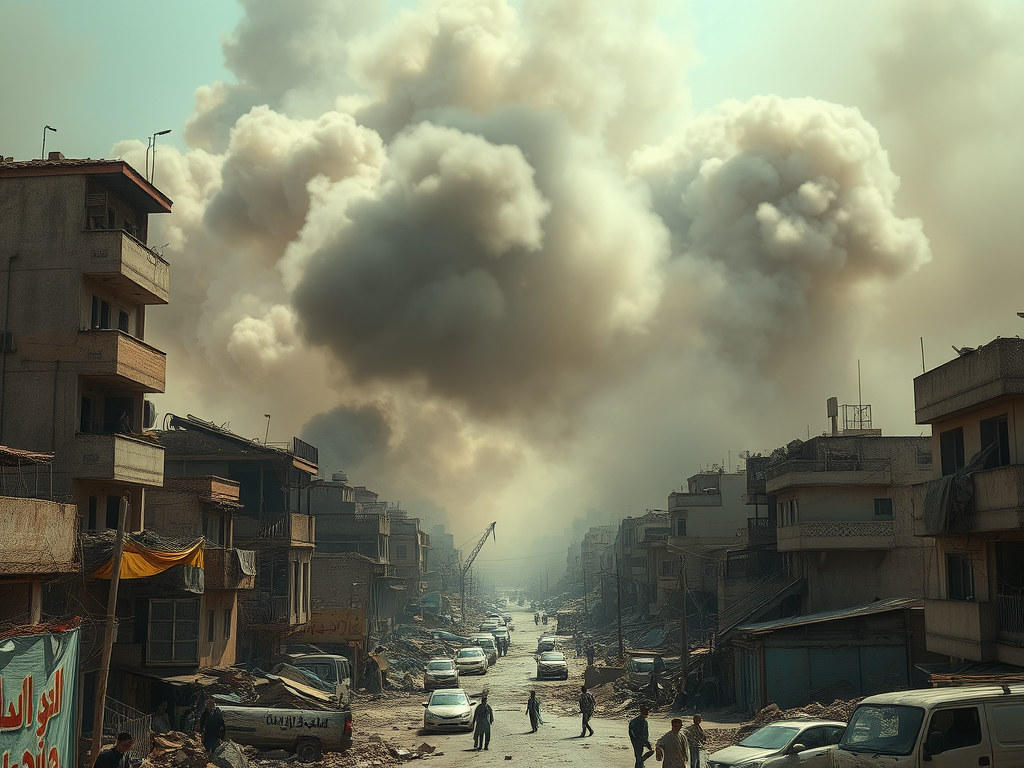

Israeli Military Strikes Near Beirut, Saying Hezbollah Was the Target

On Sunday afternoon, the Israeli military launched an airstrike targeting a residential neighborhood located in the southern outskirts of Beirut, the capital city of Lebanon. This particular area, commonly known as Dahiya, is widely recognized as a stronghold for Hezbollah, the militant group backed by Iran.
Following the airstrike, Israeli Prime Minister Benjamin Netanyahu and Defense Minister Israel Katz issued a joint statement. They confirmed that the operation specifically targeted Hezbollah infrastructure in Dahiya, where the organization holds significant influence. According to Israeli authorities, Hezbollah had been using the site to store precision-guided missiles.
“Israel will not permit Hezbollah to gain strength or pose a threat against it from anywhere within Lebanon,” Netanyahu and Katz declared. “The Dahiya neighborhood in Beirut will not be allowed to serve as a safe haven for the terrorist organization Hezbollah,” they added firmly.
They also emphasized that the Lebanese government carries full responsibility for preventing Hezbollah from carrying out activities that threaten Israel’s security.
At the time, Hezbollah had not issued an immediate response to the attack.

Meanwhile, Lebanon’s President, Joseph Aoun, condemned the Israeli airstrike through the country’s state media. He accused Israel of destabilizing the situation in Lebanon and warned that such actions could escalate tensions, posing serious threats to the overall security of the region. President Aoun called upon France and the United States—nations involved in supporting a cease-fire agreement that mostly halted fighting between Israel and Hezbollah last November—to step in and pressure Israel to halt its military actions immediately.
President Aoun asserted, “The continuous Israeli assaults on Lebanon’s sovereignty and territorial integrity are intolerable under any circumstances.”
Footage circulated on social media platforms and regional news outlets showed thick plumes of smoke rising into the sky following the airstrikes. According to Al-Manar, a Lebanese media outlet affiliated with Hezbollah, the Israeli strikes inflicted “considerable damage” to the surrounding area.
The Israeli Defense Forces (IDF) stated that its air force had targeted a weapons storage facility and claimed that housing missiles at such a location violated the understandings established between Israel and Lebanon. The military said it had taken measures to minimize civilian casualties, including issuing warnings to local residents ahead of the strike and employing precision-guided munitions.
Lebanon’s Civil Defense services later posted on social media, reporting that they were actively working to extinguish fires triggered by the Israeli attack. They noted that ambulances and firefighting teams had been on standby and were able to control the fires quickly, without any injuries being reported.

Earlier that same day, the Israeli military had released a statement confirming a separate operation in southern Lebanon, where it claimed to have killed a Hezbollah operative. According to Israel, the individual had been working to reestablish Hezbollah’s presence in the area, which had previously been disrupted during past conflicts.
Jeanine Hennis-Plasschaert, the United Nations’ senior official in Lebanon, also weighed in on Sunday’s developments. She voiced strong concerns over the Israeli strike near Beirut, posting on social media that the attack had caused widespread panic among civilians and reignited fears of a return to violence. She called on all parties involved to refrain from actions that could undermine the fragile cease-fire.
Although Israeli forces have continued to carry out strikes in southern Lebanon sporadically since the cease-fire took hold, operations in the vicinity of Beirut had largely ceased—until recently. About a month ago, in late March, Israel launched a strike near Beirut in response to a rocket fired into Israeli territory. That incident raised concerns that the cease-fire could collapse.
The broader conflict dates back to October 7, 2023, when Hamas, another Iran-backed militant group allied with Hezbollah, led a deadly assault from the Gaza Strip into Israel, igniting the current war in Gaza. In the days following that attack, Hezbollah began launching rockets into Israel from Lebanese territory. What initially started as sporadic violence eventually escalated into full-scale warfare, including Israeli ground operations inside Lebanon.

In more recent developments, Morgan Ortagus, who served as Deputy Middle East Envoy under President Donald Trump, visited Lebanon to discuss issues surrounding the cease-fire and the country’s urgent need for reconstruction. According to estimates released by the World Bank last month, the war has caused approximately $14 billion in total damage and economic loss. Rebuilding efforts are expected to cost Lebanon around $11 billion, marking the conflict as the most devastating since the end of Lebanon’s civil war in 1990.
Despite promises made by the Lebanese government to bring all weapons under state control—including those held by armed groups such as Hezbollah—there is little clarity on when or how such a goal might be achieved. Hezbollah, although significantly weakened by the recent conflict, continues to maintain considerable political and military influence within Lebanon. The group has reiterated its commitment to the cease-fire agreement with Israel, but skepticism remains high both within Lebanon and internationally regarding its true intentions.
The situation remains extremely volatile, with regional and international actors closely monitoring the developments. The risk of renewed escalation looms large as tensions between Israel and Hezbollah persist, despite the cease-fire framework. Many Lebanese citizens, already struggling under the weight of a prolonged economic crisis, fear that any further military confrontations could tip the nation into even deeper turmoil.
As both sides engage in a delicate balancing act, calls for restraint have grown louder. The international community, especially France and the United States, is under pressure to ensure that the cease-fire holds and that both Israel and Hezbollah avoid provocations that could reignite large-scale hostilities.
Nonetheless, the underlying issues remain unresolved. Hezbollah’s continued armed presence in Lebanon, Israel’s ongoing security concerns, and the fragile state of Lebanon’s political system all contribute to an environment where peace remains precarious and temporary at best.
In the days ahead, how both sides respond—whether through further military actions or diplomatic engagement—will likely determine the future of the cease-fire and the broader stability of the region.




Leave a Reply