
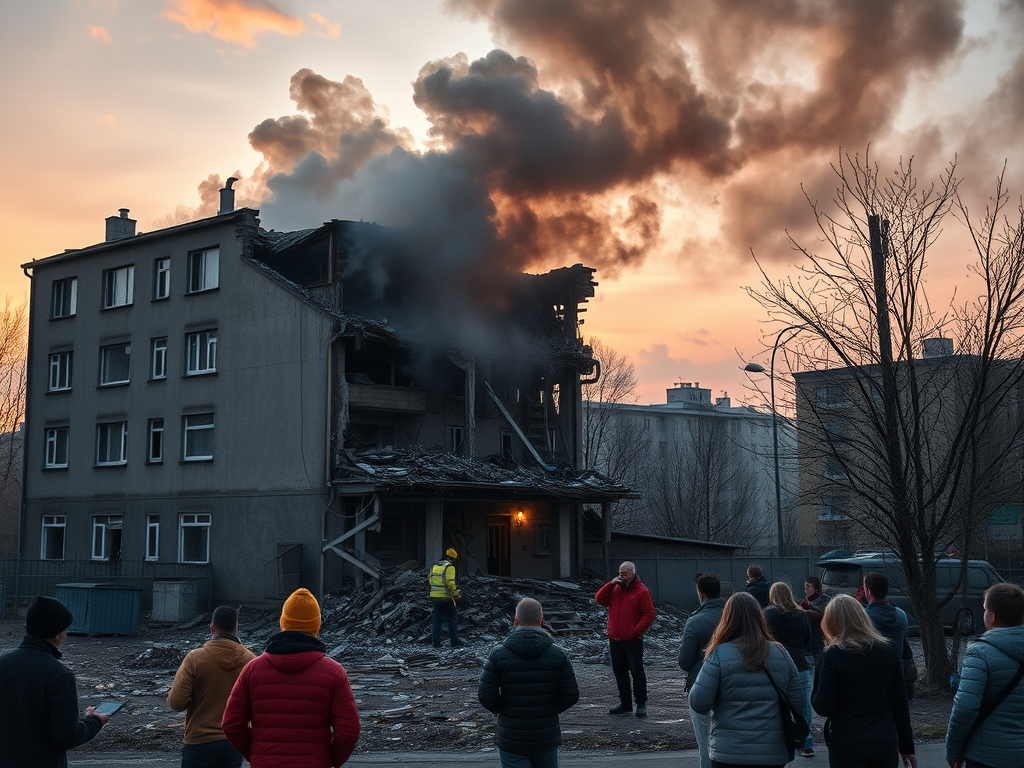

In the early hours of Thursday morning, Ukraine’s capital city, Kyiv, suffered its most devastating assault in nearly a year. The large-scale missile and drone barrage resulted in the deaths of at least 12 people and left more than 90 injured, sending shockwaves through the nation and reverberating across the global political landscape. This deadly event even prompted former President Donald Trump to break from his recent rhetoric and publicly criticize Moscow, just hours after he had chastised Ukrainian President Volodymyr Zelensky.
Russia Pummels Kyiv, Prompting Rare Rebuke From Trump

The attack, which struck while most of the city was still asleep, marked a grim milestone in the ongoing war. Explosions rocked buildings across Kyiv, forcing over 16,000 residents to take refuge in underground subway stations. As dawn broke, plumes of smoke billowed over the city skyline, underscoring the ferocity of the strikes.
One of the missiles directly hit a two-story residential building housing 12 separate apartments. Emergency crews sifted through the wreckage in search of survivors, while the neighboring five-story building was left windowless and partially damaged. Residents gathered outside in shock, many clutching their phones, reassuring loved ones that they were safe. Notably, no military installations or obvious strategic targets were found in the immediate vicinity.
President Zelensky reported that the Russian assault had employed nearly 70 missiles, including ballistic variants, along with approximately 150 attack drones in a coordinated strike on multiple Ukrainian cities. While other areas were hit, Kyiv appeared to bear the brunt of the destruction.
In a follow-up statement posted on social media, Zelensky elaborated that the air assault served as a smokescreen for a broader offensive: Russian forces had simultaneously launched attacks on around 150 frontline positions. He emphasized that the situation was particularly dire near the city of Pokrovsk, a critical logistical node for the Ukrainian military.
Former President Trump, who in recent weeks has pushed for a controversial peace proposal heavily favoring Russia, responded with uncharacteristic sharpness. Posting to his Truth Social platform, he implored Russian President Vladimir Putin to “STOP,” calling the strikes unnecessary and poorly timed. “I am not happy with this,” Trump wrote. “There was no need. Terrible timing.”

Trump’s condemnation came only hours after he and his senior aides publicly urged Kyiv to accept a U.S.-drafted peace plan that would have effectively legitimized all territory currently held by Russian forces. The proposed agreement offered Ukraine vague security guarantees in exchange for major territorial concessions — terms that President Zelensky promptly rejected, insisting Ukraine could not agree to such conditions.
Speaking at a news conference in Pretoria, South Africa — a trip he had cut short due to the crisis — Zelensky said he saw no evidence that Russia was facing serious international pressure to halt its offensive. “With greater pressure on Moscow, we believe a total and unconditional ceasefire would be attainable,” he said. “But this latest attack, to me, looks like a move to pressure the U.S. rather than end the war.”
Zelensky’s remarks came as South African President Cyril Ramaphosa, who appeared alongside him at the news conference, expressed support for Ukraine’s sovereignty. Ramaphosa rejected the notion that any peace talks should be contingent on preconditions and stressed that only inclusive dialogue and adherence to the U.N. Charter could bring a lasting solution.
Since returning to the White House in January, the Trump administration has taken a noticeably softer stance toward the Kremlin compared to the Biden era, at times echoing Russian narratives about the conflict. Over the past several days, the Trump administration has even threatened to withdraw entirely from U.S.-led peace efforts, blaming both sides for being inflexible.

On Wednesday, a planned round of peace talks in London was downgraded significantly after the United States opted not to attend. That same day, Trump described President Zelensky as “provocative,” accusing him of prolonging the “killing field” with his refusal to negotiate on Russia’s terms.
By Thursday, however, Trump appeared to shift tone again. “We have to get this peace deal DONE,” he wrote online. In a subsequent meeting at the White House with Norway’s prime minister, he said, “I have my own timeline” for reaching a peace agreement. “We want this done quickly.”
Trump emphasized that he had no personal loyalty to either Ukraine or Russia, saying his only concern was ending the war and saving lives. He also suggested that Russia had made a “significant offer” to stop the conflict, later clarifying under questioning that Moscow was “willing to stop short of occupying the entire country.”
Zelensky, however, reminded reporters that Ukraine had previously accepted a 30-day ceasefire plan proposed by the United States back in March — a plan Putin never agreed to. While the Russian leader did declare a brief truce for Easter Sunday, Ukrainian officials said it was more a symbolic gesture than a genuine effort at de-escalation. The 30-hour lull had little impact along the front lines, even if missile attacks on civilian areas paused briefly.

But the horrors returned with full force just past midnight Thursday. The first air raid alarms rang out as drones buzzed over Kyiv’s rooftops.
Yevhenii Plakhotnikov, a 40-year-old resident living opposite the apartment building that was hit, described waking to the sound of sirens. As he reached for his shoes, he received a Telegram alert warning that ballistic missiles were incoming. Moments later, an explosion rocked his building.
“I was putting on my second sneaker when I heard the blast,” he recalled. “Then something heavy crashed nearby. The force tore the interior doors off their hinges. When I opened mine, I saw shrapnel flying.”
Plakhotnikov helped evacuate other residents. One man stumbled outside, drenched in blood.
Nearby, 58-year-old Tetyana Hrynenko stood in shock on the sidewalk, covering her mouth as she gazed up at what was left of her fifth-floor apartment. “We’re alive, and that’s what matters most,” she said. She described hearing two massive blasts, followed by thick smoke and the smell of burning. The stairwell in her building had collapsed, but neighbors cleared the debris, allowing residents to escape.
Later that afternoon, dozens of teenagers gathered for a vigil near the rubble. They were waiting for news of 17-year-old Danylo Khudya, known as Danya, who was trapped beneath the wreckage along with his parents. As rescue workers combed through the remains, friends stood in silence, some sobbing, others too stunned to speak.
“I’m waiting for Danya,” said Denys, 19, one of Danya’s close friends. He declined to give his last name.

By early evening, emergency crews discovered the body of a teenage boy matching Danya’s description. A worker approached the gathered students to ask for identifying details. Moments later, he confirmed what they feared. “Your friend is no longer with us,” he said.
The teenagers collapsed into each other’s arms, weeping.
For many survivors, the pain of the attack was compounded by the sense of helplessness surrounding the broader conflict. Though they long for peace, few can accept a deal they believe would reward Russian aggression.
“Last night, I was already frustrated by the stalled negotiations,” Ms. Hrynenko said. “And then it hit me, personally. I feel so tired. So disillusioned.”
Plakhotnikov echoed that despair. “Continuing the war feels pointless,” he said. “But ending it like this — surrendering — is just not possible.”




Leave a Reply