
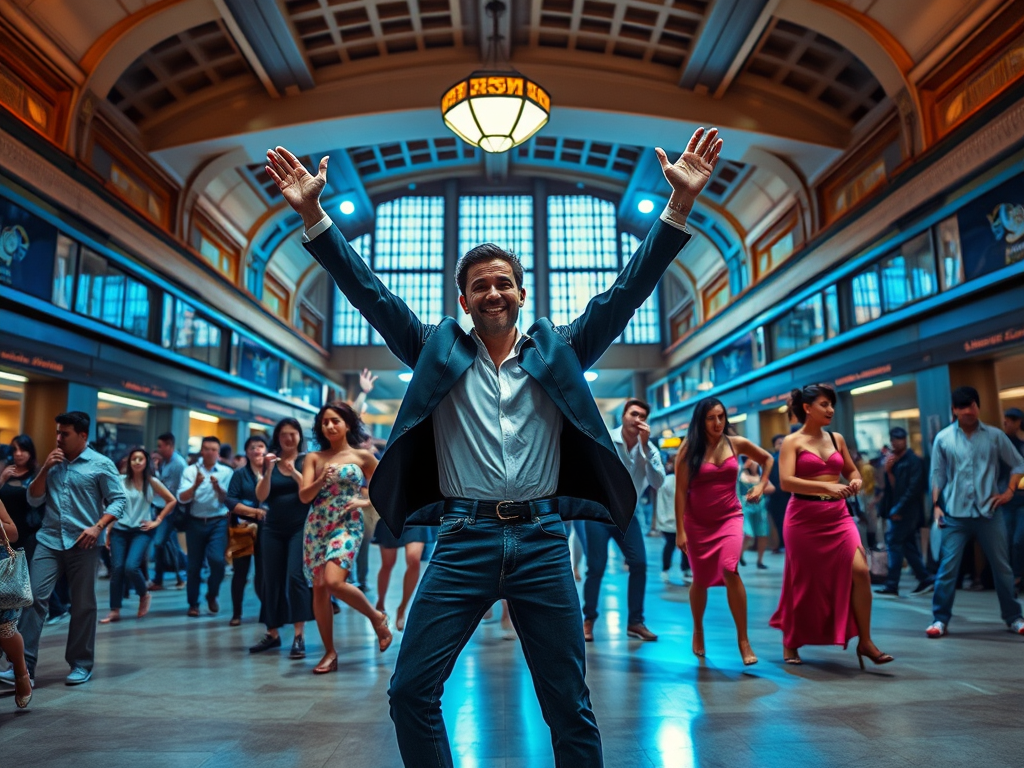

When the train to Ronkonkoma pulled into Penn Station, Jason Lockhorn lifted his arms, elbows bent in a celebratory V-shape. But he wasn’t cheering for a sports team or signaling frustration at a delayed ride. He was dancing — and in the middle of a bustling train terminal.
Penn Station’s Not-So-Secret Other Life: The People’s Dance Studio

Lockhorn wasn’t alone in his rhythmic celebration. Not far from him, a couple moved gracefully to the sensual flow of Brazilian Zouk, a partner dance that prioritizes fluidity and connection. Nearby, groups of K-pop dancers synchronized their movements with precision, their coordinated spins and sharp hip sways commanding attention even in a space designed for transit, not performance.
Travelers stepped out of elevators and escalators, some pausing in curiosity, others weaving through the crowd with suitcases in tow. For those passing through the terminal, it was an unexpected performance. For the dancers, it was just another day in what has become their unconventional rehearsal space.
“This is where New York’s cultural energy converges in motion,” said Lockhorn, 24. “If you want to see what this city is made of, through dance, you don’t have to look further than here.”
Though known as one of the busiest commuter hubs in the U.S., Penn Station has unexpectedly evolved into a popular dance venue. The unlikely studio is located in the West End Concourse, a wide, open hallway connecting Moynihan Train Hall to Tracks 7 through 16 of the Long Island Rail Road. Its appeal? Accessibility, open space, smooth flooring — and no rental fee.
This stretch of corridor has organically become a magnet for dancers of all styles: from high-energy hip-hop crews to elegant salsa duos and K-pop enthusiasts who practice polished choreographies. Mirrored windows reflect the dancers’ every move, providing a makeshift studio vibe. Overhead, blue lighting adds a stylish glow that enhances video recordings. In a city where dance studio space is expensive and limited, this corridor offers something invaluable: freedom.

Lockhorn is the leader of the Foolish Funkateers, a group specializing in Campbellocking — a funk-inspired style from the 1970s that emphasizes rhythm, freezes, and expressive gestures. He and his team started using the concourse last year after seeing videos of other dancers on social media practicing in the same spot. When weather allows, they prefer dancing outdoors near City Hall. But when it’s too cold or rainy, the concourse becomes their indoor fallback.
“This is our go-to space when the streets aren’t an option,” Lockhorn said.
Different groups tend to claim their territory along the corridor, usually occupying a space that spans the width of one or two train tracks. The slanted windows provide not only visual aid but also a resting place for water bottles, Bluetooth speakers, and phones propped up to record the routines.
Destiny Rodriguez, a K-pop dancer and member of V3RS Crew NYC, noted that while the noise level in the concourse isn’t ideal, it hasn’t stopped them from making it work. “It’s louder than a traditional studio,” she said, “but we still manage to rehearse well and get our choreo sharp.”
The concourse doesn’t pretend to replace a professional studio, with its soundproofed walls and floor-length mirrors. But in Manhattan, where renting a studio can cost anywhere between $35 to $150 an hour, dancers — especially those who are unpaid — are often priced out. Most of them are students, baristas, retail workers, or creatives hustling multiple gigs. In that context, a free space with decent lighting and foot traffic becomes a dream come true.
And there’s another perk no dance studio can match: a constantly changing live audience.

Luke Fletcher, visiting from Boston with his 15-year-old son, was pleasantly surprised to witness dancers in action while waiting for their train. “It’s incredible to see this happening in the middle of the week,” he said. “You don’t expect a dance show in a place like this.”
Kai Fritz, a 22-year-old barista and K-pop dancer with the Not Shy Dance Crew, regularly travels from Flatbush in Brooklyn to Penn Station, even after a 5 a.m. shift making coffee in Bensonhurst. After a quick break at home to stretch and refuel, Fritz heads to the concourse to meet with their group.
“My paycheck isn’t enough to cover studio space,” Fritz said. “This place is the most realistic option for us.”

Beyond cost and convenience, the physical space of the concourse is a huge advantage. Paula Naconecy, a Brazilian Zouk dancer, praised the floor’s consistency. “It’s smooth — not slick, but just right,” she said. “No cracks, no tiles. I’ve looked all over the city for a good surface, and this is the best I’ve found.”
Salsa dancer Lizbeth Lucana agreed. She commutes in from Long Island multiple times a week to rehearse with her partner, Jacob Aliapoulios. Together, they log more than 20 hours of practice in the concourse weekly.
“I’m wearing proper salsa shoes, and here I can spin with ease,” Lucana said. “It makes a huge difference when you’re training intensively.”
Interestingly, the dancers’ presence isn’t officially approved or condemned by transit authorities. The Metropolitan Transportation Authority (MTA) acknowledges the concourse is, first and foremost, a transit space.
“As long as people follow the general rules and don’t obstruct passenger flow or block access to platforms, we typically don’t intervene,” said Aaron Donovan, deputy communications director for the MTA.
Still, the gray area of their presence means interactions with station security can be unpredictable. Naconecy recalled being asked to stop filming during practice, and Fritz noted that their crew has occasionally been told to lower the volume of their music. But for the most part, the dancers are left alone.

The jurisdiction over the concourse is somewhat tangled. Penn Station is owned by Amtrak, but the West End Concourse is managed by the Long Island Rail Road. Each agency has its own policies, and the nearby subway system adds another layer of complexity. Unlike subway buskers who must apply for permits to perform, the dancers at Penn Station fall into an undefined space — not quite street performers, not quite commuters.
But that suits them fine. They don’t dance for donations or tips. They do it for the love of movement, the joy of collaboration, and the energy of the city.

Aliapoulios, 32, paused to catch his breath between routines, glancing at the dancers twirling around him and the steady stream of commuters hustling by.
“You really feel like you belong to New York when you’re here,” he said with a grin.
In the middle of chaos, a community has formed — one pirouette, spin, and shuffle at a time.




Leave a Reply