
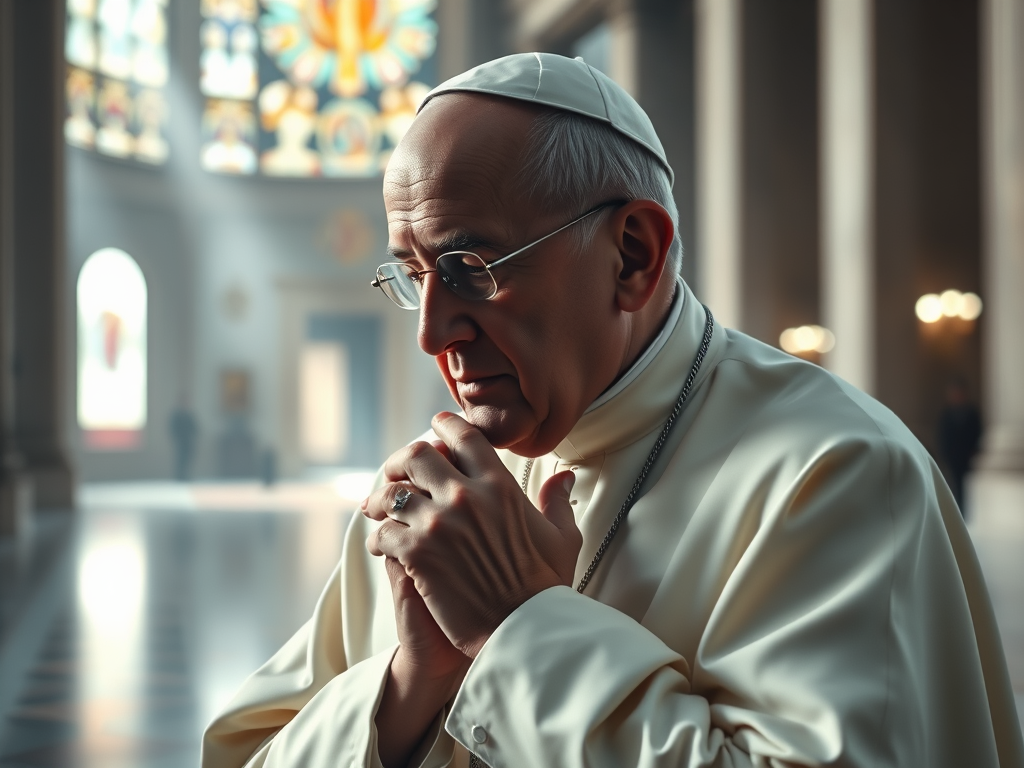

Francis’ Death Silences a Voice for the Voiceless

In recent years, as the world that Pope Francis envisioned — one rooted in compassion for migrants, stewardship of the Earth, and protection of human rights — began to unravel, his response to each fresh disappointment was increasingly marked by silence.
Archbishop Paul Gallagher, the Vatican’s Secretary for Relations with States and a trusted advisor to the Pope, explained it succinctly: “When Francis felt disheartened by certain governmental decisions, he would often fall into a contemplative quiet.” That silence, once an occasional response, has now become final.
Pope Francis passed away on Monday morning, leaving a world that is starkly different from the one he entered when he assumed the papacy in 2013. His death signifies the loss of a steadfast moral voice, one that consistently championed society’s most vulnerable members. In a time when mass deportations are increasingly normalized, authoritarian tendencies are on the rise, and the alliances formed in the wake of World War II are rapidly shifting, Francis’ absence is deeply felt.
When he first appeared on the balcony of St. Peter’s Basilica over a decade ago, Pope Francis joined the global stage during an era of relatively aligned values. World leaders such as U.S. President Barack Obama and German Chancellor Angela Merkel shared a common concern for issues the Pope prioritized: climate change, refugee welfare, and social justice. Today, as arrangements for his funeral take shape, those filling the pews will largely represent a new wave of political leadership whose ideologies diverge sharply from Francis’ own — among them, U.S. President Donald Trump and Argentina’s President Javier Milei.

As progressive leaders gradually disappeared from the international stage, Francis remained a solitary figure advocating for compassion, inclusiveness, and humility. Now that he is gone, many wonder who — if anyone — will step in to carry his legacy forward.
“His voice is missing — and people are beginning to realize how much it mattered,” said Archbishop Gallagher. He had recently met with U.S. Vice President JD Vance in Rome, using the opportunity to emphasize the Vatican’s deep concerns regarding the treatment of migrants and refugees. “It was one of the very few moral compasses left that people across the globe could still look to,” he added. “Now, a new kind of global instability is settling in.”
Pope Francis never limited his concern to the poor or displaced alone. He used the massive platform afforded to him as leader of more than a billion Catholics to critique world leaders who, in his eyes, scapegoated immigrants and marginalized communities for political gain. His papacy was marked by repeated calls for empathy and equitable treatment of all people, often placing him at odds with powerful political figures.

Throughout his tenure, Francis didn’t shy away from calling out injustices, even when it meant directly challenging national policies. In February, before falling ill, he criticized former President Trump’s aggressive deportation tactics. In a letter to American bishops, he wrote, “What is built on force, and not on the truth of the equal dignity of every person, is doomed from the start and will end in failure.”
During what would be his final public appearance — the traditional Urbi et Orbi Easter message delivered from the balcony of St. Peter’s — Pope Francis lacked the physical strength to speak. Instead, a fellow prelate delivered his words, reaffirming his unwavering concern for migrants, the victims of war and violence, and the troubling resurgence of anti-Semitism worldwide.
Yet despite his persistent warnings, the world often failed to act on his counsel.
Cardinal Michael Czerny, a trusted aide who helped draft many of Francis’ key encyclicals, especially those on environmental concerns, described him as a “prophetic voice.” But, he admitted, this voice was frequently “applauded more than it was heeded.” Even leaders who outwardly praised the Pope — such as President Obama — ultimately pursued policies that conflicted with Francis’ vision.
From the earliest days of his papacy, when he visited migrant camps in southern Italy, Pope Francis urged nations to adopt more humane approaches to migration. Yet, during the same years, anti-immigrant sentiment gained traction across Europe, fueled by nationalist rhetoric and public frustration over economic inequalities. As right-wing populism surged, Francis warned repeatedly of authoritarianism’s return and of history’s darker chapters threatening to repeat themselves.

By the end of his pontificate, nationalist parties had won significant influence in European politics, and former President Trump — whose brand of Christianity Francis once questioned — had returned to the political forefront.
Despite these trends, Francis never seemed to be angling for political alliances. His concern was never with power, but with people. He remained, as Cardinal Czerny noted, deeply connected to the plight of the poor, the migrant, and the disenfranchised. “He had a rare gift — an ability to grasp the reality most people lived in,” Czerny said. “And he became a trusted voice for those who felt forgotten by society.” His successor, Czerny added, will likely struggle to replicate that same moral clarity and empathetic resonance.
Cardinal Anders Arborelius of Sweden also emphasized how critical Francis’ role was in an increasingly fragmented world. “His message became more urgent as the global political climate shifted,” he said. “He helped the Church recognize that it must always be the voice for those who have none.” Yet, he conceded, speaking up for the voiceless may become significantly more difficult moving forward.
Just hours after the Vatican confirmed the Pope’s passing, a sense of loss began to settle over those who had aligned with his mission. At St. Peter’s Square, 64-year-old Pino Caporale, who runs a soup kitchen in Rome, arrived with a migrant he had helped. “The poor, the migrants, the imprisoned — Pope Francis was their shepherd,” Caporale said. “His death leaves an enormous void. In a world where too many leaders sow discord, he stood alone — but he stood firm.”

Amy Pope, Director General of the International Organization for Migration, called Francis “a beacon of moral clarity” and “a relentless advocate for the rights of migrants and victims of injustice.” She hoped that “his legacy of compassion and human dignity would continue to guide the world.”
Others worried that without Francis, global attention might shift away from the vulnerable. Anthony Ssembatya, a 38-year-old researcher from Uganda visiting the Vatican, expressed concern: “Now that he’s gone, who will speak for the migrants dying at sea trying to reach Europe?”
Yet Archbishop Gallagher emphasized that Francis’ quiet in the face of setbacks never stemmed from despair. The Pope, he said, viewed each challenge as a reminder of human limitations and the need for perseverance. “He accepted the way things were,” Gallagher explained. “He saw setbacks not as endings but as chapters in an unfolding story.”
“He would say, ‘This is the reality we’re facing. Now let’s get to work — let’s try to build again, even if we’re starting from the rubble.’”
In the end, Pope Francis leaves behind not only a legacy, but also a challenge. A challenge to global leaders, to the faithful, and to all people of goodwill: to listen more deeply, to care more broadly, and to never forget the dignity of those on the margins. His voice may be silent now, but the echoes of his message still ring — if the world is willing to hear them.


Leave a Reply