
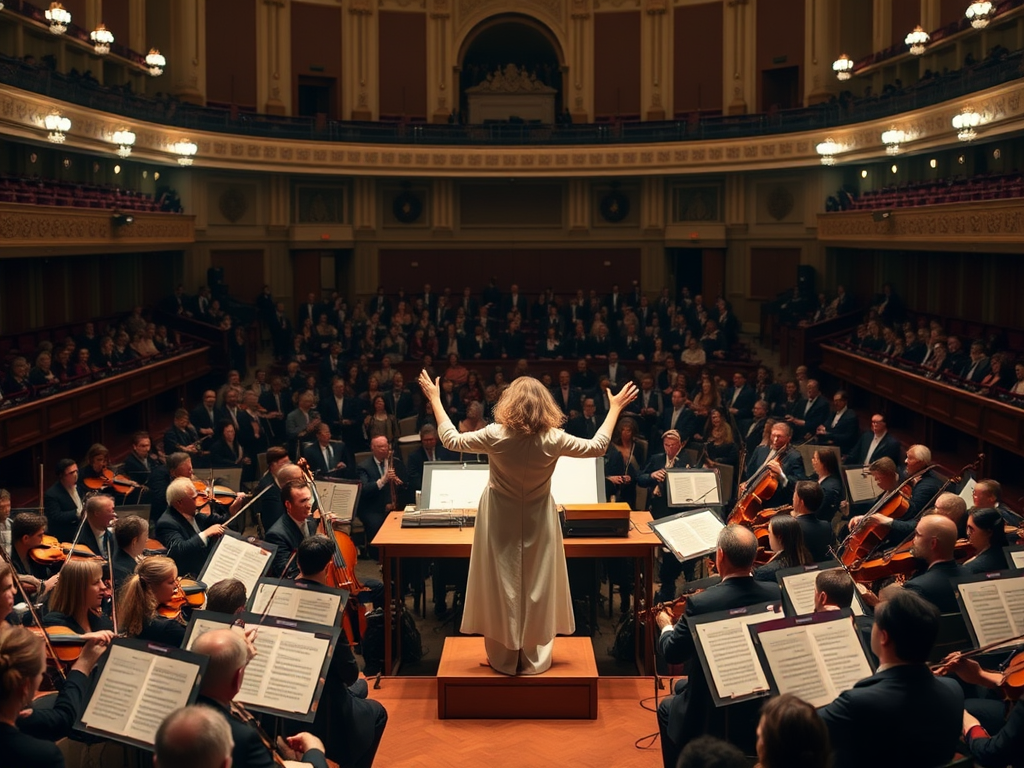

A New Conductor Isn’t Daunted by the Size of the Met

Stepping into the vast expanse of the Metropolitan Opera House can unsettle even the most seasoned artists. The sheer size — the broad proscenium arch, the immense distance between conductor and singers, the monumental scale of the orchestra pit — creates unique challenges. The Met is not a place where opera can afford to spiral into disarray, particularly for productions that demand pinpoint timing and finely tuned coordination. Mozart’s The Marriage of Figaro, a work of fast-paced humor and intricate ensemble work, is one such piece. It calls for a conductor with a firm grasp of both detail and drama — someone who can harness the musical forces spread across this sprawling stage.
This makes Joana Mallwitz’s recent debut at the Met all the more remarkable. At just 37 years old, the German conductor is already earning a reputation for her insight and authority, and her leadership of Figaro confirms why. With the current run continuing through May 17, Mallwitz has proven herself more than equal to the challenge. Her interpretation is elegant and assured, managing the orchestra and singers with balance, grace, and a clear artistic vision.

From the opening bars of the overture — brisk, sparkling, and rhythmically tight — Mallwitz established a tone of crisp energy. But it wasn’t merely speed or volume that defined her approach. Rather than opting for exaggerated dynamics or rushed tempi to create drama, as some younger conductors are prone to do, she maintained a measured pace, trusting the music’s natural wit and emotional complexity to shine through. Her control was not rigid but flexible, allowing the performance to breathe while never veering off course.
Throughout the evening, the orchestra under her baton played with a light touch, its sound airy and transparent. This delicate approach let the singers’ voices blend seamlessly with the instrumental lines, rather than be drowned by them. The woodwinds in particular, especially during Cherubino’s tender arias, were notable for their warmth and expressiveness. In “Non so più,” the winds didn’t merely accompany the teenage page’s confusion — they seemed to sigh and flutter with him, adding emotional depth to his romantic confusion. And in “Voi che sapete,” the pizzicato strings were unified and subtle, gently underscoring the character’s naïve yearning.
What stood out most in Mallwitz’s Figaro was the sense of cohesion. She displayed a sophisticated understanding of Mozart’s musical architecture — how scenes ebb and flow, how tension builds and releases. Nowhere was this more evident than in the long and riotous second-act finale. It’s a sequence notorious for its complexity: overlapping voices, abrupt shifts in mood, and a constantly evolving dramatic situation. Mallwitz paced it masterfully, avoiding chaos while still maintaining the momentum and sparkle that the music demands. Her restraint and precision made the farcical climax feel not only funny, but musically rewarding.
This revival of The Marriage of Figaro is part of a larger rotation of classic works at the Met this season, sharing the stage with Rossini’s The Barber of Seville — the narrative prequel to Figaro — and another Mozart favorite, The Magic Flute. While each of these operas brings its own character and challenges, they all benefit from conductors who understand the value of clarity over spectacle.

On Wednesday night, The Magic Flute received just that kind of thoughtful direction from Evan Rogister. His reading was unforced and natural, allowing the music’s charm to emerge without pushing too hard. There was a sense of cheerful ease in his conducting — a kind of musical smile that supported the production’s lighter moments without sacrificing musical integrity.
However, the staging of The Magic Flute, directed by Simon McBurney, seemed to have lost some of its original freshness. When it first arrived at the Met two years ago, the production’s playful use of live animation, sound effects performed onstage, and metatheatrical flourishes felt imaginative and bold. Now, with the novelty somewhat faded, the production comes across as cluttered. The mix of modern clothing, live drawing projections, sound technicians in view, and sporadic audience interaction feels less like a coherent artistic vision and more like a series of disconnected ideas. Papageno’s costume — a worn blue and yellow vest — subtly references Ukraine’s national colors, but broader symbolic gestures remain vague.
Musically, there were also uneven moments. Stephen Milling’s Sarastro lacked the deep, resonant bass voice that lends gravitas to the character’s music, and Thomas Oliemans as Papageno, while comically appealing, did not quite project the vocal fullness needed to fill the house. Still, the production had its vocal highlights. Tenor Ben Bliss and soprano Golda Schultz were in excellent form as the romantic leads, their duets delivered with lyricism and tenderness. Kathryn Lewek, one of the definitive Queens of the Night in recent years, dazzled with her precise, stratospheric coloratura — executing the role’s famously difficult arias with both technical brilliance and expressive nuance.

Returning to Figaro, the production itself — directed by Richard Eyre — has now been in the Met’s repertoire for a decade. Its setting relocates the story to 1930s Spain, a choice that adds a touch of visual flair through period costumes and architecture without significantly altering the opera’s themes. The set, with its cylindrical rooms and ornate Moorish-inspired woodwork, is elegant and functional. The visual language, inspired by the photography of Jacques-Henri Lartigue, evokes a refined but emotionally complex domestic world — fitting for an opera about desire, deception, and shifting power dynamics between upstairs and downstairs.
The cast assembled for this revival is youthful and well-balanced. Soprano Federica Lombardi gave the Countess a dignified sadness, with a voice that floated effortlessly through her arias. As Susanna, Olga Kulchynska sang with both charm and wit, making her one of the evening’s standouts. Baritone Michael Sumuel portrayed Figaro with geniality rather than bravado, offering a portrayal that emphasized good humor over bluster. Sun-Ly Pierce brought vocal finesse to the role of Cherubino, while Joshua Hopkins’ Count Almaviva was more bewildered than menacing, a man slowly realizing that the world — and the women — around him are no longer so easily controlled.
Individually, none of the performances were jaw-dropping. But taken together, under Mallwitz’s firm and graceful guidance, they combined into something quietly special. The production never felt forced or self-important. Instead, it radiated a gentle vitality — a sense that everyone involved was committed to serving the opera with respect and joy.
Ultimately, it was Mallwitz’s poised leadership that made the evening memorable. She didn’t resort to theatrics or overstatement. Her achievement was subtler, yet no less significant: she made the complex machinery of a large-scale Figaro feel effortless, guiding the performance with intelligence, sensitivity, and style. For a debut on one of opera’s biggest stages, it was an outstanding showing — and a sign that this rising conductor has an exciting future at the Met and beyond.




Leave a Reply