

Rashid Johnson Finds His Promised Land at the Guggenheim

Frank Lloyd Wright, the iconic American architect, was never fond of urban congestion. He thrived on open spaces and lush natural surroundings, which inspired much of his architectural philosophy. So in 1943, when the Solomon R. Guggenheim Foundation invited him to design a new museum in New York City, Wright initially resisted the idea of situating it in Manhattan. His preference was for a serene site in the Spuyten Duyvil neighborhood of the Bronx, an elevated, green space overlooking the Hudson River, far from the bustling downtown.

The Foundation, however, had other ideas. They purchased a plot on Fifth Avenue, right in the heart of Manhattan. While Wright didn’t get his way regarding location, he made sure to incorporate the feeling of nature into the museum’s design. The result: an iconic spiraling structure resembling an inverted ziggurat, crowned with a massive skylight. This central oculus would flood the building’s rotunda with natural light, creating an environment where both plant life and art could thrive under one roof.
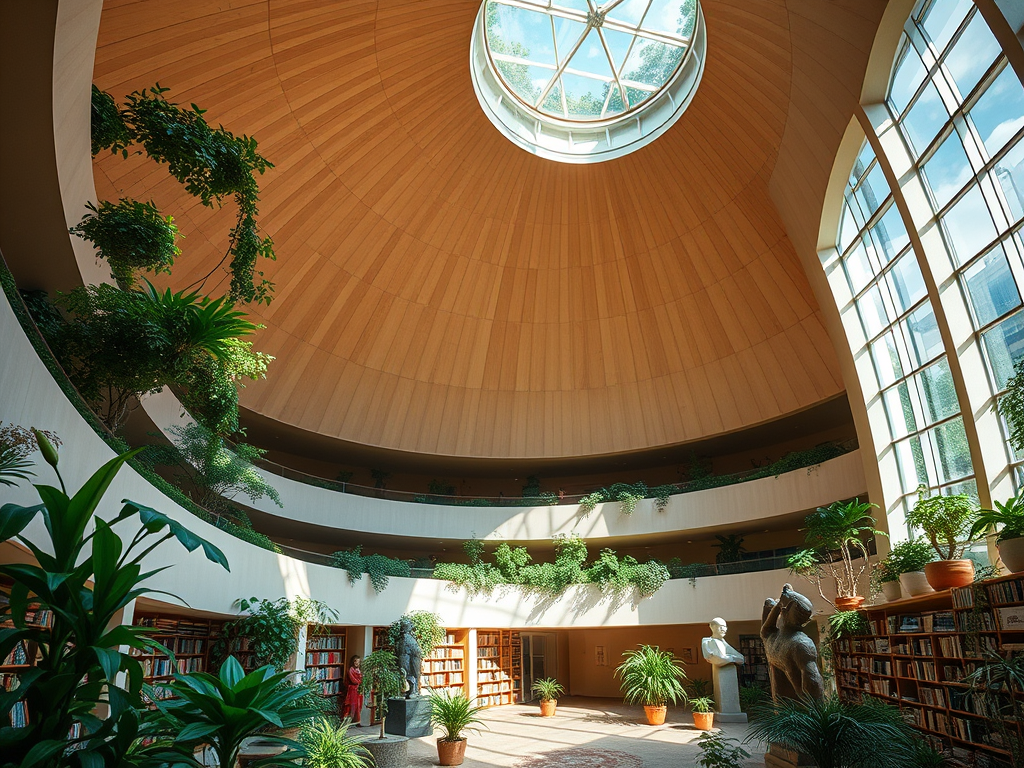
Today, that vision has taken on new meaning with the museum’s current exhibition, Rashid Johnson: A Poem for Deep Thinkers. This show makes poetic use of Wright’s oculus. Situated at the museum’s highest point is an immersive installation that evokes growth and introspection. Shelving units packed with thriving houseplants, books, sculptures, and cultural objects form a kind of indoor greenhouse under the natural light of the skylight above. The space feels simultaneously contemplative and alive, a meditative ending to an emotional journey through the spiral gallery.


Born in 1977, Rashid Johnson grew up in the Chicago area in a middle-class Black family. His mother, Cheryl Johnson-Odim, is a distinguished scholar specializing in African and African American history. His father, Jimmie Johnson, is a practicing artist who supported himself through work in the electronics business. Although his parents divorced when he was just two, Johnson remained closely connected to both his intellectual and creative roots.
As a teenager, Johnson was deeply influenced by the explosion of Black popular culture in the 1990s. Hip-hop music, soul, Spike Lee’s films, and television shows like The Cosby Show played a major role in shaping his worldview and artistic imagination. His desire to become an artist was clear early on, and he pursued it with determination, eventually earning a graduate degree from the School of the Art Institute of Chicago. He began his career in photography, though his creative reach would eventually extend across numerous disciplines.
The exhibition opens with some of Johnson’s earliest photographic works from 1998 — intimate portraits of homeless men in Chicago. Rendered using the 19th-century Van Dyke Brown printing process, the images are rich in earthy tones and shadow, evoking a sense of quiet dignity. In later pieces, Johnson turns the camera on himself, often referencing prominent historical figures. One 2003 piece, Self-Portrait With My Hair Parted Like Frederick Douglass, is a thoughtful blend of homage and personal identity.

Johnson’s work often straddles the line between the profound and the playful. This ambiguous tone has led some critics to underestimate the political weight of his art, labeling it as elusive or inconsistent. But ambiguity is precisely the point: Johnson’s practice thrives on multiple meanings, offering viewers no singular interpretation. This approach aligns him with the “post-Black” generation of artists — a term coined by curator Thelma Golden in her groundbreaking 2001 exhibition Freestyle at the Studio Museum in Harlem. The show introduced a cohort of young Black artists who were redefining racial identity in personal, abstract, and critical ways. Johnson, then only 24, was among them.
Over time, Johnson’s art has grown increasingly multidisciplinary. While photography remains an important foundation, he has embraced painting, sculpture, video, installation, performance, and even mosaic. His mixed-media works, though sometimes described as chaotic or scattered, are actually densely layered expressions of personal and collective history.


In painting, Johnson continually reinvents his style. Some of his works, like the Soul Paintings, feature mask-like imagery in oil on canvas. Others take on a more direct, text-based approach — words like “Run,” “Promised Land,” and “Stay Black and Die” are spray-painted graffiti-style on mirrors. In 2008, he created a series of abstract paintings using a blend of African black soap and wax. By 2019, he began experimenting with painting on cracked ceramic tiles, adding texture and sculptural depth.
These tile works resemble mosaics and often incorporate found objects such as mirror shards, shells, wax, and cast bronze. They are visually striking and blur the line between painting and sculpture, evoking comparisons to the late artist Jack Whitten, whose innovative mosaics are currently being celebrated in a MoMA retrospective.
The sculptural installations in the exhibition are among Johnson’s most compelling pieces. One standout, Post Prison Writings, pays tribute to revolutionary thinkers Frantz Fanon and Eldridge Cleaver. Another powerful work, Triple Consciousness, takes its title from W.E.B. DuBois’s theory of Black identity. This assemblage places three images of singer Al Green — lifted from his 1975 Greatest Hits album cover — on a high shelf, flanked by candlesticks like sacred icons. Below, small bowls hold African shea butter, a recurring symbol of healing in Johnson’s work.

In contrast, Fatherhood as Described by Paul Beatty carries a darker tone. Constructed from scorched wooden floorboards, it centers on a haunting 1950 photo by Elliott Erwitt of a Black child playfully holding a toy gun to his head. The sculpture exudes tension, reflecting themes of trauma and resilience in Black fatherhood.
Although these sculptural works were made within a narrow timeframe (2009–2011), the curators wisely dispersed them throughout the exhibition instead of grouping them together. The same curatorial logic applies to the mosaics and abstract paintings — by distributing them across the spiral, each piece is allowed to stand on its own, rather than blending into a repetitive whole.
The show, while loosely chronological, does not rigidly adhere to a timeline. This fluid structure, crafted by curators Naomi Beckwith, Andrea Karnes, and Faith Hunter, mirrors the ever-evolving, multifaceted nature of Johnson’s practice. It presents his career as a dynamic continuum rather than a linear progression.
At the top of the museum, beneath the expansive oculus, the mood lightens. The artworks here — recent oil paintings with titles like Soul Painting, Surrender Painting, and God Painting — are serene and luminous. A short video titled Sanguine adds an emotional touch. It features Johnson, his father, and his son at home, reading peacefully, then donning African masks, and finally walking along a beach together. The word “sanguine” — which can mean both a reddish hue and an optimistic state of mind — perfectly captures the mood.


One of the most touching moments in the video is a scene in which Jimmie Johnson offers a bouquet of radiant flowers to the viewer, as though extending a gift. The gesture echoes the exhibition’s central installation: a vibrant indoor garden filled with books, sculptures, and plants. Inspired by poet Amiri Baraka, whose work lends the show its title, this living sculpture embodies Johnson’s artistic spirit and nods to Wright’s original intent — to make a space where life and art could grow together.
The exhibition is slated to run for an extended period — until January 18, 2026. The museum, still recovering from pandemic-era financial challenges and staff reductions, is experimenting with longer, more cost-effective shows. To keep things fresh, the Guggenheim will host a range of performances throughout the exhibition. Musicians and spoken-word artists will activate the space, especially the top-floor greenhouse, where a piano already sits in anticipation.
Whether these efforts will succeed in attracting new visitors or encouraging repeat attendance remains to be seen. But the Guggenheim’s decision to use its galleries as a platform for living, evolving creativity — rather than solely preserving the past — feels timely and courageous.




Leave a Reply