

Europe Seeks a Direct Line to Trump, Skeptical That Aides Speak for Him

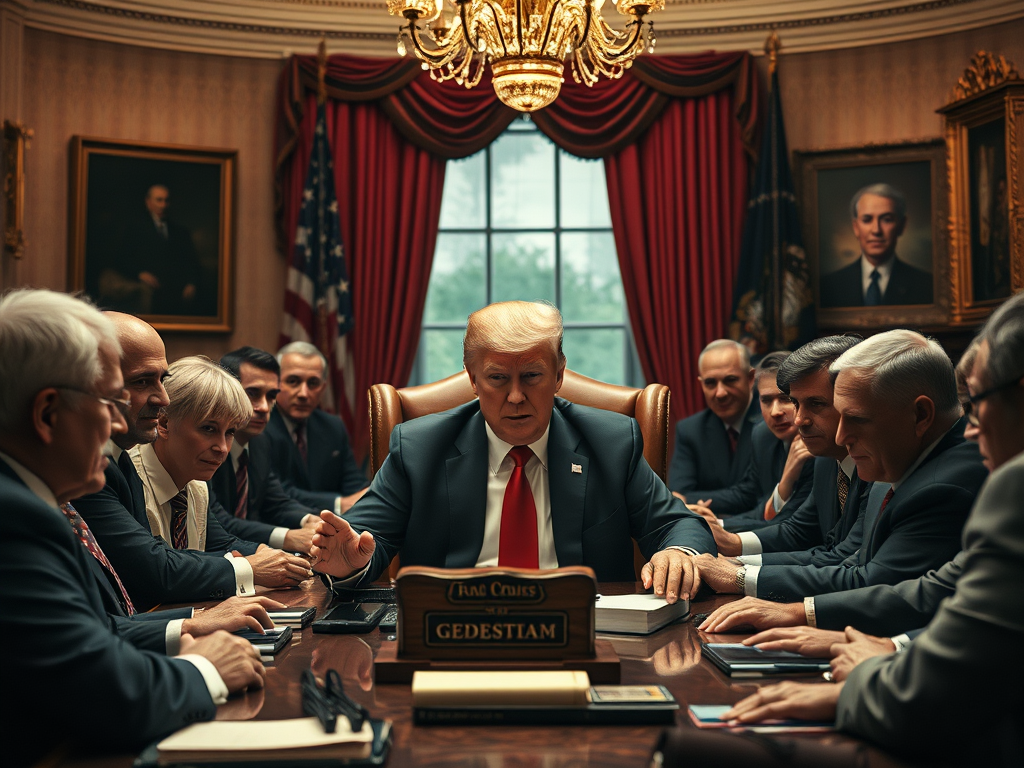
For many of America’s European partners, the current White House under President Trump resembles more of a royal court than a traditional executive office. The Oval Office — ornate and guarded — serves as a stage where friends, loyalists, and advisers gather, all vying for attention and decisions from a president known for his unpredictability and unilateral authority.
President Trump remains the key decision-maker on virtually every issue, and his choices are often difficult to anticipate. As a result, European leaders have spent the early months of his administration working tirelessly to establish direct lines of communication with him. Among those who have managed to secure a coveted audience is Italian Prime Minister Giorgia Meloni, who is expected to meet with the president at the White House on Thursday.
What has unsettled many European diplomats is the unconventional nature of Trump’s inner circle. Rather than relying on formal diplomatic channels or institutional representatives, the administration often turns to personal advisers or informal envoys — figures like Elon Musk or Steve Witkoff — to relay messages and engage in sensitive negotiations. Whether or not these unofficial intermediaries convey information effectively or even accurately is unclear. Yet, Trump appears to favor them over the career diplomats he frequently disparages.

“Everyone in D.C. says the only way to make progress is by speaking to Trump directly,” a high-ranking European official remarked.
While many Trump officials are courteous in their demeanor, European representatives say they often seem more focused on executing Trump’s directives than fostering cooperation with allies. A notable example is the recent reopening of nuclear discussions with Iran — a development that caught key European nations off guard. Despite being original signatories to the 2015 nuclear agreement, the UK, France, and Germany were not informed in advance, even though they had played a central role in brokering the initial deal and continue to push for diplomatic progress.
Despite being home to nearly 750 million people and forming one of the world’s most influential economic blocs, the European Union does not appear to be a central concern for Trump. In fact, he often regards the EU more as a competitor or even a foe than as a partner, believing it was established with the intent of disadvantaging the United States.
“The administration shows little interest in our views,” another European official explained. “They operate unilaterally and see little value in consulting with us. If we aren’t seen as true allies, why would they?”

In an effort to gauge the current state of transatlantic relations, The New York Times spoke to European officials across several major capitals — Berlin, Paris, London, Brussels, and Rome. Most of these individuals requested anonymity, as they were not authorized to speak publicly about diplomatic engagements.
Privately, European diplomats say that members of the Trump administration often offer assurances about their commitment to transatlantic unity, NATO, and shared defense responsibilities. Figures such as Secretary of State Marco Rubio and Vice President JD Vance have reinforced these messages in meetings, which, according to one American official, are generally respectful and civil. Recently, Rubio and Witkoff traveled to Paris for high-level talks with French authorities on ending the conflict in Ukraine.
Yet despite these gestures, it remains unclear whether either Rubio or Witkoff possesses significant influence over foreign affairs. Publicly, both have made inflammatory comments about U.S. allies — seemingly to align themselves with Trump’s rhetoric — while European officials have mostly stayed silent to avoid triggering presidential backlash.

Europe’s access to Trump’s foreign policy circle is uneven. Some officials can engage with individuals like Michael Waltz, the national security adviser, or special envoys such as Keith Kellogg. However, these individuals often juggle numerous responsibilities, making sustained communication difficult. Witkoff, for example, lacks an official counterpart in European institutions, making coordination ad hoc at best. Meanwhile, Waltz has grown more guarded, particularly after inadvertently adding a journalist to a secure group chat for top Trump advisers — a mishap that raised eyebrows in diplomatic circles.
Traditional diplomatic routes — via embassies, the State Department, or the National Security Council — have yielded limited results. Part of the issue lies in the Senate’s slow confirmation of key officials. Although such delays are not unusual in the early stages of a new administration, they create bottlenecks in international engagement. Moreover, lower-level political appointees, who bypass the confirmation process, often appear more ideologically aligned with Trump’s “America First” doctrine.
Officials at the Pentagon, meanwhile, are reportedly treading carefully when speaking with foreign counterparts, afraid of missteps that could lead to dismissal. One senior British defense official expressed frustration, saying it was unclear who currently leads U.S. strategy in the Indo-Pacific — an area of growing strategic importance for the UK.
Trump’s skepticism of multilateralism remains a defining feature of his presidency. He views institutions like the European Union and NATO with deep suspicion, considering them impediments to American sovereignty rather than assets of shared global order. As a result, his administration frequently sidelines multilateral organizations, even those established by U.S. leadership in the post-war era.

This stance has trickled down to Trump’s cabinet. In February, Secretary Rubio declined a meeting with Kaja Kallas, the EU’s foreign and security chief, who supports a tougher stance on Russia. Other European officials have struggled to secure time on the president’s calendar. Despite multiple attempts, European Commission President Ursula von der Leyen has yet to meet with Trump. A spokesperson for the Commission confirmed that no meeting had occurred so far.
With formal channels yielding little progress, European leaders are turning to bilateral engagements to break through the White House barrier. Giorgia Meloni, the sole EU leader invited to Trump’s inauguration, persisted for weeks before finally arranging her White House meeting — a sign of the significant effort now required to speak directly with the president.
While Meloni is attempting to balance her alignment with both Brussels and Washington, her role as a go-between for Europe is likely to carry limited influence. Nevertheless, she will have the rare opportunity to personally voice European concerns to Trump.
On matters of trade, frustrations persist. Despite the EU’s global economic clout, Trump’s trade adviser Peter Navarro has repeatedly declined meeting requests from European officials. Cabinet-level interactions, particularly with Commerce Secretary Howard Lutnick, have been courteous but unproductive. Lutnick has openly acknowledged that he acts more as a messenger than a policy maker — Trump alone makes the calls, and he can change his mind with little warning.

Earlier this week, Maros Sefcovic, the EU’s trade commissioner, spent two hours meeting with Lutnick. Despite the length of their discussion, little progress was made, and European officials remained unclear on U.S. objectives after the meeting.
Europe is also uneasy about Trump’s ambivalent stance on NATO and his warm gestures toward Russian President Vladimir Putin. Though collective defense is a pillar of the alliance, Trump has repeatedly pressed other NATO members to increase spending and has suggested that the U.S. could reconsider its commitments.
In March, NATO Secretary General Mark Rutte met with Trump in an effort to reinforce the alliance’s importance. Rutte, who built a rapport with Trump during his time as Dutch prime minister, believes personal relationships may be the only way to ensure the U.S. remains engaged in NATO.
NATO officials, aware of Trump’s criticism, have recently focused on domestic outreach — particularly targeting Americans aged 18 to 30 — to emphasize the alliance’s relevance to U.S. national security. A NATO official declined to elaborate on a leaked briefing document but confirmed that public engagement efforts are ongoing.
Some European leaders have tried to build rapport with Trump using tact and diplomacy. French President Emmanuel Macron and British Prime Minister Keir Starmer, both of whom enjoy relatively easy access to Trump, have opted for conciliatory approaches. In February, Starmer hand-delivered an invitation from King Charles III for a state visit and has refrained from any public criticism of the president.

However, goodwill has its limits. Despite Starmer’s efforts, Britain was not spared from Trump’s blanket 10 percent tariff. UK officials working on trade negotiations describe the process as erratic. Commerce Secretary Lutnick is reportedly vague on specifics, while trade representative Jamieson Greer, though knowledgeable, lacks sway within the administration.
Beyond trade, concerns linger about Trump’s handling of the conflict in Ukraine. Some European diplomats believe the U.S. wants to control the relationship with Russia without external input and has resisted calls to include Europe in negotiations or post-war security arrangements.
Ultimately, in Trump’s worldview, Europe represents the remnants of an outdated global order — one associated with his predecessor, President Biden. Trump’s vision for international affairs is centered on U.S. dominance and self-reliance, with little regard for traditional alliances.
“They think Europe is weak,” said Anna Cavazzini, a German member of the European Parliament, after a recent visit to Washington. “Europe is based on cooperation, but that’s not what this administration values.”




Leave a Reply