

Jennie C. Jones Unveils ‘Ensemble’ at the Met Roof Garden

On a crisp and clear morning not long ago, artist Jennie C. Jones returned to the rooftop of the Metropolitan Museum of Art for the first time since installing her latest work. She was there to see “Ensemble,” a collection of sculptural pieces commissioned for the museum’s annual Roof Garden series, which officially opens to the public this Tuesday.
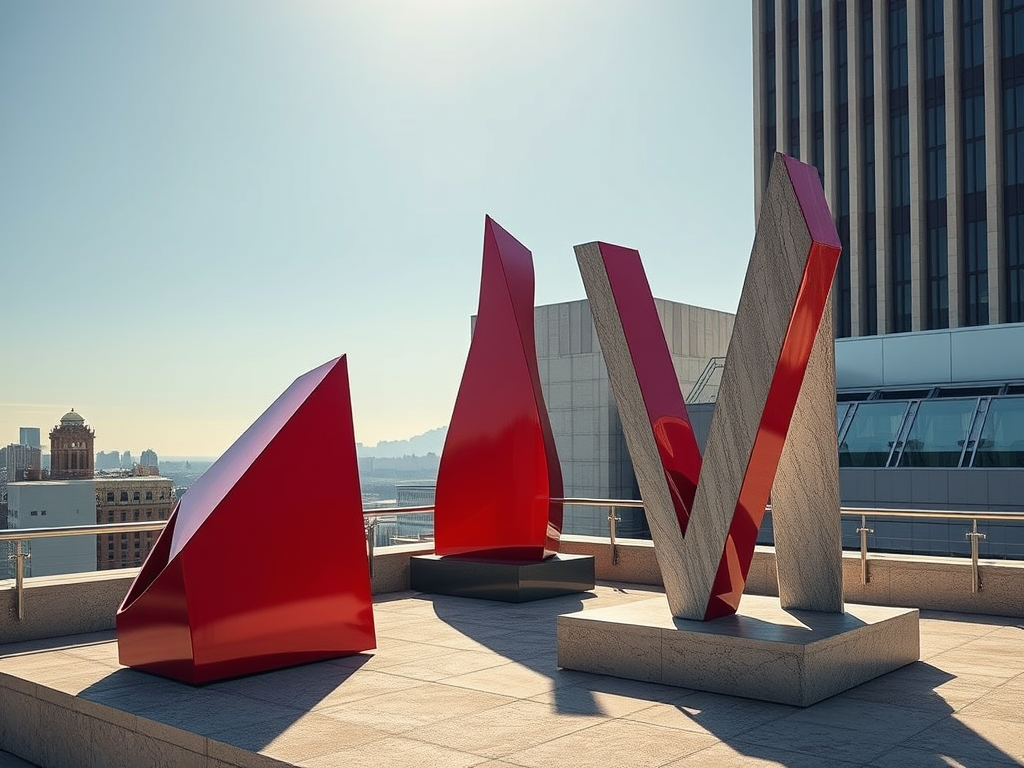
Basking in the morning sunlight were three striking sculptures — sleek, angular, and meticulously crafted. One featured a trapezoidal form resting on its side, its face marked by a deliberate groove slicing through the surface. Another, taller than a human being, rose with a pronounced vertical opening, its geometry exuding both authority and elegance. The third sculpture was formed by two tilted panels, arranged like an asymmetrical “V.” Each sculpture carried sets of tightly stretched strings, secured by piano tuning pegs: seven on the first, five on the second, and one string on each side of the third.
Crafted from powder-coated aluminum and travertine concrete — the latter chosen for its visual harmony with the Met’s architecture — the sculptures had a clean, intentional materiality. Their surfaces were painted in a disciplined palette of reds: a deep wine-like hue for the primary areas, with brighter scarlet accents. A fourth element in this composition lay flat along the garden’s edge, resembling a runner or boundary that framed the installation like a stage awaiting performance.

Jones, 56, was visibly moved when a gust of wind brushed past one sculpture and produced a low, resonant hum from its strings — a sound that briefly eclipsed the ambient city noise. She stood still, smiling as the sound hovered and gradually faded. “I’m thrilled!” she exclaimed. “It’s performing. Right on cue.”
Though sound has long been a cornerstone of Jones’s artistic vocabulary, it is often implied rather than explicitly heard. Her works — which range from drawing and sculpture to painting and audio collage — frequently reference sound through both concept and material. Early in her career, she integrated audio cables and CD cases into her visual compositions; more recently, she’s been creating hybrid paintings using acoustic panels similar to those used in professional recording studios.
Jones has also developed audio compositions that sample Black classical music and avant-garde experimental sounds, often producing long, droning vibrations that explore the physicality of listening. These sound pieces have been played in unique and charged settings — from a Confederate memorial site in New Orleans to Philip Johnson’s Glass House in Connecticut, and even within the Guggenheim Museum during her 2022 solo show there.

Her work on the Met’s rooftop adds a new dimension to this exploration by presenting sculpture as latent instruments — objects that may or may not produce sound, depending entirely on chance elements like wind and weather. These sculptures pay homage to both canonical abstraction and often-overlooked contributions from Black artists and inventors, bridging the gap between minimalism and vernacular creativity.
Jones’s references are layered. Her forms echo the influence of minimalists such as Ronald Bladen and Tony Smith, the latter having previously exhibited work on this very rooftop. But they also allude to instruments handmade by Black rural musicians, such as the one-string diddley bow or wind-activated Aeolian harps. Some viewers may even be reminded of the mid-20th-century sonic sculptures of Harry Bertoia.
Importantly, these sculptures are not intended to be played by human hands. Their musicality is activated only by nature. Light, for example, deepens the wine-red color into near-black in intense sun, while the strings hum only when stirred by the breeze. Jones embraces this uncertainty. “A big part of the project is about waiting, silence, spontaneity — the things we cannot control,” she said. “Anticipation is its own kind of presence.”

Since its inception in 2013, the Met’s Roof Garden commission has offered artists a unique space to explore themes both monumental and intimate. In previous years, artists like Petrit Halilaj and Lauren Halsey have turned the rooftop into a platform for stories rooted in conflict, cultural memory, and place. Halilaj interpreted schoolroom doodles from war-torn Balkan towns into airy metal sculptures, while Halsey’s 2023 project merged Egyptian iconography with the visual culture of South Los Angeles.
Jones approached her own commission by first reflecting deeply on the space itself. “The rooftop isn’t simply another gallery,” she said. “It’s a threshold — suspended above 5,000 years of global art history.” She was immediately aware of the need to respond not just to the Manhattan skyline, but to the museum’s legacy and physical presence. “It’s a complex site,” she added. “It asks for dialogue.”
While other artists have drawn directly from the Met’s collection, Jones opted for a more personal route. She visited the galleries of musical instruments, analyzing the curves and proportions of zithers and lutes, but ultimately decided to stick with her own voice. “This wasn’t the moment for an institutional critique,” she said. “I wanted to hold the space with my own ideas, ones I’ve been refining over the past 25 or 30 years.”

Born and raised in Cincinnati, Jones studied at the School of the Art Institute of Chicago before earning an MFA at Rutgers. Even as she was drawn to the formal purity of Minimalism, she remained critical of its historical exclusion of non-white, non-male voices. Alongside her studies, she immersed herself in the worlds of free jazz and Black experimental music, genres that offered the same radical potential as the avant-garde figures typically held up in art schools.
For Jones, Minimalism has never been static. Instead, it’s a medium for tension and contradiction, a place where emotional resonance can emerge from formal restraint. “Sound is the thread that ties it all together,” said Lauren Rosati, the Met’s associate curator of modern and contemporary art and Jones’s collaborator on the project. “While many contemporary artists are exploring Black figuration, Jennie remains firmly committed to abstraction — but on her own terms.”
“Ensemble” builds upon earlier outdoor projects by Jones, particularly her 2020 work “These (Mournful) Shores” at the Clark Art Institute in Massachusetts. That piece, a 16-foot structure of aluminum and wood with harp strings integrated into a granite wall, operated as an Aeolian harp — a wind-played instrument associated with the Romantic tradition.

In “Ensemble,” similar themes return. The trapezoidal piece references her 2013 sculpture “Bass Traps With False Tones,” its strings arranged like a dulcimer or zither. The final sculpture, with one string per panel, evokes the diddley bow — a single-string folk instrument made from salvaged materials.
Jones delved into the lives of musicians like Moses Williams and Louis Dotson, self-taught blues artists from Mississippi who built their own one-string instruments. One image in particular — a hand plucking a string nailed to a wooden plank, with a stone wedged underneath — struck Jones as deeply resonant. She saw in it the same formal gestures admired in Minimalism: linearity, repetition, humble materials.
“The origin story of my Minimalism includes these men,” she said. “There’s depth and functionality in their creativity. They found music in everyday materials — wood, wire, walls. That, to me, is the essence of abstraction.”
As “Ensemble” prepares to debut, it also marks a transitional moment for the museum itself. This is the final Roof Garden commission before the space is removed to make way for the new Tang Wing, set to open in 2030. The redesigned area will feature a more expansive garden on a lower level. For Jones, this moment carries symbolic weight. “I want this work to suggest what’s coming,” she said. “That the Met is shifting — broadening its language around abstraction, around whose voices are heard.”
David Breslin, the museum’s head of modern and contemporary art, echoed her sentiments. “I hope our future work builds on Jennie’s example — intellectual rigor grounded in personal, heartfelt vision,” he said.

Later this year, Jones will open a major exhibition at the Pulitzer Arts Foundation in St. Louis, which will include both new and existing works, alongside a show she is curating featuring influential artists from the 1960s and 1970s, including Carmen Herrera, Fred Eversley, Agnes Martin, and others. Meanwhile, two of her sound installations will be presented at the Confederate Memorial Chapel in Richmond, Virginia — a charged and poignant setting for her explorations of sound and memory.
Reflecting on “Ensemble,” Jones said she usually prefers to keep her artistic research private. But this time, she felt compelled to share more of the story — perhaps because the histories embedded in the work refuse to stay silent.
“It’s hard not to think about ancestors right now,” she said quietly.
Then, as if summoned, the breeze shifted again, and the strings began to hum. She paused. “And there they are.”




Leave a Reply