
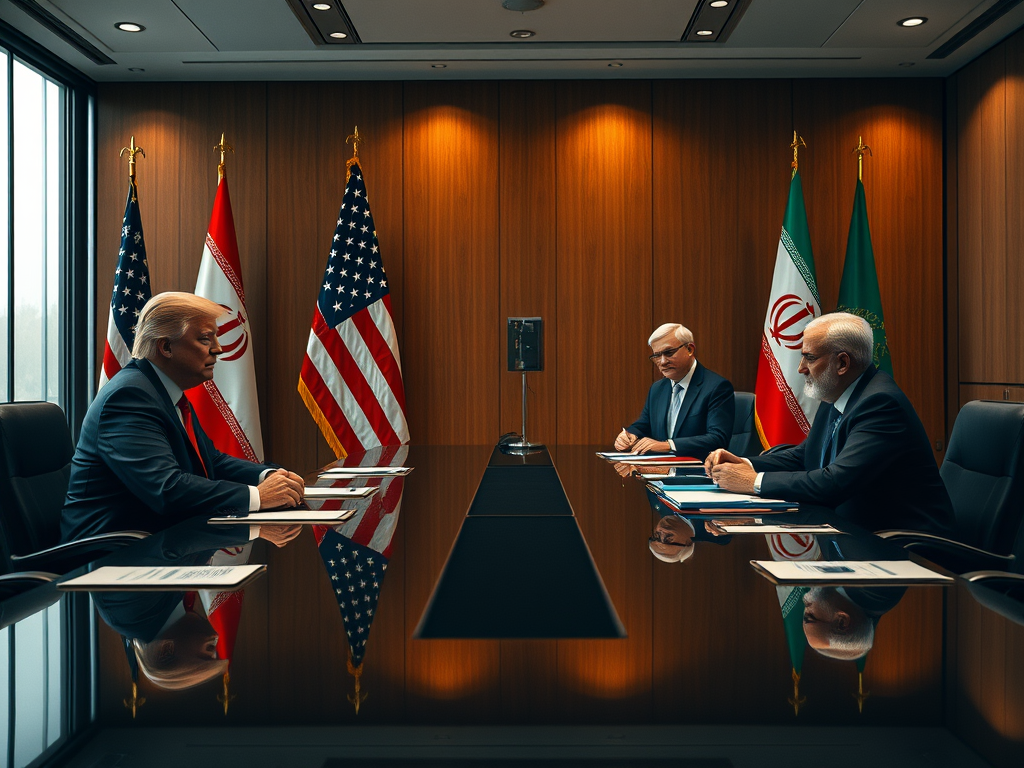

An Explosive Clock Is Ticking on Iran and Its Nuclear Program

Negotiations between the United States and Iran, which President Trump recently announced would commence this Saturday in Oman, are already mired in a complex web of mistrust, conflicting agendas, and high geopolitical stakes.
Though the desire for diplomacy has been voiced, particularly by Mr. Trump, time is running short for what is expected to be an extremely intricate diplomatic endeavor.
“We’ve reached a crucial crossroads, and the path ahead could lead to crisis,” said Sanam Vakil, Director of the Middle East and North Africa Programme at Chatham House, a prominent British think tank.
Despite Mr. Trump’s combative rhetoric — at one point threatening Iran with military strikes of unprecedented scale — he has also reiterated his preference for reaching a diplomatic resolution. That dual message, delivered even while seated alongside Israeli Prime Minister Benjamin Netanyahu in the White House, sends mixed signals. Netanyahu, a long-time advocate for military action against Iran, appeared supportive of the tougher stance. Still, for many in the Arab world, particularly in countries already reeling from conflict, the emphasis on diplomacy offered some reassurance.
Even if Iran is widely seen as pursuing regional dominance, a full-blown war involving the US and Israel would be catastrophic for the broader region. Nations from Egypt to the Gulf states fear the devastating social and economic consequences such a conflict would unleash — especially as the violence in Gaza drags on.
Yet the core demands being publicly laid out by the Trump administration — including a full halt to nuclear enrichment, surrender of enriched uranium stockpiles, and dismantling of all nuclear infrastructure — are highly unlikely to be accepted by Iran’s supreme leader, Ayatollah Ali Khamenei. Such terms would be perceived as tantamount to capitulation and humiliation. What remains uncertain is how far either side is prepared to compromise. Trump’s known strategy involves setting maximalist opening positions and later seeking middle ground.
This weekend’s discussions are expected to be of significant diplomatic weight, with Iran’s deputy foreign minister, Abbas Araghchi, and US special envoy Steve Witkoff likely to be involved. While there is disagreement over whether the talks will be direct, as claimed by Trump, or indirect through mediators, as Iran has insisted, the presence of high-ranking officials suggests meaningful engagement is possible.

Araghchi himself has described the talks as “both a test and an opportunity,” emphasizing that they will gauge the willingness of both parties to engage in sincere negotiations over Iran’s nuclear ambitions — which Tehran maintains are strictly for peaceful, civilian purposes — in exchange for lasting sanctions relief.
However, European officials caution that the timeline for diplomacy is dangerously tight. By late July, European signatories to the 2015 nuclear deal — namely Britain, France, and Germany — must determine whether to restore punitive United Nations sanctions on Iran, which were suspended under the original agreement. That authority to reimpose sanctions, known as the “snapback” mechanism, expires on October 18.
While Iran is already under extensive sanctions — including those reinstated by Trump after withdrawing from the nuclear deal in 2018, and additional UN sanctions related to ballistic missile development and human rights abuses — the return of broad UN sanctions would further cripple Iran’s already fragile economy. These potential penalties serve as powerful leverage for the West to press Tehran into either complying with the terms of the previous agreement or committing to a new, more restrictive one.
Yet, if the snapback sanctions are enforced, Iran has threatened to withdraw entirely from the Nuclear Nonproliferation Treaty (NPT), a foundational international agreement designed to prevent the spread of nuclear weapons.
Such a move would escalate tensions dramatically and might provoke an Israeli military response, possibly with American support. Both nations have made clear that they are prepared to use force to stop Iran from acquiring a nuclear weapon.
European powers are eager to finalize their decisions before Russia — which has grown increasingly aligned with Iran — assumes the presidency of the UN Security Council in October. On Tuesday, Iranian representatives were already scheduled to meet with officials from Russia and China in Moscow for technical discussions on nuclear matters. The Kremlin, through spokesperson Dmitri Peskov, signaled support for the Oman negotiations, stating that Russia favors resolving Iran’s nuclear issue through diplomatic channels.
Despite diplomatic overtures, some analysts remain concerned that the Trump administration’s strategy of combining threats with negotiation lacks the depth and consistency of a comprehensive Iran policy.

“This approach of negotiating under threat is not a substitute for real strategy,” said Suzanne Maloney, Director of Foreign Policy at the Brookings Institution and a long-time Iran specialist.
In the meantime, the US military has ramped up its regional presence, deploying stealth B-2 bombers and a second aircraft carrier, the USS Carl Vinson, to the area. Additionally, the US has launched a significant bombing campaign against the Houthis in Yemen — an Iranian ally — which many interpret as a signal of Washington’s readiness to escalate if necessary.
Iran, under immense economic pressure from unilateral US sanctions, is eager to avoid the additional weight of multilateral UN sanctions. Still, European leaders have been firm: unless a new agreement is reached, sanctions will be reimposed. In response, Iran has doubled down on its warning that it will leave the NPT altogether — a decision that requires a 90-day process, potentially leaving a brief window for last-minute diplomacy.

Even if Iran agrees to maintain the presence of international inspectors, the International Atomic Energy Agency (IAEA) has expressed concern over Tehran’s lack of cooperation in the past, which has already reduced the global community’s visibility into Iran’s nuclear program. Without oversight, Iran’s potential to develop a nuclear weapon increases — a scenario that could provoke preemptive military action from Israel or the US.
The West’s unease is rooted in suspicions that Iran may be pursuing a more rapid and less sophisticated path to weaponization. According to recent IAEA data, Iran possesses enough near weapons-grade uranium to produce several nuclear bombs.
“It’s inconceivable that Israel would tolerate an Iranian nuclear program this advanced without international oversight,” said Ali Vaez, Director of the Iran Project at the International Crisis Group.
Any military strike by Israel or the US would almost certainly trigger retaliatory attacks from Iran targeting American and Israeli interests, as well as key Gulf infrastructure like oil facilities in Saudi Arabia. No Gulf state wants to see such instability. Ironically, such a war might push Iran to fast-track the development of a nuclear weapon — the very outcome these actions are intended to prevent.
It is still unclear whether European powers will have the political will — or legal authority — to extend the deadline for reimposing sanctions. But doing so would require demonstrable progress toward a new agreement.

Given the lingering distrust — especially following the US withdrawal from the original nuclear deal — any new accord would likely need to include binding economic guarantees in exchange for permanent curbs on Iran’s nuclear program. For Ayatollah Khamenei, a staunch opponent of US influence, such guarantees must be credible.
In remarks from the White House, Netanyahu suggested a deal should mirror the 2003 arrangement with Libya, when Muammar Gaddafi agreed to dismantle his WMD programs. But such a model is deeply controversial. If Trump insists on a “Libya-style” outcome — demanding Iran dismantle its nuclear and missile programs while severing ties with regional allies — many experts believe diplomacy will collapse.
On the other hand, if Trump focuses narrowly on ensuring that Iran cannot build a nuclear weapon — and bases negotiations on verifiable compliance rather than regime change — there may be grounds for optimism.
Still, Mr. Vaez warned that Iran is not optimistic about reaching an agreement with the Trump administration. “They are preparing for conflict,” he said, noting signs such as efforts to improve internal unity, the softening of hijab law enforcement, the release of political prisoners, and official warnings against mass protests.
After sustained Israeli attacks on Iran’s proxies across the region — including Hezbollah in Lebanon and Hamas in Gaza — and air strikes on Iranian missile systems, Tehran is seen as vulnerable militarily. But Mr. Vaez cautioned against underestimating Iran.
“Iran may be weakened, but it is not weak,” he said. “Nor is it desperate. If Iran agrees to talks under duress, it legitimizes pressure as a negotiating tactic. For Khamenei, capitulating to that kind of pressure is even more dangerous than enduring it.”




Leave a Reply