
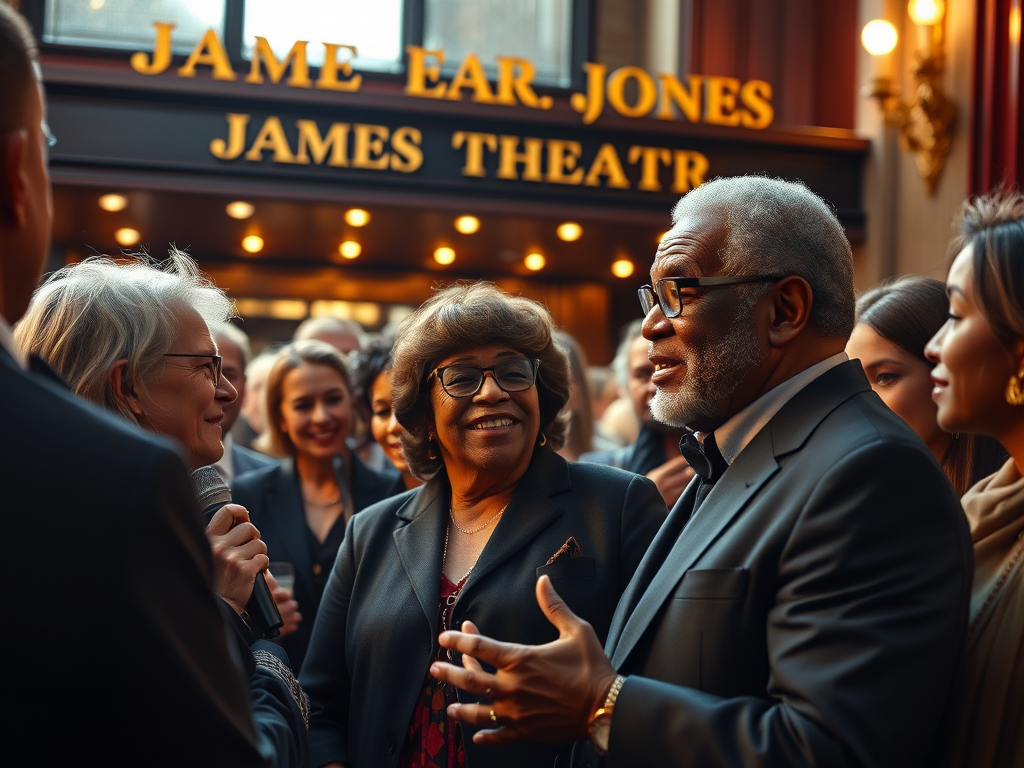

At James Earl Jones Memorial, Friends Share Laughs, Tears and Moving Stories

On Monday afternoon, the heart of New York City pulsed with memories, laughter, and tears as some of the most revered names in entertainment gathered at the James Earl Jones Theatre on West 48th Street. They came together to celebrate the life and legacy of a man whose voice echoed across generations, and whose presence uplifted countless lives—James Earl Jones.
Jones, who passed away last year at the age of 93, left behind a legacy that transcends the stage and screen. Known for his deep, thunderous voice and an acting ability that could move audiences to their core, Jones was far more than a performer. He was a mentor, a friend, a North Star—as Denzel Washington called him—who illuminated the path for so many others.
The theater, renamed in his honor in 2022, was filled with friends, colleagues, and admirers who shared stories that painted a rich portrait of a man who was as generous as he was gifted. Over the course of more than 90 minutes, they remembered not just his unforgettable performances, but the way he made people feel—seen, supported, and inspired.
A Presence of Grace and Power
Denzel Washington, who is currently playing Othello in a Broadway revival of the Shakespearean tragedy that Jones famously starred in more than sixty years ago, spoke with heartfelt reverence. “James Earl Jones represented strength, purpose, and humility,” he said. “He wasn’t just the greatest African American actor—he was, in my view, one of the finest actors to ever grace a Broadway stage.”
Washington, visibly moved, spoke about the legacy Jones left not only through his work, but in the way he lived—with dignity, kindness, and an unwavering commitment to his craft.
A Career That Spanned Eras

Jones’s journey to the spotlight was anything but typical. Raised on a farm in Dublin, Michigan, by his grandparents after being abandoned by his parents, he suffered from a debilitating stutter that led to years of near-silence during his youth. It wasn’t until an English teacher encouraged him to channel his thoughts through poetry that he began to regain his voice—and eventually, find his calling.
That calling led him to Broadway in 1957, where he first appeared as an understudy in “The Egghead.” Just a year later, he landed a role in “Sunrise at Campobello,” performed in the very same theater that now bears his name. Over the decades, Jones appeared in 21 Broadway productions, spanning everything from classical works to modern dramas. He won two Tony Awards for Best Actor—first in 1969 for The Great White Hope, and again in 1987 for originating the role of Troy Maxson in Fences. A lifetime achievement Tony followed in 2017.
His final stage appearance came in 2015, alongside Cicely Tyson in The Gin Game, capping off a theatrical career that defined excellence and commitment.
A Gentle Force Behind the Scenes

For many, James Earl Jones wasn’t just a towering figure onstage—he was a guiding light offstage as well. Actress Linda Powell recounted the powerful experience of working with him in a 2004 revival of On Golden Pond. “James insisted I be cast as his daughter,” she shared, “and it turned out to be one of the most fulfilling experiences of my career. His belief in me was one of the greatest gifts I’ve ever received.”
Similarly, Phylicia Rashad recalled witnessing Jones perform as a young woman and then having the honor of acting opposite him decades later in a revival of Cat on a Hot Tin Roof in 2008. “To share the stage with someone who had once inspired me from the audience—it was surreal,” she said.
A Legacy that Uplifted Others
Jones’s generosity extended beyond colleagues to his family and community. His cousins, Terry Connolly and Tracy Connley Johnson, spoke warmly of the man who introduced them to poetry and Black literature. “He didn’t just change our lives,” they said, “he helped build them—sometimes quite literally, helping us construct homes for our family.”
Flynn Earl Jones, his son, provided a more intimate glimpse into his father’s personality during a conversation earlier in the day. “He was frustratingly humble,” Flynn said with a chuckle. “People see him as a king, a president, or the voice of a galactic villain. But to me, he was just Dad—curious, thoughtful, and simple in the best way.”
Indeed, the man who voiced Darth Vader and Mufasa, who commanded stages with Shakespearean authority, was also someone who enjoyed quiet moments, valued family, and remained grounded through fame.
Tributes from All Corners

Monday’s tribute featured voices from every corner of show business. Frankie Faison, Candice Bergen, Glynn Turman, and Kelsey Grammer were all present, sharing their own anecdotes of working with Jones. Laurence Fishburne and Mark Hamill sent video messages, offering reflections on the magnitude of Jones’s influence.
Whoopi Goldberg, who voiced opposite Jones in The Lion King, expressed her admiration plainly. “There was no such thing as a bad performance from James,” she said. “When you talk about Broadway—when you talk about Black men doing extraordinary things—his name always comes up.”
Courtney B. Vance, who played opposite Jones in Fences, closed his tribute with an impassioned performance of a monologue from the play. Years ago, as a young actor still learning the ropes, Vance said Jones and the cast of Fences took him under their wings. “I didn’t even know what ‘upstage’ and ‘downstage’ meant,” he laughed. “They showed me. They gave me a chance. And I’ve carried those lessons with me ever since.”
He last saw Jones during the pandemic, visiting his home in upstate New York. Jones, ever the humorist, joked about being kept in a bubble by his family. “He said he thought he’d live to be 100,” Vance recalled with a smile. “And we all told him, ‘Yes you will.’”
A Voice That Echoes On

The memorial was a fitting reflection of James Earl Jones’s life—not just as a legend of stage and screen, but as a deeply human, profoundly kind man whose reach extended far beyond the footlights. His was a voice that shook theaters and inspired millions, yet it was his heart, humility, and enduring commitment to uplifting others that truly defined him.
As the lights dimmed on Broadway that evening, they did so in tribute to a man who never sought the spotlight for its own sake, but rather as a platform to tell truth, embody grace, and pave the way for others. James Earl Jones may be gone, but his voice—literal and metaphorical—resounds still.




Leave a Reply