

Reggie Wilson’s The Reclamation: A Dance of Resilience

In a world increasingly defined by turmoil, both political and emotional, Reggie Wilson stands as a choreographer whose work consistently transcends the noise. His latest piece, The Reclamation, which premiered at NYU Skirball over the weekend, does more than merely present a dance performance — it offers a meditative experience, a physical journey through time and memory, struggle and resilience, grief and hope.
Wilson, long admired for his ability to blend rich cultural narratives with striking formalism, returns here with a work that is both deeply personal and historically resonant. The Reclamation is in part a revisitation — and a reimagining — of gestures and motifs from his earlier pieces. But rather than feeling nostalgic or retrospective, it breathes new life into past material, grounding it in the present moment. The result is a complex, solemn dance that contemplates the idea of inheritance: how we carry the weight of history, and how, perhaps, we can reclaim it on our own terms.
Throughout the performance, the movement language speaks volumes even in its silences. Much of the choreography exudes a sense of groundedness — not merely in terms of the dancers’ physical relationship to the floor, but in emotional gravity as well. There are moments when the pace quickens, when limbs cut sharply through the air, and dancers move with urgency. Yet these bursts feel less like a release and more like a reckoning, a physical confrontation with internal or external forces. They do not transport the audience to joy, but rather plunge us deeper into contemplation.

Wilson’s Fist and Heel Performance Group, composed of seven accomplished performers, embodies this vocabulary with stunning discipline and emotional depth. Among them, Paul Hamilton stands out for his quiet magnetism, though each dancer contributes to the ensemble’s powerful presence: Oluwadamilare (Dare) Ayorinde, Bria Bacon, Rochelle Jamila, Annie Wang, Henry Winslow, and Miles Yeung. Their cohesion is precise, but never mechanical. This is dance that breathes — that listens to itself and to the audience.
The piece begins with a simple but weighty tableau. One by one, dancers approach the front of the stage and pause, standing still in silence. It’s as though they are presenting themselves not just as performers, but as bearers of personal and collective stories. Gradually, they move toward the back, where they begin to shed outer garments, folding them carefully and placing them in tidy piles. The act is unhurried, ritualistic — a shedding of layers that reads as both intimate and symbolic. The metaphor is clear: in removing these clothes, they are reclaiming something deeper, something closer to the skin, perhaps even the soul.
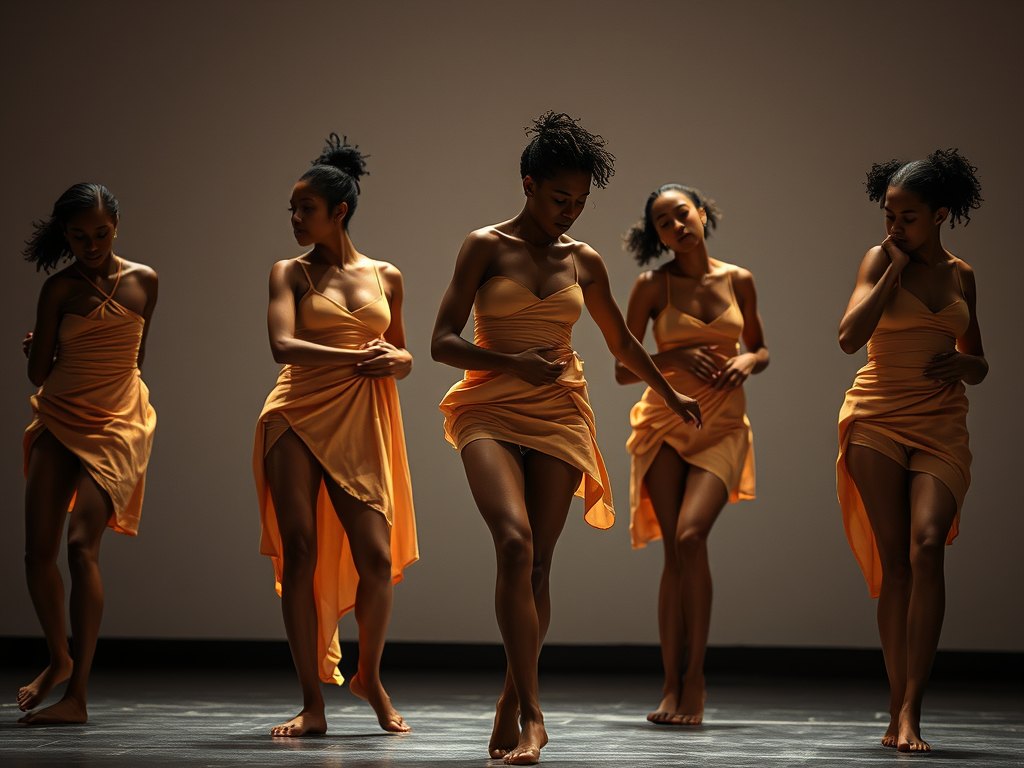
Once dressed in sleek, body-conscious costumes designed by Naoko Nagata and Enver Chakartash, the dancers begin to move more freely. The costumes — simple, occasionally marked with bright splashes of color — evoke a modernist aesthetic, aligning with the early postmodern qualities of the movement. Wilson’s choreographic language features sharp angles, torsos that tilt and collapse, limbs that extend and retract like breath. It’s a vocabulary that reshapes itself continually, never allowing the viewer to settle into one interpretation. When dancers diverge from structured formations, spinning into space or lunging across the floor, they inevitably find their way back to the group — reconvening in lines, duets, or mirrored pairs. There is a constant tension between freedom and order, individuality and collectivity.

One of the most striking aspects of the performance is the use of sound. Rather than a single, unified score, Wilson assembles a soundscape that plays like a poetic mixtape — each track chosen for its emotional and thematic resonance. We hear the raw, aching voice of blues legend Son House singing “Motherless Children,” followed by the soulful optimism of “I Can See Clearly Now,” as interpreted by Gladys Knight and the Pips. Yet in the context of The Reclamation, even these familiar songs take on new meanings. As the dancers move forward with slow, rocking steps — their feet seemingly trapped in an invisible mire — the hopeful lyrics feel ironic, almost bitter: “Gone are the dark clouds that had me blind.” The music says the storm has passed, but the bodies onstage tell a different story.
As the piece unfolds, Wilson uses the full width of the Skirball stage to striking effect. He scatters his dancers across the space, then pulls them together in twos or threes, forming small clusters that momentarily dominate the scene before dissolving again. These shifting groupings are like echoes of past relationships, memories half-recalled. The choreography grows increasingly dynamic, with sweeping runs around the perimeter, arms slicing through the air like paddles through water. The sense of urgency heightens, driven by the inclusion of Tom Smothers’ “Helping,” a song whose lyrics suggest a paradox: “Some kind of help is the kind of help we all can do without.” It’s a clever and poignant insertion — a reminder that not all offers of aid are benevolent, and that support sometimes comes with strings attached.
What makes The Reclamation so affecting is not just its choreography, but its emotional layering. Wilson masterfully builds intensity through repetition and variation, using recurring gestures and spatial patterns to evoke the passage of time, the weight of history, the cycles of loss and renewal. Yet even as the work deepens into darker terrain, there is a consistent thread of resilience. It is not a hopeful dance in the conventional sense, but it is far from hopeless. It suggests that healing is possible, but not without acknowledging the scars.

In the final section, Wilson turns to the gospel-infused sound of the Staple Singers’ “Touch a Hand, Make a Friend.” The music is joyful on the surface, but in this context, its refrain — “Touch somebody! Touch somebody!” — becomes something more desperate, more urgent. The dancers respond with speed and fervor, their footwork rapid and percussive, their bodies alive with motion. Hands clap, thighs are slapped, stomps punctuate the floor with precision. Energy builds and builds until, one by one, the dancers fall to the ground and begin to roll in unison, forming a wide circle that gradually tightens into a smaller, denser knot.
This closing image is haunting in its simplicity. A circle that contracts, not in defeat, but in unity — as if pulling everything inward, toward the core. It is both an embrace and a surrender. And it lingers in the mind long after the final note fades.
The Reclamation is a deeply considered, fiercely executed work that reaffirms Reggie Wilson’s place as one of contemporary dance’s most essential voices. In a time when clarity and purpose in art are both rare and necessary, Wilson gives us not only something to watch, but something to feel — and to carry with us.




Leave a Reply