
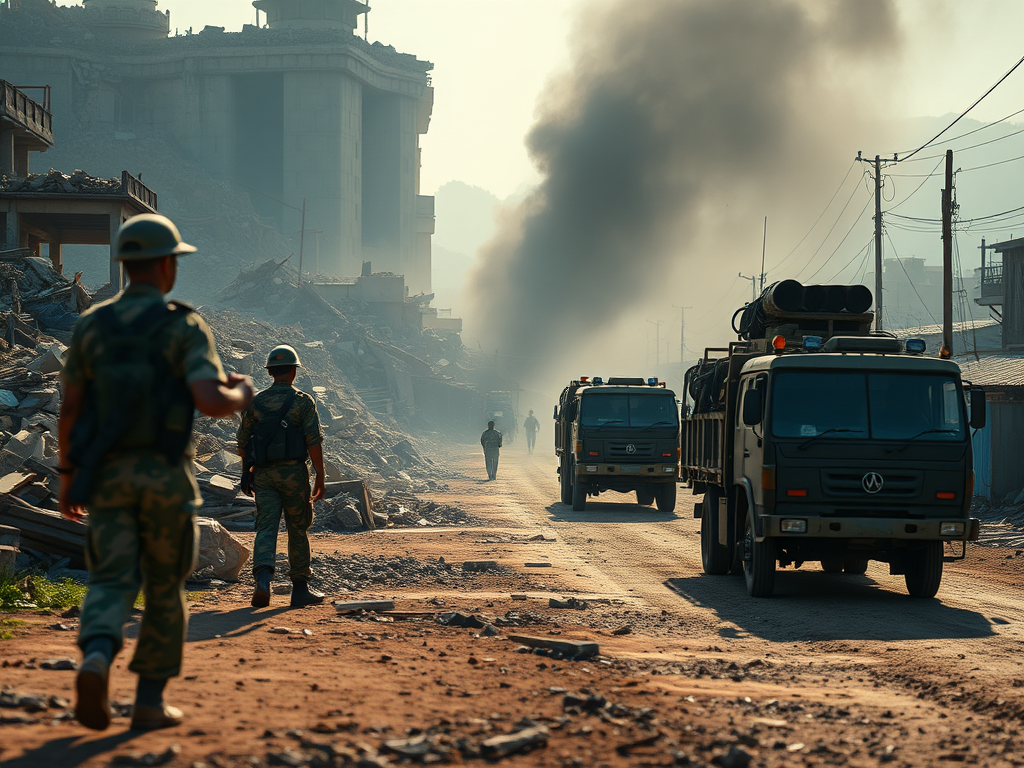

Myanmar Military Calls for Temporary Truce After Earthquake

Myanmar’s military announced on Wednesday a 21-day ceasefire aimed at supporting relief and reconstruction efforts following a catastrophic earthquake. This declaration came just a day after the military attacked a convoy operated by the Chinese Red Cross, which was attempting to deliver essential food and medical supplies to survivors in urgent need.
The assault on the Chinese humanitarian convoy, which has drawn widespread condemnation from human rights organizations, underscores the risks aid groups face amid Myanmar’s ongoing civil conflict.
Doubts remain over whether the ceasefire will be upheld, as armed rebel factions report that the military has continued its aerial bombardments despite the disaster. Since the 7.7-magnitude earthquake struck last Friday, killing at least 2,700 people, the military has allegedly carried out numerous airstrikes.
In response to the crisis, the exiled National Unity Government and a coalition of three rebel groups declared ceasefires. However, the military, which seized power in a coup four years ago, had initially signaled no intention of halting hostilities. Even before the earthquake, the devastating civil war had already left millions in dire conditions, with shortages of food and water exacerbating their suffering.
On Wednesday, Senior General Min Aung Hlaing’s office announced that the ceasefire would last from April 2 to April 22. The statement framed the temporary truce as an expression of sympathy for affected civilians, a means to facilitate humanitarian assistance, and an effort to maintain stability during the recovery phase.
However, just a day prior, the general had reaffirmed that military operations would persist as necessary “protective measures,” regardless of the disaster.

“There is nothing protective about attacking those who are trying to help others,” remarked Tom Andrews, the United Nations special rapporteur on human rights in Myanmar. “Continuing military offensives in the midst of a humanitarian crisis is simply appalling.”
The attack on the Chinese Red Cross convoy took place at approximately 9:30 p.m. on Tuesday near Ummati village in northern Shan State. According to Myanmar military spokesperson General Zaw Min Tun, the convoy had failed to inform authorities of its presence in advance.
The Ta’ang National Liberation Army (TNLA), one of the rebel factions that had earlier declared a month-long ceasefire, reported that the convoy was traveling toward Mandalay, near the earthquake’s epicenter.

General Zaw Min Tun claimed that when soldiers noticed the convoy, they attempted to stop it. Flashlights were used to signal the vehicles from a distance of 100 to 200 yards, but the convoy did not slow down. When it was about 100 yards away, soldiers fired warning shots into the air three times.
“This area remains an active conflict zone with ongoing clashes between the TNLA and the military,” Zaw Min Tun explained. “Failure to provide prior notification could have led to the mistaken assumption that the convoy was a hostile entity.”
The Red Cross Society of China has yet to issue a response regarding the attack. China, which maintains close ties with Myanmar, was among the first nations to send aid following the disaster, dispatching search-and-rescue teams and contributing approximately $14 million in emergency assistance.
At least 15 countries, including the United States and Russia, have also provided aid. In recent days, major international humanitarian organizations such as the World Food Program and UNICEF have gained access to Mandalay and the neighboring Sagaing region. However, Taiwan reported that its offer to send a 126-member rescue team was declined by Myanmar’s authorities.
Tayzar San, a pro-democracy activist from Mandalay, accused the military junta of exploiting the disaster for political gain rather than prioritizing effective rescue operations.

Locals in the affected cities have reported significant obstacles to aid delivery, with military roadblocks preventing relief efforts.
Ko Thein Swe, a volunteer from Thaton in Mon State, recounted how his charity group, carrying food and medical supplies, was stopped at a military checkpoint while en route to Mandalay on Sunday. The group was informed that they needed special permission to proceed and were only allowed to pass after making a payment to the soldiers.
“In a time of immense suffering, not only is the military refusing to help, but they also lack the basic humanity to let others provide assistance,” Thein Swe said.
Myanmar has remained in a state of war since the military’s 2021 coup. While the junta maintains control over major urban centers, it has lost vast areas to powerful ethnic armed groups along the country’s borders and to civilian-led resistance forces in parts of Sagaing.
Despite the destruction caused by the earthquake, the military has continued to launch airstrikes across the country. Activist Tayzar San stated that, according to sources on the ground, the military had conducted over 100 airstrikes in the past week, including in areas severely impacted by the earthquake.
On Tuesday at approximately 5:30 p.m., an airstrike in Kachin State killed 38 young trainees of the Kachin Independence Army (KIA), an armed group engaged in combat with the military in northern Myanmar, according to KIA spokesperson Colonel Naw Bu.




Leave a Reply