

Andrew Scott on ‘Vanya’: ‘Who Isn’t Sad?’

Andrew Scott firmly believes in the complexity of human nature. “I really believe that we all do contain multitudes,” he remarked one brisk March morning. Among actors, Scott may embody this idea more than most. Known for his remarkable sensitivity and dynamic presence, he takes center stage in an Off-Broadway adaptation of Chekhov’s bittersweet comedy, “Uncle Vanya.” The production, which arrived from London, has been streamlined—both in title, now simply “Vanya,” and in cast, featuring only Scott.
A few nights earlier, this latest iteration had made its New York debut. In this adaptation, playwright Simon Stephens shifts the setting from 19th-century Russia to contemporary rural Ireland. Scott plays Vanya, a man who has sacrificed his own ambitions to support his self-indulgent brother-in-law. But Scott’s challenge doesn’t end there—he also portrays the brother-in-law, the neglected wife, the overburdened niece, and numerous other characters. Though alone onstage, he fills the space with an entire ensemble’s worth of personalities.
New York Times critic Jesse Green likened Scott to a “human Swiss Army knife,” marveling at his ability to embody so many roles with precision and depth. Given Scott’s past performances in “Fleabag,” “Ripley,” and “All of Us Strangers,” Green also described him as a “sadness machine”—an assessment echoed by Variety, which dubbed him “Hollywood’s new prince of heartache.”

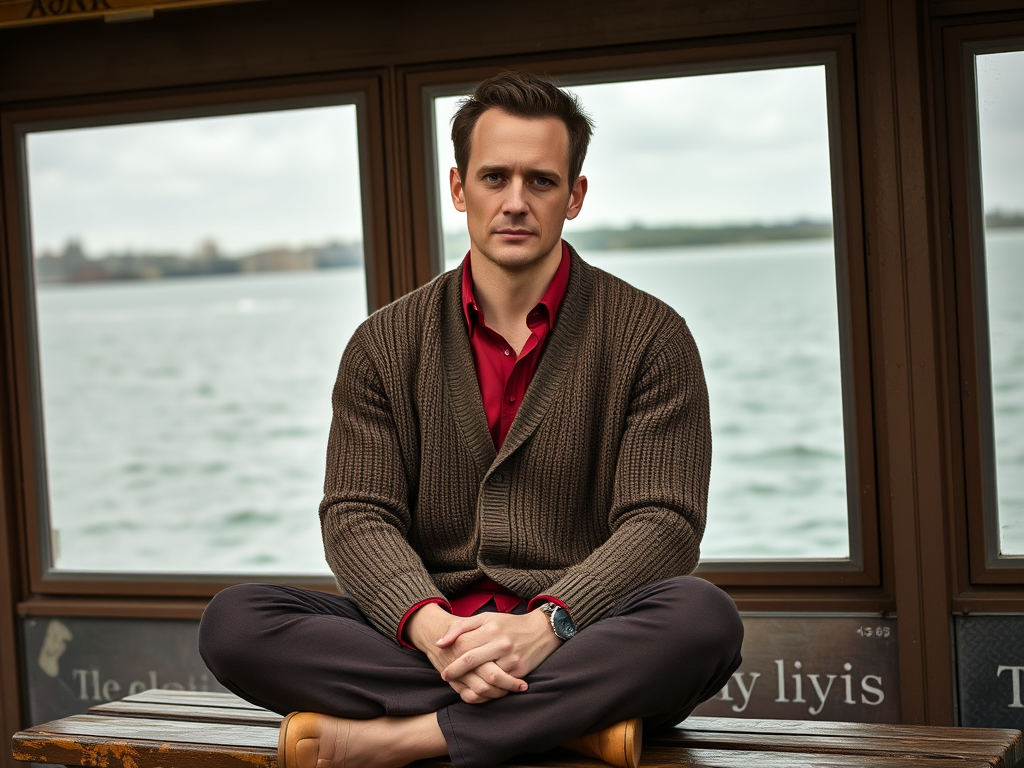
Yet on this particular morning, Scott, at 48, did not exude any unusual sorrow. Slightly disheveled, yes, but not melancholy. The initial plan had been to walk toward the Hudson River and then onto Little Island, but harsh weather forced a change. “Oh my God, it’s windy,” he remarked as they stepped outside, prompting his publicist’s concern: “You can’t get sick.” Instead, Scott took refuge at a nearby pier, sipping a bright orange juice and nibbling on a breakfast burrito. Through the large windows, the choppy, gray-green waters of the Hudson mirrored the hues in his eyes.
In conversation, Scott exudes a quiet intensity, yet he wears it lightly. His intelligence and deep empathy are immediately apparent, yet never forced. Vanity seems foreign to him—despite knowing he would be photographed, his hair looked as if it had never encountered a comb. Seated cross-legged on a bench, draped in a textured brown cardigan, he projected a rare authenticity. Later, when he removed the cardigan, a small embroidered heart became visible on his red shirt—subtle yet telling.
Scott never initially intended to play every character in “Vanya.” Though Stephens, a frequent collaborator, relocated the play’s setting to Ireland, his adaptation was otherwise conventional. However, during an early reading with Stephens and director Sam Yates, Scott found himself performing a scene where he took on both characters’ lines. Something clicked.

Despite the spark, he hesitated. Was it a gimmick? Would it feel artificial? Yet as he delved deeper into the material, he noticed the common threads binding the characters. “They’re all expressing their personal pain, each convinced their suffering is uniquely theirs,” he observed. “But in reality, they are far more alike than they realize.” By eliminating the physical distinctions between characters, a single actor could make these underlying connections even more apparent.
The rehearsal process was intense, yet undeniably thrilling. Memorizing the lines was grueling—”so [expletive] hard,” he admitted—but he had tackled “Hamlet” before, so he knew he could manage. He avoided exaggerated accents, though attentive listeners—particularly Irish ones—would detect subtle differences in class and regional backgrounds. He also eschewed elaborate costume changes, opting instead to differentiate characters through small props and distinct gestures: Michael, the country doctor, bounces a tennis ball; Ivan, the titular Vanya, wears sunglasses and fiddles with a sound-effects machine; Sonia, Ivan’s niece, nervously wrings a dishrag. As the play progresses, even these props and gestures fade away, leaving only Scott’s raw energy to delineate the shifting roles.
“You don’t want the audience to feel lost, wondering, ‘Which character is this now?’” he explained. “But you do want them to lean in, to actively engage.”
Remarkably, it works. Even in moments of intimacy, where Scott must “interact” with himself, the transitions are seamless—and, surprisingly, charged with real chemistry. Given his now-iconic role as the “Hot Priest” in “Fleabag,” perhaps that isn’t so unexpected. “It’s about representing intimacy in its purest form,” he said. Each character exists vividly within him, his movements and gaze precisely calibrated to define their presence onstage—even when he is the only one standing there.
“It’s a never-ending experiment,” he said. “I’m discovering new things about it constantly.”

Though he often portrays melancholic figures—Vanya among them—Scott doesn’t believe he is inherently sadder than most. He acknowledges his affinity for roles steeped in deep emotion, but he also sees beauty in vulnerability. “People often assume I’m just good at playing sadness,” he reflected. “But I laugh easily, too. Sensitivity, emotional openness—those are things I find incredibly beautiful. I don’t fear them. Or at least, not much.”
And in the end, isn’t sadness universal?
“Who isn’t sad?” he asked, almost rhetorically. “I genuinely don’t understand people who claim they aren’t.”
On the surface, “Vanya” is a story about squandered potential. And yet, the irony is that in bringing it to life, Scott is doing anything but wasting his own. The challenge is daunting—each night, he confronts the expectation of delivering his best performance. “It’s a terrifying thing to think you must live up to your full potential every single time you step on stage,” he admitted. Some mornings, he wakes up doubting his ability to do it again. And yet, night after night, he does.
In embracing the contradictions of humanity—the monstrous and the beautiful, the tragic and the absurd—Scott creates a world far larger than himself. “My job is to embody all of it,” he said. “The chaotic, contradictory ways in which we exist as human beings—that’s what I have to bring to the stage.”
And somehow, he does.




Leave a Reply