

Franz Boas and the Mowachaht Shrine: Cultural Controversies Unveiled

In the early 20th century, Franz Boas, one of the pioneering figures in American anthropology, developed a keen interest in a significant Indigenous shrine linked to whaling traditions off the coast of British Columbia.
His curiosity was piqued after receiving a photograph of the shrine, which belonged to the Mowachaht people. The image depicted a wooden structure nestled on a small island, enveloped by dense cedar and spruce trees. Within the shrine were 88 intricately carved wooden human figures, four sculpted whale representations, and 16 human skulls.

Determined to add the shrine to the collection at the American Museum of Natural History in New York, where he served as a curator, Boas pursued its acquisition. He was guided by a philosophy known as “salvage anthropology,” which sought to preserve Indigenous cultural artifacts amid fears that they would be lost due to declining Native populations.
Even at the time, this undertaking stirred controversy. George Hunt, a researcher dispatched to Yuquot, a village near the shrine, attempted to negotiate its purchase on behalf of the museum. Letters exchanged between Boas and Hunt, later published in Aldona Jonaitis’s 1999 book, The Yuquot Whalers’ Shrine, reveal that an initial agreement with a chief to sell the shrine for $500 was swiftly rescinded due to community objections.

Despite this setback, Hunt eventually persuaded two chiefs to accept $500 for the shrine, though they insisted it remain untouched until much of the village had departed for seasonal seal hunting in the Bering Sea.

By 1905, the shrine had reached New York, coinciding with Boas’s departure from the museum. Rather than being fully exhibited, the shrine remained largely in storage for over a century. While certain carvings were occasionally displayed or loaned to other institutions, the museum primarily kept the collection out of public view. A scaled-down model was showcased from the early 1940s until around 2019.
The loss of the shrine left a profound void within the Mowachaht/Muchalaht First Nation, its original stewards. For decades, efforts to reclaim it were met with obstacles, delaying its return. However, after years of negotiations and shifting attitudes toward Indigenous heritage, change finally arrived.

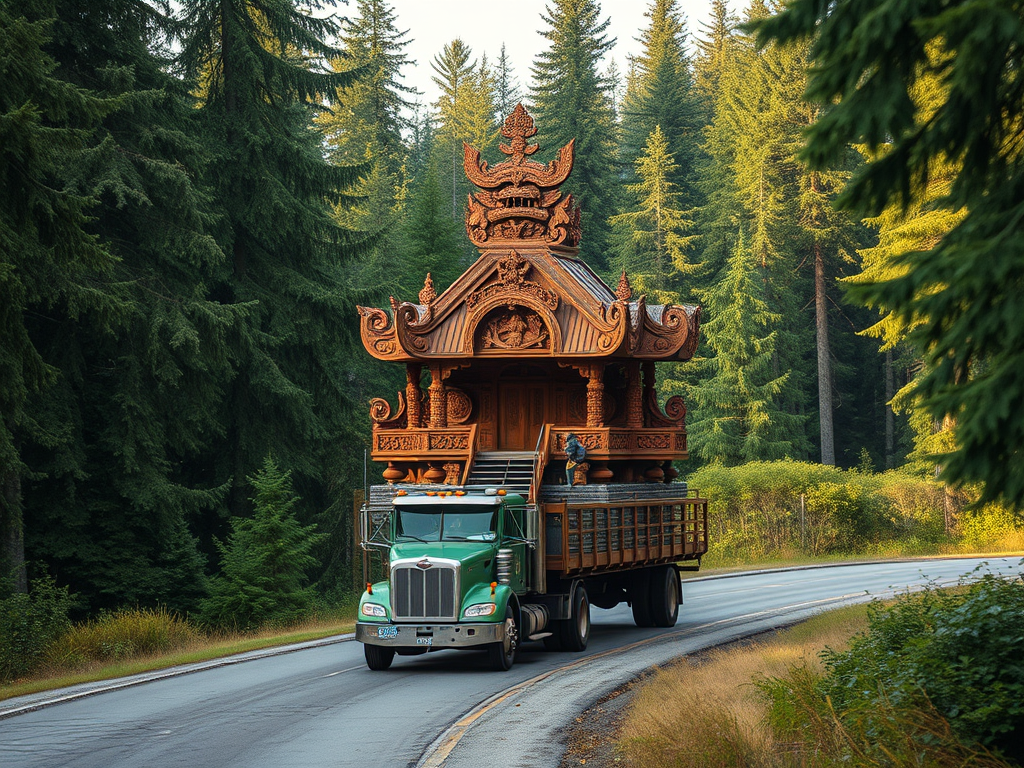
Last Thursday, a truck carrying the disassembled shrine embarked on its long-awaited journey back to Vancouver Island, marking one of the most significant repatriation efforts in the museum’s history.
“We are ready to welcome it home,” said Marsha Maquinna, a direct descendant—eight generations removed—from the Mowachaht chief who once presided over the shrine. “As a community, we have a great deal of healing to do.”
This historic return was made possible in part due to the museum’s evolving stance on its stewardship of Native collections and human remains. Playing a key role in the process were an unlikely duo: a father and son from California who, through Ancestry.com, recently discovered their ancestral ties to the Mowachaht/Muchalaht First Nation.
For years, the museum, like other major American institutions, faced criticism for its slow progress on repatriation and its outdated portrayal of Native cultures. Acknowledging this, the museum’s new president, Sean Decatur, took decisive steps, including the closure of two major exhibition halls featuring Native American artifacts. He cited the growing urgency for museums to redefine their relationships with Indigenous communities.

In the United States, the 1990 Native American Graves Protection and Repatriation Act (NAGPRA) established guidelines for museums and institutions to return human remains, funerary objects, and cultural artifacts to their rightful tribal communities. Recent federal regulations have strengthened these protocols. However, these laws do not extend to Indigenous groups outside the U.S.
Of the human remains still held by the museum, more than half of the 12,000 individuals represented come from outside the United States. In 2023, the museum restructured its policies concerning human remains, emphasizing collaboration with global Indigenous communities for repatriation efforts.

Momentum for the shrine’s return gained traction last year, though calls for repatriation had persisted for decades. In the 1990s, representatives of the Mowachaht/Muchalaht First Nation visited the museum to examine the collection, and their demands for its return grew louder amid a broader movement advocating for Indigenous rights and cultural preservation.
A 1994 documentary, The Washing of Tears, captured the deep spiritual significance of the shrine and the belief that its return would contribute to the community’s healing. In the film, hereditary chief Jerry Jack referred to the shrine by its traditional name, cheesum, stating that its removal had devastated their people: “It represented our strength… When that cheesum was taken away from us, it was a real shock. It stripped us of our spirituality.”

Despite various attempts over the years, the repatriation process repeatedly stalled due to internal disagreements within the First Nation and a lack of initiative from museum officials.
The turning point came when Albert Lara, a retiree living near Sacramento, California, began researching his family history. Though his grandfather had shared stories about their Indigenous roots, Lara had never explored his connection to the Pacific Northwest until a DNA test from Ancestry.com confirmed his link to the Mowachaht/Muchalaht First Nation.
Upon reaching out to tribal representatives, Lara was introduced to Margaretta James, president of a local cultural society and a longtime advocate for repatriation efforts. Lara and his son, Alex, soon asked James if there was anything they could do to assist. Her response was swift: “As a matter of fact, there is.”
Having worked closely with Native American tribes in California—Albert with Indigenous veterans in employment development—the Laras were seen as sincere allies in the process. In April of last year, they initiated discussions with the museum, acting as official representatives of the Mowachaht/Muchalaht First Nation.
Over the following months, they coordinated the shrine’s complex return logistics. The First Nation resolved to send a delegation to witness the shrine’s departure from New York and accompany it on its journey home.
On Tuesday, in a private space within the museum’s Northwest Coast Hall, over two dozen First Nation members gathered amid boxes and crates containing their sacred shrine. These individuals, ranging from elders to young children, had traveled from their 200-person reserve near Gold River, many recalling how their ancestors spoke of the shrine’s absence with sorrow.

Addressing the group, museum president Decatur acknowledged, “This shrine has remained here in New York City for far too long—far from its rightful home.”
In a symbolic exchange, First Nation members gifted the museum carved wooden masks crafted by local artists. They performed a victory song in Nuu-chah-nulth, and a group of men and boys used cedar boughs to ritually cleanse the shrine’s pieces before their departure.
The Laras flew in from California to oversee the logistics. The transportation costs, as well as the delegation’s travel expenses, were covered by the Canadian government, which designated the shrine as a national historic site in the 1980s.
A century ago, the shrine’s journey to New York took months. Now, its return will take less than a week.
Out of respect for their ancestors, members of the First Nation opted against transporting the 16 skulls via truck. Instead, they carefully placed them in reinforced carry-ons and brought them home by air, equipped with official documentation to clear security screenings.
Meanwhile, the remaining artifacts—including six large cardboard boxes, four heavy wooden crates, and towering poles reaching up to 23.5 feet—are making their way back westward by truck. From there, they will be ferried to Yuquot before being airlifted by helicopter to a temporary resting place in a local church until the community determines a permanent home.

Margaretta James summed up the community’s sentiments: “We always knew it would return to the island. But it must be safeguarded.”





Leave a Reply