

In Myanmar, Aftershocks and Military Airstrikes Terrorize Residents

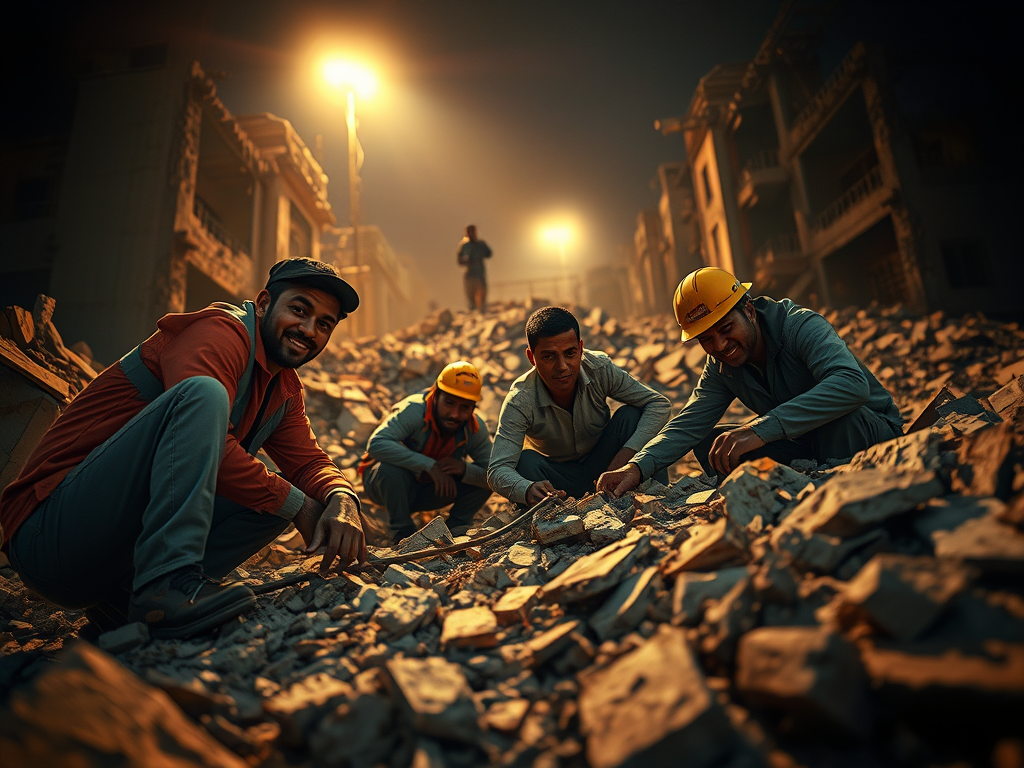
Myo Zaw and his team of volunteer rescuers were the first to reach the scene of a collapsed three-story house in Mandalay on Saturday evening, just past 8 p.m. As they sifted through the wreckage with their bare hands, a faint voice reached their ears.
“Help me, I’m here,” a girl called out.
The rescuers worked tirelessly for three to four hours to free the 12-year-old, who had miraculously survived the devastation around her. However, as the night stretched into early Sunday morning, no other voices emerged from the rubble. With temperatures nearing 100 degrees Fahrenheit, the team unearthed three bodies—the girl’s mother and her grandparents.

“Unfortunately, I fear we will recover more bodies than survivors,” Myo Zaw remarked. “The extreme heat accelerates decomposition, and in some cases, we can only locate victims because of the odor.”
Time is of the essence in Mandalay, Myanmar’s second-largest city, which is located near the epicenter of the powerful earthquake that struck on Friday. In one district alone, satellite imagery revealed entire blocks reduced to rubble.
As of Saturday night, the official death toll across the country had exceeded 1,600, with over 3,000 injured. This earthquake is the most catastrophic to hit Myanmar in more than a century. Experts warn that after the crucial 72-hour window—ending Monday evening—the likelihood of finding survivors will drastically decline.
While volunteer teams continue searching through the wreckage of homes, monasteries, mosques, and hospitals, frequent aftershocks keep residents in a state of fear. A particularly strong tremor on Sunday caused buildings that had withstood Friday’s quake to collapse.

Despite the dire need for emergency relief, Myanmar’s military has continued its relentless bombing campaign amid the ongoing civil war. Reports surfaced of an airstrike on Sunday afternoon in Pakokku Township, Magway Region, which killed two women and wounded seven others.
How the military government, led by Senior General Min Aung Hlaing, responds to this crisis could have significant political consequences. The general, already widely unpopular after orchestrating a coup four years ago, faces mounting pressure. Before the quake, his regime had already lost considerable ground to rebel groups, with nearly 20 million of Myanmar’s 54 million citizens in need of basic necessities, according to the United Nations.
In the immediate aftermath of the disaster, a shortage of heavy machinery and trained personnel hindered rescue efforts. However, the arrival of Chinese rescue teams equipped with advanced equipment on Saturday night provided a glimmer of hope.
By Sunday, volunteers had successfully rescued 29 individuals from a collapsed apartment building in Mandalay while recovering eight bodies, according to Soe Paing, a member of Myanmar’s fire service rescue team. He acknowledged that assistance from the Chinese had significantly accelerated their progress.
“We estimate that around 90 people are still trapped inside,” he said. “We are doing everything possible to bring them out alive.”
Later that day, another aftershock sent terrified residents scrambling into the streets.
Survivors face an uncertain future, struggling with power outages and a dwindling supply of food and water. Volunteers are urgently requesting additional body bags as the number of corpses retrieved continues to climb. Many have accused the military of providing little assistance.
Although international aid has begun to trickle in, concerns remain about how Myanmar’s military will distribute it. Several countries—including India, Malaysia, Russia, Singapore, and Thailand—have dispatched rescue teams and humanitarian supplies. However, reports indicate that aid shipments, such as those from Singapore and India, were first directed to Naypyidaw, the capital, where the military leadership resides, rather than to the hardest-hit areas like Mandalay.
Scot Marciel, who served as the U.S. ambassador to Myanmar from 2016 to 2020, voiced skepticism about the junta’s intentions. “They have a long history of using aid as a tool for control,” he said. “I suspect they will prioritize distributing resources to their allies while restricting access to resistance-controlled regions. I don’t trust them to do what is right.”

Padoh Saw Taw Nee, a spokesman for the Karen National Union—a prominent rebel group—welcomed international aid but warned donors to remain cautious.
“The military has not ceased its attacks, even after the earthquake,” he noted. “We fear they may divert humanitarian funds to fuel their war efforts.”
Myanmar is now effectively divided, with the military holding power in urban centers while ethnic armed groups control vast border regions. Since the 2021 coup, Sagaing Region—another area devastated by the earthquake—has emerged as a major stronghold for anti-junta resistance. However, the military has restricted internet access in Sagaing, making it difficult to assess the full extent of the damage.
Less than an hour after Friday’s earthquake, residents of Chaung Oo village in Sagaing witnessed another horror: a military paramotor dropped bombs on their community.
“People were already in panic from the earthquake,” recalled Phyu Win, a resident. “With the chaos, there was no time to take shelter from the bombs.”
Military aircraft have continued to circle overhead, exacerbating fears among survivors. “The junta has no interest in aiding the people,” Phyu Win added. “Their only goal is destruction.”
Last year, rebel forces had advanced dangerously close to Mandalay, raising speculation that the war might soon reach a turning point.
Some analysts believe this earthquake could further shift the balance of power. The National Unity Government, Myanmar’s shadow government in exile, has proposed a two-week ceasefire, though it does not control all resistance factions. The Arakan Army, which has seized large portions of Rakhine State, may capitalize on this moment to push further south.

Much now depends on how Min Aung Hlaing and his military interpret the crisis.
“They are overwhelmed and cannot cope with the situation,” said Khin Zaw Win, a political analyst and director of the Tampadipa Institute in Yangon. “We are nearing a moment where the military may be forced to make concessions.”
Richard Horsey, a senior adviser on Myanmar at the International Crisis Group, called the disaster “a moment of reckoning for Min Aung Hlaing.”
“This is a pivotal juncture for him—not only in shaping his legacy but also for the survival of his regime,” Horsey observed. “He does not know how this will unfold, but he is keenly aware that the political aftershocks will be enormous.”



Leave a Reply