
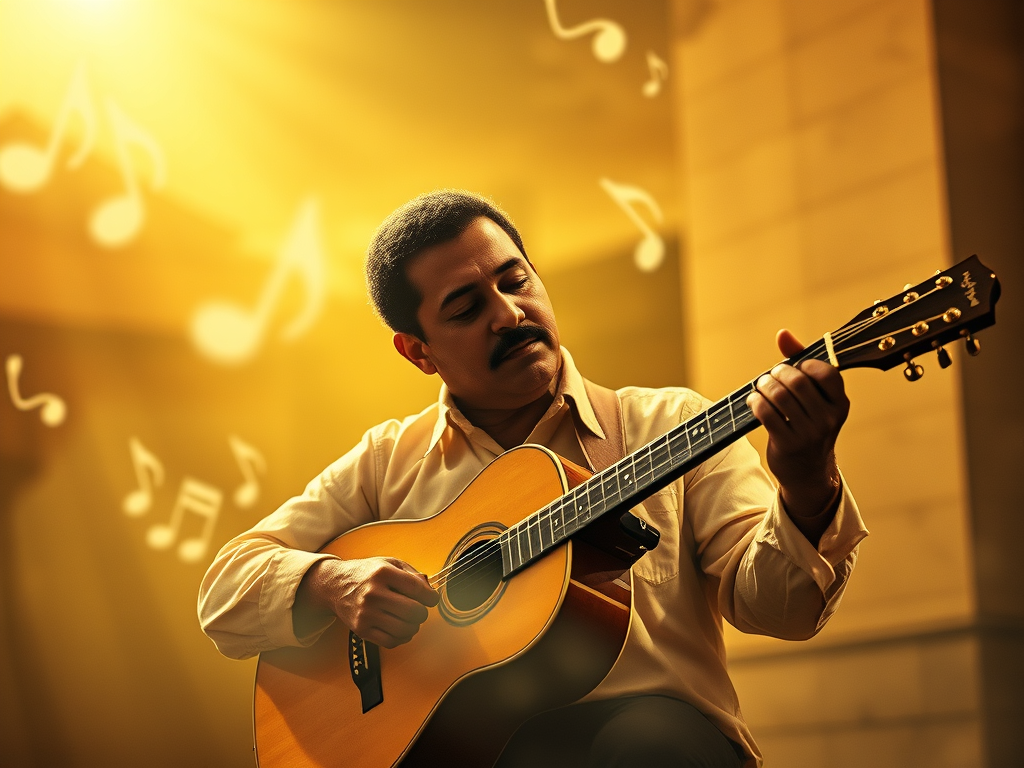

The Legacy of ‘Chan Chan’: From Cuba to Broadway

One night in 1984, the renowned Cuban singer and guitarist, Compay Segundo, experienced a dream that would lead to the creation of his most iconic composition.
“I awoke to the sound of four delicate, haunting notes,” he later recounted. “Inspired by a childhood fable, ‘Juanica y Chan Chan,’ I crafted lyrics to accompany the melody.”
“Chan Chan” is a mesmerizing depiction of rural life in Cuba, its hypnotic four-chord introduction instantly recognizable. Initially, the song gained regional popularity when guitarist and vocalist Eliades Ochoa recorded it. However, it wasn’t until 1996, when a collective of esteemed Cuban musicians came together for an album titled Buena Vista Social Club, that the song transformed into an international sensation.
More than 25 years after the album’s release, Buena Vista Social Club—the best-selling world music album of all time—has now been adapted into a Broadway musical of the same name. Within the production, “Chan Chan” is one of eight featured songs from the original album, playing a pivotal role at a critical moment in the storyline.
When the album was released in 1997, it introduced audiences worldwide to classic Cuban sounds, and “Chan Chan” emerged as a standout track. Though it was never officially released as a single, it has amassed over 250 million streams on Spotify—far surpassing any other song on the album. To put this into perspective, its streaming numbers are on par with 1997 chart-toppers like Toni Braxton’s “Un-Break My Heart” and Hanson’s “MMMBop.”
Understanding the significance of “Chan Chan” for audiences, the creative team behind the Broadway musical, currently running at the Gerald Schoenfeld Theater after an initial Off-Broadway premiere in 2023 at the Atlantic Theater Company, grappled with how best to incorporate the song. Despite its iconic status, its introspective and atmospheric nature posed a challenge—it wasn’t an obvious choice for an opening or grand finale number.

“We knew it had to be in the show,” said Marco Ramirez, who wrote the musical’s book, which moves between the years 1956 and 1996. He and the team debated its placement: “Should we start with it? End with it? Save it for an encore? It was a fluid decision.”
Initially, Ramirez envisioned “Chan Chan” as a personal “Moby Dick” moment for Segundo, who was 89 during the Buena Vista Social Club recording sessions—a declaration of artistic immortality. “It was like ‘One Song Glory’ from Rent,” he explained. “Compay Segundo was capturing how music allows one to live on forever.”
Dean Sharenow, the musical’s music supervisor, noted that aside from deciding where to place “Chan Chan,” the team also had to balance Spanish-language songs with English dialogue.
“We experimented with different placements—at the end of Act One, as a recording session performance—but it never fully connected,” he said. “Given the song’s immense popularity, we had to ensure it had emotional weight, yet its relaxed tempo made it challenging.”
Eventually, the song found its rightful place at the story’s turning point. In 1950s Cuba, the character of Omara Portuondo, a young singer, faces a life-changing decision: leave for New York with her sister to pursue a prestigious recording contract or remain in Havana as the revolution unfolds.
“The sisters’ separation symbolizes Cuba’s division—some people left, while others stayed,” explained director Saheem Ali, a Tony nominee for Fat Ham. “It’s a crossroads moment. The song is about travel and direction, but here, it’s also about our protagonist’s personal dilemma—should she go left or right?”
During this scene, “Chan Chan” is the only song that functions more like a film score than a stage performance. Unlike other musical numbers where actors or the band take center stage, here, the song serves as an internal reflection, reinforcing the weight of the decision before Omara.

To enhance the song’s impact, layers were added to its musical arrangement. In addition to the signature rolling riff played on the tres (a Cuban guitar) and a spirited trumpet solo, Marco Paguia’s arrangement subtly incorporates motifs from other songs in the show. “Memory and music are deeply interwoven in this production, and ‘Chan Chan’ epitomizes that connection,” Paguia noted. The New York Times critic Elisabeth Vincentelli echoed this sentiment, writing, “The music takes center stage, and we immediately grasp its communal power.”
Dance plays a crucial role in the show, particularly in the staging of “Chan Chan.” Choreographers Patricia Delgado and Justin Peck incorporated callbacks to earlier moments in the performance, while also infusing ballet-inspired movement into the ensemble’s routine. “Ballet is fundamental to Cuban culture,” Delgado remarked. “We wanted to reflect that grace, that fluidity—something lyrical and elongated, rather than sharp or percussive.”
For Delgado, who grew up in a Cuban family where “Chan Chan” was ever-present, the number required close collaboration across all creative departments. “We couldn’t finalize ‘Chan Chan’ without everyone in the room,” she explained.
Indeed, just two weeks before opening night, aspects of the scene were still being refined. “No surprise—it’s the number we’re still fine-tuning,” Ali admitted. “We’re figuring out the ideal length, the right feel.”
The song’s opening notes often elicit immediate applause from audiences. However, Sharenow emphasized that the most telling reaction is the silence that follows. “People don’t know what to expect next,” he said. “They’re being drawn into a story in a way that differs from the rest of the show.”

Segundo’s composition resonates on an almost subconscious level. “He tapped into a set of chords that stir something deep within us,” Ali reflected. “It evokes emotions you can’t quite put into words.”
Billboard’s chief content officer for Latin music, Leila Cobo, attributes the song’s unlikely global appeal to its distinctive opening. “The first time I heard it, I thought, ‘This is just an old Cuban song sung by an old Cuban man.’ But when you really listen, the beginning is almost rock-like—it doesn’t sound like traditional Cuban music at first.”
She likened its crossover success to Livin’ la Vida Loca: “I’m not saying they’re the same, but both have elements that make them accessible to wider audiences. ‘Chan Chan’ starts in a way that feels familiar—even before you realize it’s in Spanish and sung by an elderly voice, you’re already hooked.”
The song’s influence continues today, inspiring Cuban musicians like Camila Cabello. “It’s slow, sultry—nostalgic yet timeless,” she shared via email. “Every artist strives to create a song that feels both classic and personal, and ‘Chan Chan’ achieves that.”
David Bither, president of Nonesuch Records, vividly remembers hearing the album for the first time. “There was an immediate magic to it. Maybe I’m romanticizing it now, but from the first listen, we all felt it.”
Decades after Segundo dreamt of those simple, evocative notes, the song remains a cultural touchstone. What started as a melody in the mind of an aging guitarist became the heart of an album that redefined Cuban music—and now, it has found a new life on Broadway.
In a sense, the song has come full circle. “That moment in the show feels like a dream,” Sharenow said. “And for that, you need a song that transports you into a trance.”




Leave a Reply