
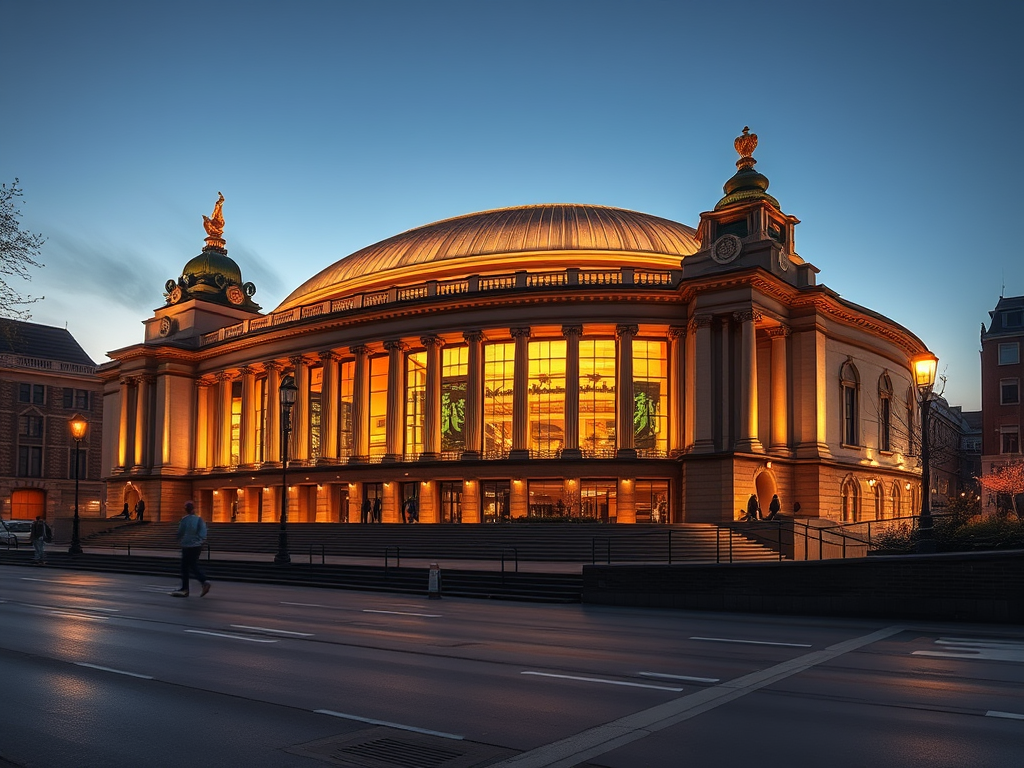

Opera Has a Sustainability Problem. One Company Wants to Fix It.

Opera is a unique fusion of multiple art forms—music, theater, dance, visual arts, and even film—all converging to create an extraordinary, yet fleeting, experience. This grand performance tradition brings together artists, creative teams, and audiences from across the globe, but such an elaborate art form inevitably carries a significant environmental impact.
The carbon footprint of opera extends far beyond the travel required for international productions. Companies striving for sustainability must consider every aspect of their operations: the materials used in costumes and sets, the energy efficiency of their theaters, and even the environmental impact of food and drink served during performances. Audience transportation, which often involves thousands of people commuting to and from venues, also plays a crucial role in the overall ecological footprint.

Given the financial pressures many opera houses face, transitioning to greener practices can seem daunting. However, the Dutch National Opera in Amsterdam has emerged as a leader in this movement, taking significant strides toward sustainability. While achieving carbon neutrality remains an ambitious long-term goal, the company has implemented numerous changes at an impressive pace.
As part of its Green Deal initiative, the Dutch National Opera has integrated sustainability into nearly every facet of its operations. In a groundbreaking move, the company revised its contracts to require that at least 50% of materials used in new productions be recycled. According to Sophie de Lint, the opera house’s director since 2018, this shift has been met with enthusiasm rather than resistance.
“If an artist says, ‘Sorry, but I’m not interested in your Green Deal,’ that’s fine,” de Lint stated. “We shake hands and move on. But that hasn’t happened. People are actually very open and want to be part of this initiative.”

One advantage for the Dutch National Opera is its location in the Netherlands, a country where sustainability is deeply ingrained in everyday life. Generous state funding also supports these efforts, making it easier to implement large-scale environmental initiatives. In contrast, many opera houses in the United States struggle with tight budgets and a politicized discourse around climate change, making even small changes—such as eliminating plastic Champagne flutes—a challenge.
De Lint, who previously served as artistic director at the Zurich Opera House in Switzerland, was drawn to Amsterdam partly because of its progressive cultural approach. “Here, people don’t dwell on what was better in the past,” she noted. “It’s about what can be improved for the future.”

One of the opera’s early steps toward sustainability came in 2019, when it earned certification through the Building Research Establishment Environmental Assessment Method (BREEAM), similar to the LEED certification in the U.S. The opera house installed solar panels, adopted eco-friendly waste disposal methods, and even created spaces to promote local biodiversity, such as bird nest boxes and insect-friendly gardens.

The COVID-19 pandemic further demonstrated how quickly operational habits could change, reinforcing the potential for sustainability initiatives. In 2021, the company appointed a sustainability coordinator, Julie Fuchs, who took on the task of measuring the carbon footprint of every aspect of opera production. Her findings revealed that the greatest emissions sources were audience transportation and concessions sold at the theater’s bars.
While it is difficult to control how audience members travel to the venue, internal operations were rapidly adjusted. Guided by the Paris Agreement’s goal of reducing emissions by 50% by 2030, the Dutch National Opera began implementing data-driven sustainability measures. For example, Fuchs analyzed whether shifting to a paperless office would be environmentally beneficial compared to continued paper use, ultimately confirming that digital storage was the greener option.

The opera house also revamped its food services, offering only vegetarian meals, including a plant-based version of the Dutch delicacy bitterballen. At a banquet for major donors, guests only realized mid-meal that no meat or fish had been served—a testament to the effectiveness of seamless change. Meanwhile, the theater’s bar eliminated disposable dishware and plastic bottles, and LED lighting replaced traditional bulbs throughout the venue. Staff air travel was also significantly reduced, with remote meetings prioritized and artists encouraged to remain in Amsterdam for extended periods rather than making frequent trips.
In addition to modifying operational practices, the Dutch National Opera has embedded sustainability into the creative process itself. From the earliest stages of production planning, discussions about environmental impact take place. The company has built a database cataloging reusable props and costumes, and it provides artists with a sustainability guide for materials, ranking them by ecological impact. Aluminum, for example, is highly discouraged due to its resource-intensive production, while wood and repurposed materials are favored.
This commitment to sustainability has influenced the opera’s programming decisions as well. If a project’s artistic vision conflicts with environmental goals, the company is prepared to make difficult choices. “If something isn’t working, we can be radical and say, ‘No, we’re not doing this anymore,’” de Lint explained. “It’s tough, but necessary.”

There is no single formula for integrating sustainability into opera, as each production presents unique challenges. However, the company learns with every new project. Ellen Reid’s opera The Shell Trial, which focused on climate change, aimed for near-carbon neutrality. When the creative team insisted on including fire and ice in the production, Fuchs sought a compromise—reducing the gas consumption for the fire effect by 50% while still maintaining the artistic vision.
The Opera Forward Festival has further pushed sustainability boundaries, featuring three world premieres designed with eco-friendly principles. Productions like We Are the Lucky Ones and Oum utilized portable, low-impact staging, while costume designers consciously avoided environmentally harmful materials like silk.
Ultimately, the Dutch National Opera hopes to inspire a broader cultural shift. Director Gregory Caers, who staged Codes with a cast of 170 young performers, believes that conversations about sustainability extend beyond the stage: “When we discuss these issues with young artists, they take these ideas home and share them with their families.”
By embedding sustainability into every aspect of its productions, the Dutch National Opera is not only reducing its environmental impact but also setting a new standard for the industry. As the world grapples with climate change, initiatives like these offer a glimpse of how even the most tradition-bound art forms can evolve to meet the demands of a more sustainable future.




Leave a Reply