
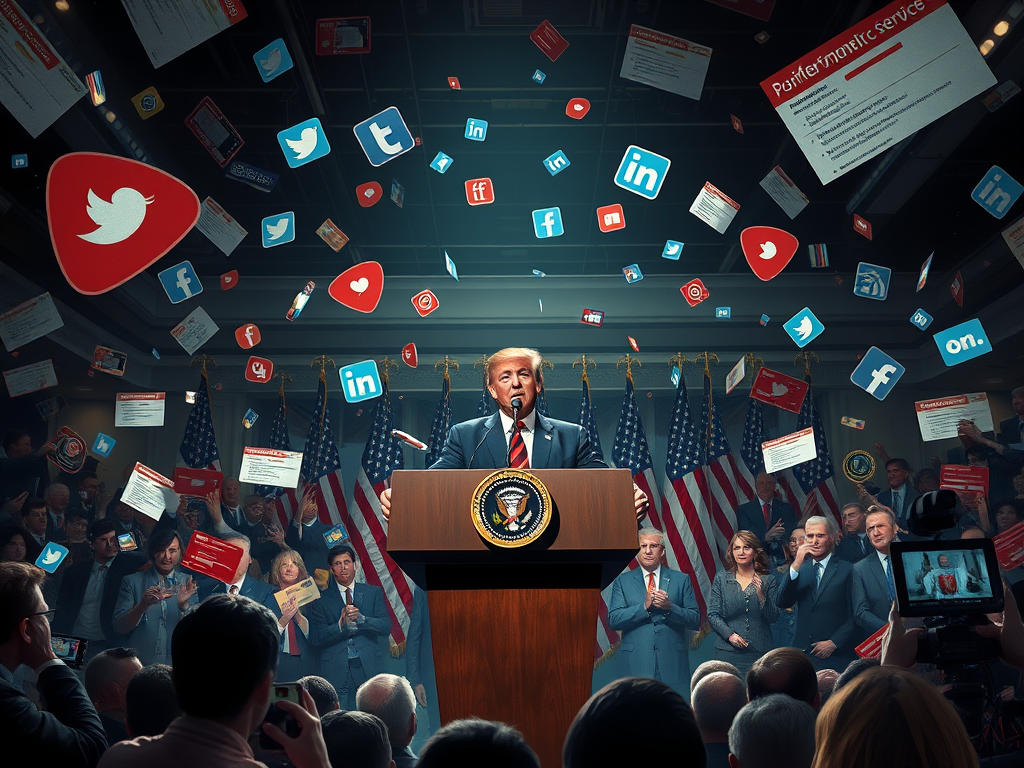

In His Second Term, Trump Fuels a ‘Machinery’ of Misinformation

In her debut briefing as White House press secretary, Karoline Leavitt declared her dedication to “telling the truth from this podium every single day.” Shortly after, she made the claim that the new administration had blocked a $50 million contract for condoms in Gaza.
“This is an outrageous waste of taxpayer money,” she said.
However, this statement quickly unraveled as a baseless and implausible assertion. While there were significant federal funds allocated to combat sexually transmitted diseases in Gaza, the money was directed to Mozambique, not the Palestinian territory.
Despite being fact-checked, the condoms claim spread widely, gaining traction in the political narrative that President Trump has used to rationalize his aggressive push to reduce federal spending.
Trump’s first term was marked by an overwhelming number of false or misleading claims—30,573, or an average of 21 a day, according to one tally. During that time, aides often tried to mitigate the impact of these falsehoods.
Now, in his second term, Trump is not alone in spreading disinformation. His cabinet members and advisors amplify these falsehoods, even spreading their own, effectively embedding disinformation into the political system.

Although it’s still early in his second term and many of his executive orders face legal challenges, Trump and his team have ushered in an era of post-truth politics, where facts are contested and falsehoods serve to advance policy goals.
Trump justified pardons for hundreds of rioters convicted of violent actions, including assaults on police officers during the Capitol riot on January 6, 2021, by claiming they had not attacked anyone. He also blamed Canada for the fentanyl crisis, despite the fact that less than 1 percent of fentanyl in the U.S. was traced to the country.
Brooke Rollins, Trump’s agriculture secretary, claimed she had canceled a $600,000 contract for a study on the menstrual cycles of transgender men, when in reality, the study focused on using natural fibers like cotton and hemp in feminine hygiene products.
Robert F. Kennedy Jr., the vaccine skeptic now heading the Department of Health and Human Services, falsely claimed that the measles vaccine kills people every year, a statement debunked by scientists.

Audrey McCabe, an analyst at the nonpartisan government watchdog Common Cause, said the administration’s approach amounts to a strategy of “disinformation overload,” which is overwhelming not just its opponents but also the judicial system.
Falsehoods that once circulated in the darkest corners of the internet are now pushed by Trump and his appointees, amplified by a media echo chamber, distorting political discourse and eroding trust in institutions.
Elon Musk, who has led a crusade against federal spending, has frequently spread disinformation, including the false claim about the condoms for Gaza. He has admitted to mistakes but continues to spread misleading statements.
Musk recently called Social Security “the greatest Ponzi scheme of all time,” suggesting that a popular government program is a criminal activity.
While some of these statements may be exaggerated for effect, others are clear attempts to mislead Americans, falling under the category of disinformation.
The rise of such false claims is also tied to seismic changes in the media landscape. Many Americans have moved away from traditional news outlets and now rely on a digital landscape dominated by podcasts, livestreams, and social media feeds, where partisanship often prevails over fact-based discourse. While the left has its preferred media, the right has gained control of this new media ecosystem.

In a lecture last month, Kate Starbird, a disinformation expert at the University of Washington, described this ecosystem as a “machinery of bullshit,” one designed over time to manipulate and control public discourse.
Trump’s second term has helped bring a new generation of online influencers to the forefront, many of whom echo his views across platforms, blurring the lines between professional media and partisan political commentary.
One such influencer, Brian Glenn of the right-wing streaming platform Real America’s Voice, criticized Ukrainian President Volodymyr Zelensky for not wearing a suit during his meeting with Trump in the Oval Office, playing into White House aides’ frustrations.
For Trump’s supporters, the current political moment feels like a battle over the truth, one they believe they are winning.
“We are waging a 21st-century information warfare campaign against the left,” said Jesse Watters of Fox News last month.
Trump’s false claims, such as the condoms for Gaza story, spread rapidly through online platforms, even before mainstream media could verify the facts. Websites and TV shows, particularly right-wing outlets, fueled the false narrative, claiming fraud at the U.S. Agency for International Development (USAID).
An article from Front Page Magazine dubbed the supposed aid “terror condoms,” connecting the claim to an old story about Hamas using condoms to launch explosives.
Within 24 hours, posts on Musk’s platform X, along with mentions on podcasts and TV shows, had reached over 111 million views, according to one tracking service. Despite extensive fact-checking by organizations like The New York Times, the false claim continued to spread.
USAID reported spending $61 million on contraceptives worldwide in 2023, mostly in Africa, with no funds directed to Gaza. Additionally, a $68 million grant went to emergency medical aid in Gaza, but it did not include condoms or family planning services.

Undeterred, Trump reiterated the false claim, stating that the U.S. had spent $100 million on condoms for Hamas fighters, and falsely insisted that they were used to make bombs. This assertion continued well after it had been disproven.
Despite numerous debunkings, false claims about USAID’s spending on Gaza contributed to the Trump administration’s efforts to slash the agency’s budget. Secretary of State Marco Rubio announced plans to cancel over 5,200 contracts, reducing the agency’s total budget by 83 percent.
In response to questions about these falsehoods, officials have occasionally deflected or attempted to downplay the inaccuracies. For example, a spokesperson for the Department of Health and Human Services cited a Fox News opinion piece by Robert F. Kennedy Jr., which made dubious claims about vaccines, and a statement from the Department of Agriculture clarified the nature of Rollins’ canceled contract.
Trump has also shown hostility toward efforts to track and address misinformation, such as his moves to dismantle government agencies designed to tackle disinformation.
Meanwhile, media platforms have also faced increasing pressure from the right. Meta, under CEO Mark Zuckerberg, recently ended its third-party fact-checking program, bowing to Republican criticism that fact-checking was politically biased. Instead, the company plans to rely on community-driven fact-checking, a strategy already used by Musk on X.
Trump’s supporters often frame his false or exaggerated statements as negotiation tactics, with Trump himself saying that repeating a lie long enough will make people believe it. However, the consequences of this strategy are far-reaching, undermining trust in both the administration and its policies.

The spread of misinformation, especially regarding critical issues like Ukraine, has made it difficult to have rational discussions on important topics. For example, Trump’s false claim that Ukraine is responsible for the war with Russia has led to confusion, as it ignores the fact that Russia invaded Ukraine in February 2022.
Trump’s lies have angered many of his allies, particularly in Europe, and have prompted ridicule on the global stage.
Laura Thornton of the McCain Institute argued that Trump’s rewriting of history on Ukraine aligns with Kremlin narratives, undermining international consensus on the facts. “A new narrative has emerged,” she said, “one that’s unfortunately very much in line with the Kremlin’s version of events.”




Leave a Reply