

To Him, Americans Were Always Heroes. He’s Not So Sure About Today’s.

For eighty years, Henri Mignon has regarded Americans as heroes. Twice, they liberated his small Belgian hometown of Houffalize from German occupation—the second time when he was just eight years old, only hours after shrapnel from a bombardment claimed his father’s life.
The memory of U.S. soldiers handing out chewing gum to local children has stayed with him ever since. For more than three decades, he has devoted himself to recounting the history of the war, guiding tourists eager to learn about the last major German offensive on the Western Front in this region near the Belgium-Luxembourg border.
However, this month, 88-year-old Mr. Mignon felt uneasy as he prepared for his Saturday morning Battle of the Bulge tour in Bastogne, a town just south of Houffalize.
His apprehension followed the disastrous meeting between Ukrainian President Volodymyr Zelensky and then-President Donald Trump in the Oval Office, as well as Trump’s increasingly conciliatory stance toward Russian leader Vladimir Putin.
Mr. Mignon was accustomed to depicting Americans as heroes and emphasizing the deep ties between this part of Europe and the United States. But this time, he found himself uncertain about how to characterize the relationship.
“I feel it is changing,” he admitted in the days leading up to the tour.
Though he had previously questioned aspects of American foreign policy—during the Vietnam War and at times in the Middle East—recent events had unsettled him and his fellow guides in a way they had not experienced before. Like many Europeans, they felt their longstanding admiration for the United States faltering.

Some guides even contemplated ceasing tours for American groups altogether. Mr. Mignon never considered that, but he did worry about how to frame his narrative as he led a group of students and teachers from North Carolina through Bastogne. Could he still emphasize the historic bond between Europeans and Americans when, from his vantage point in Belgium, the modern United States seemed far less heroic?
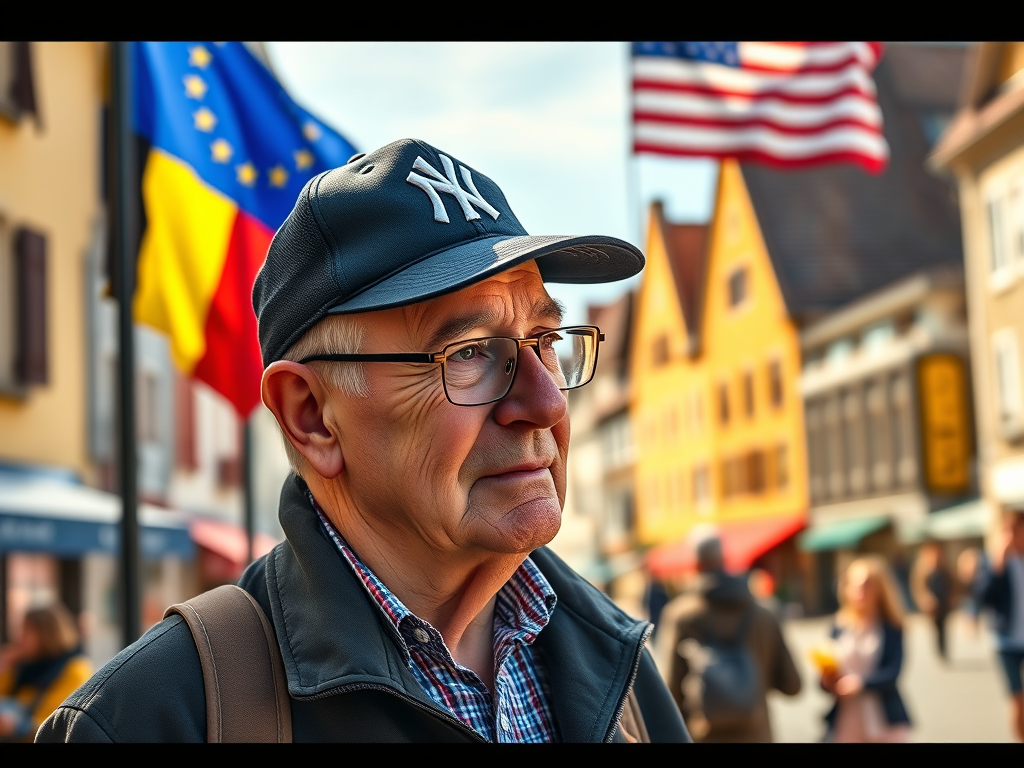
The sun shone brightly in the clear March sky as Mr. Mignon, energetic despite his white hair and wearing a Yankees cap, waited in Bastogne’s town square for the students to gather. Behind him, the flags of Belgium, the European Union, and the United States fluttered gently as the visitors arrived, carrying bags of Belgian chocolate.
He broke the ice with a joke about his name, which means “small and cute” in French, before launching into his tour. He recounted how the Germans had occupied Bastogne for much of the war. The Americans first liberated the town in September 1944, but by December, the Germans had recaptured it. It was then freed once again by American forces during the Battle of the Bulge.

The book and television series Band of Brothers prominently feature the events in Bastogne, and as the students boarded their tour bus, Mr. Mignon directed the driver past real-life locations depicted in the show. He narrated the true story of Easy Company, the unit at the heart of the book and series.
Bastogne, he explained, remains a deeply “American town,” where the bell tower still plays the opening notes of The Star-Spangled Banner every hour.

At one stop, beneath a memorial bearing the names of American states, Mr. Mignon took the students into an underground crypt dedicated to fallen soldiers and shared “his war.”
He recalled the day he was suddenly sent home from school with assurances he would return soon—it would be more than a year before that happened. He described the German soldiers who occupied every corner of his home, from the basement to the attic, growing increasingly hostile as the war dragged on. He recounted the final day of the second occupation, when American troops rescued him in a jeep as his family home burned in the crossfire.
His family, he said, lost everything in the war, but it was the Americans who helped them rebuild.
After the war, Mr. Mignon completed his education, studied military history in Brussels, and eventually became an officer in the Belgian Army. In retirement, he returned to his small hometown in French-speaking Belgium and dedicated himself to historical tours.

As he spoke, his tone reflected the precision of someone who has told a grim tale hundreds, perhaps thousands, of times. He offered no direct commentary on Trump or on how America’s military role in Europe 80 years ago contrasts with its current stance. He had decided that this tour was about honoring the veterans of the past, not analyzing the America of today.
The American visitors, for their part, avoided discussing politics during their trip, which had begun in France and would later take them to Germany.
“My responsibility as a government teacher is to teach how the government works and is supposed to work,” explained Laura Krizan, one of the teachers leading the group. “I’d rather them graduate and not know how I vote.”

Even the Europeans they met seemed hesitant to bring up current affairs, observed Thomas Boyreau-Suzémont, who had helped organize the tour through various World War II sites. Yet, despite the silence, he acknowledged that political concerns were ever-present.
“We never imagined this alliance could be at risk,” Boyreau-Suzémont said of the European-U.S. relationship. “People are in shock.”
At the final stop of the tour—a peaceful pine forest hiding the remnants of foxholes once occupied by Easy Company—Mr. Mignon’s usual composure slipped.
Using his cane, he pointed out the depressions in the earth where American soldiers had taken shelter from relentless shelling and gunfire during the brutal winter months. The towering trees above, he noted, had grown after the war; they had not “witnessed” the battle.
The students, who had been polite but reserved throughout the tour, were suddenly captivated. The foxholes resonated with them more than any other site. When Boyreau-Suzémont suggested it was time to leave, Mr. Mignon protested. They had not yet visited the most significant, best-preserved foxholes.
“Je cours,” he insisted. “I’ll run.”
And so, they stayed.
Yet even a man so deeply immersed in the past could not entirely separate himself from the present.
On the bus ride back, with only minutes remaining, his resolve to avoid modern politics wavered.
He was describing the annual May 8 celebrations in Bastogne, when the town commemorates Victory in Europe Day with ceremonies honoring its American liberators. In Russia, the occasion is marked on May 9 due to the time zone difference.
Reflecting on the upcoming event, he quipped, “Perhaps your president will be in Moscow then,” pausing for effect.
“With his friends Putin, Xi Jinping, and Kim Jong-un.”
The bus fell silent.



Leave a Reply