

Angelina Jolie Wants to Pick Up Where Warhol and Basquiat Left Off

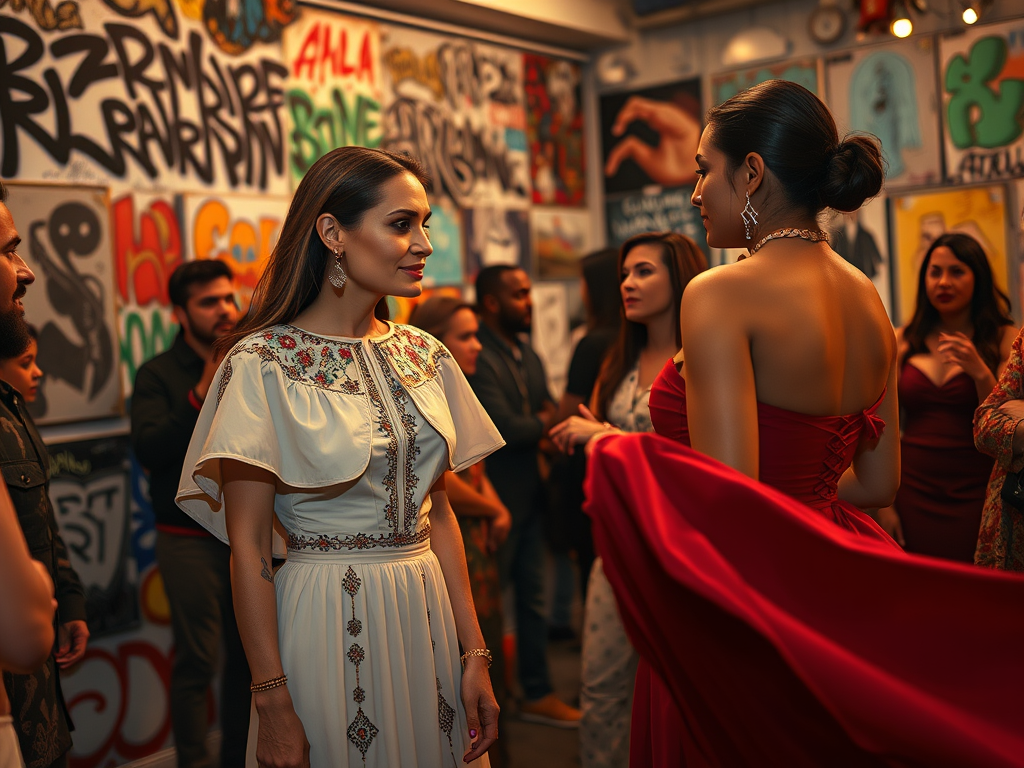
It was a Saturday night, and inside the graffiti-covered walls of Atelier Jolie, her downtown creative hub and gallery, Angelina Jolie engaged in a conversation with artist Shirin Neshat.
Their discussion was profound, touching on the struggles of refugees, women’s rights, the search for meaning in exile, and the role of art in all of it. Draped in a cream dress with an embroidered capelet, Jolie radiated warmth as she addressed the gathering of about 50 invited guests. “I’m so happy to be with all of you,” she said, emphasizing her desire for community to help her continue exploring ways to make a difference. For her, art was a form of dialogue: “I want to know if you feel the same pain.”

She listened attentively as Neshat, the Iranian visual artist and filmmaker, a striking presence with kohled eyes, shared her thoughts. “Art doesn’t just emerge from intuition,” Neshat explained. “It must stem from the life you’ve lived and connect to the world around you.”
During the reception, prominent figures such as musician Jon Batiste, writer Suleika Jaouad (his wife), and chart-topping rapper Jack Harlow mingled among the artwork. A Sufi dancer, dressed in a flowing crimson gown, spun gracefully between the painted walls.

Yet, despite being a globally renowned actress and humanitarian, Jolie was not the center of attention that evening—a role she was perfectly content with. “I love seeing what others create,” she remarked. “That’s part of my own creativity.”
For over a year, she has been working to establish Atelier Jolie as a dynamic space for artists, makers, chefs, students, and even Broadway performers. The building itself carries a rich artistic history: 57 Great Jones Street was once owned by Andy Warhol and later became the studio of Jean-Michel Basquiat until his passing in 1988.
Jolie envisioned the space as a cultural hub—a gathering place for inspired minds from around the world, where the public could explore, take workshops, and enjoy a slice of orange almond cake at Eat Offbeat, the global cuisine café inside.

However, bringing this vision to life proved more challenging than anticipated. “It’s been tricky,” she admitted in a recent interview. “A lot of it has been learning what not to do.”
Initially, Atelier Jolie launched as a pop-up fashion studio for visiting designers, capitalizing on the world’s fascination with fashion. “People focus on fashion,” she noted.
But she quickly realized it wasn’t her true passion—especially given fashion’s environmental impact, from water pollution to greenhouse gas emissions and excessive consumption. “I don’t want to tell people they need to buy something new every few months,” she said.
So, she pivoted. Instead of limiting the space to fashion, she opened its doors more widely, offering one of New York’s rarest commodities—square footage—for free.
French multimedia artist Prune Nourry, who helped organize the Neshat event as part of the Strand for Women exhibition, became Atelier Jolie’s artist-in-residence. She now occupies a second-floor studio, where she plans to craft large-scale sculptures over the next two years.
Another newcomer to the atelier is The Invisible Dog, a beloved Brooklyn art space with a 16-year legacy. Its original building is being redeveloped, prompting its founder and curator, Lucien Zayan, to seek a new home. After Nourry introduced him to Jolie, he quickly became immersed in programming exhibitions and building a new artistic community in Manhattan. Reflecting on the building’s Warhol-Basquiat era, he noted, “There used to be a big communal table where people gathered and talked. That’s exactly what she wants to recreate.”


For Jolie—an enigmatic figure in an age when most celebrities overshare on social media—opening a public space was an unexpected move. She has long been known for her advocacy rather than personal visibility, particularly in her work as a UN Refugee Agency envoy, a role she stepped down from in 2022 after more than two decades.
Yet, those who know her well recognize her as a connector—someone who welcomes people into her home, offers support, and learns through personal interactions. She has taken painting, dance, silk-screening, felting, and cooking classes at Atelier Jolie. “I wanted a place where I could spend time with local artists,” she said. She hoped to replicate the atmosphere of a film set, especially one with an international crew. “There’s a sense of purpose when you create alongside others,” she explained.
In Nourry, Jolie found a like-minded artist committed to fostering community. Through her nonprofit, the Catharsis Arts Foundation, Nourry has begun hosting monthly discussions at Atelier Jolie. The first event featured Dr. Rita Charon, a Columbia University professor and founder of narrative medicine, drawing deep thinkers like musician David Byrne. The topics vary (Neshat later led a discussion on Iranian liberation), but the central theme remains the same: Can art heal?
Jolie sees the atelier as a platform for discussion, not a space for dictating ideas.
Nourry, 40, and Jolie, 49, first met nearly a decade ago through filmmaker Agnès Varda, after Nourry was diagnosed with breast cancer. Having lost her mother, grandmother, and aunt to the disease, and undergoing a preventative double mastectomy in 2013, Jolie offered guidance and later co-produced Nourry’s 2019 documentary Serendipity, in which the artist explored her illness through art. In one of Nourry’s books, Jolie recalls visiting her Paris studio and admiring a wooden sculpture of a breast that had cracked during carving. “Isn’t it even more beautiful this way?” Nourry had asked.


Nourry’s Atelier Jolie studio—once home to Basquiat’s bed—is now filled with anatomical models and history books. Her Strand for Women project invites participants from around the world to donate a lock of hair in solidarity with the #WomanLifeFreedom movement for women’s rights. (Jolie and her daughters contributed their own strands.) The collected hair hangs in the atelier’s basement, alongside a dress-like sculpture made from hair by Iranian-German artist Homa Emamy, displayed in collaboration with Invisible Dog.
Collaboration is at the heart of everything. “That’s the rule—you can’t just come in for yourself,” Jolie explained. “You have to support other artists, too.”
Through Eat Offbeat, Nourry hosted an archaeological dinner led by an Afghan chef, featuring a traditional dish encased in clay. Guests were given small hammers to break open their meals, symbolizing the destruction of ancient Buddhist monuments by the Taliban in 2001, as well as Nourry’s own sculpted Buddhas.
Atelier Jolie is significantly smaller than the 30,000-square-foot Invisible Dog, but Zayan and Jolie share a common vision—one that integrates performance, treats dining as cultural dialogue, and prioritizes hands-on artistic creation. “When you create in the space, it changes everything,” Zayan said. “You leave behind a spirit, a soul. It’s not just about hanging art.”

Atelier Jolie, a for-profit public benefit corporation (certified as a B Corp), is providing Invisible Dog with a rent-free yearlong residency. In Brooklyn, the gallery required $500,000 annually just to keep running. Now, donations can directly support artists’ work. “We’re doing well, and we’re building a new model,” Jolie said, noting that Atelier Jolie has an eight-year lease on the building.
Zayan envisions the atelier becoming a major downtown destination, just as Invisible Dog was in Brooklyn. Jolie has been deeply engaged in the process. “You never know where she is or what time zone she’s in, but when you email her, she responds immediately,” he said. “She’s incredibly involved.”
Although fashion is no longer the atelier’s primary focus, Jolie still supports select designers, like Zarif, an Afghan artisan brand. Collaborating with its founder, Zolaykha Sherzad, she co-designed a capsule collection of embroidered jackets and capes, one of which she wore to the Neshat event. “She offered her atelier as a platform to highlight the craftsmanship, talent, and resilience of Afghan weavers and tailors,” Sherzad said.
While film remains a major part of Jolie’s life, she has been spending more time in New York, not only for the gallery but also as a producer of The Outsiders, the Tony-winning Broadway musical. Cast members often visit Atelier Jolie, helping shape its future as a creative space for young artists. “Seeing all these worlds come together—that’s what excites me,” Jolie said.




Leave a Reply