

A few years ago, NASA took a gamble, believing that commercial companies could transport scientific experiments to the moon at a lower cost than the agency itself.
After Lunar Disappointments, NASA Hits the Jackpot With Blue Ghost

Last year, that bet didn’t pay off. The first NASA-funded lander missed the moon completely, while the second made it to the surface but toppled over.
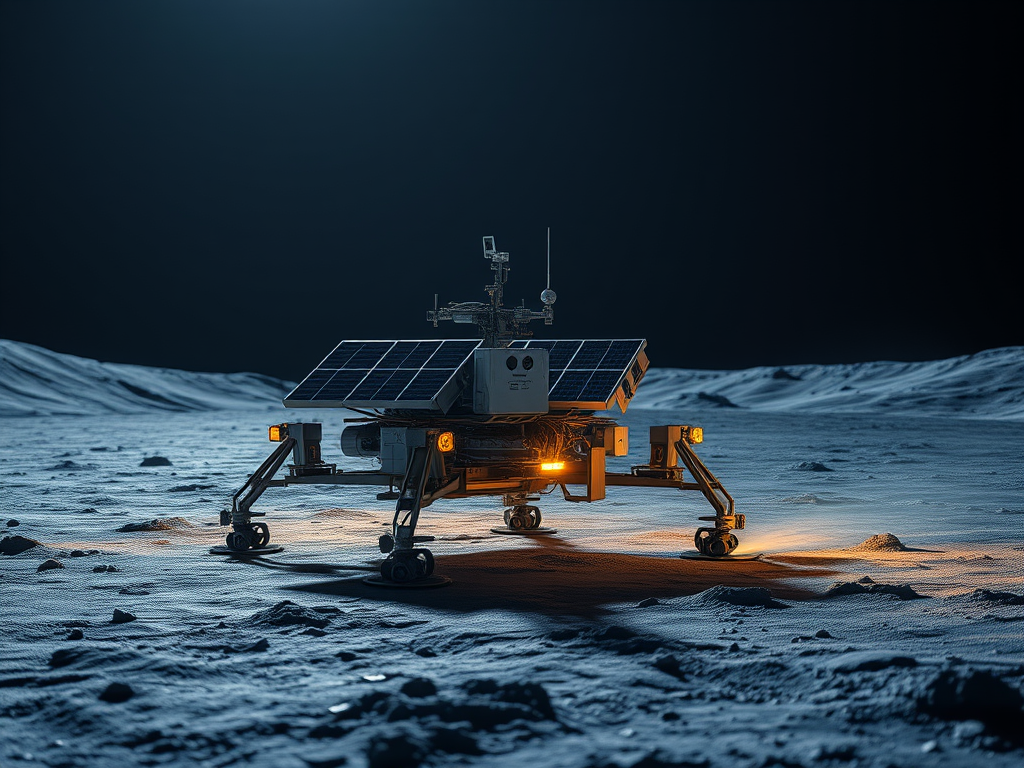
However, this month, Firefly Aerospace, based in Cedar Park, Texas, successfully completed its mission with the robotic lander Blue Ghost.
On March 16, at Firefly’s mission control near Austin, emotions were mixed—joyful yet wistful. There was nothing left to fix or worry about—only the final moments of the spacecraft to witness.
A quarter-million miles away, the sun had already set over Mare Crisium, the lunar lava plain where Blue Ghost had spent two weeks gathering scientific data.
With its solar-powered systems, the lander’s remaining hours were numbered.
“I think the overall mood is lighthearted,” said Ray Allensworth, Firefly’s spacecraft program director. “People are both thrilled and relieved that the mission was such a success, and they’re taking a moment to appreciate the lander’s final hours.”

For scientists who had invested years into experiments on other commercial moon missions, the outcome had often been disappointing, yielding little or no results. But those working with Blue Ghost were leaving with a wealth of new data.
Robert Grimm, a scientist at the Southwest Research Institute in Boulder, Colorado, who led one of the mission’s experiments, acknowledged his good fortune. “Better than ending up as just another crater,” he quipped.
One NASA experiment managed to capture data right at the moment of landing. Four cameras recorded multiple angles of the spacecraft’s thrusters as they stirred up lunar dust, creating a small crater in the process.
“These cameras allow us to analyze three-dimensional structures,” explained Paul Danehy, a scientist involved in the SCALPSS project (Stereo Cameras for Lunar Plume-Surface Studies).
Understanding this dust displacement is crucial for preventing hazards when larger spacecraft, like SpaceX’s Starship, begin landing astronauts on the moon. If NASA establishes a lunar outpost, repeated landings at the same site could send rocks flying, potentially damaging engines or nearby structures.

Initial reviews of the footage revealed an unexpected finding—Blue Ghost’s thruster exhaust began disturbing lunar dust while the lander was still about 50 feet above the surface, much higher than anticipated. The same camera system is set to observe dust behavior on a larger lander, Blue Origin’s Blue Moon Mark 1, scheduled for launch later this year.
NASA is also keen to study lunar dust, or regolith, and develop ways to mitigate its effects. These tiny particles can be as sharp as glass shards, posing a serious risk to both equipment and astronauts. Blue Ghost carried an experiment called the Electrodynamic Dust Shield, designed to use electric fields to repel dust from surfaces.
Additionally, two other experiments aimed to provide insights into the moon’s interior.
Dr. Grimm’s experiment, the Lunar Magnetotelluric Sounder, was the first of its kind deployed on another celestial body.
To operate, four spring-loaded launchers scattered probes, each about the size of a soup can, in different directions. Connected to the lander via cables, they functioned like oversized voltmeters. A separate instrument, mounted on an eight-foot mast, measured magnetic fields.
These measurements helped scientists analyze fluctuations in electric and magnetic fields to determine the conductivity of the lunar subsurface, offering clues about its composition. For example, colder rocks generally conduct electricity less efficiently.
Another key instrument aboard Blue Ghost was a pneumatic drill that used nitrogen gas bursts to excavate lunar soil. A needle at its tip measured temperature and thermal conductivity. Although scientists had hoped to drill 10 feet down, rocks in the way limited it to just three feet.
“You can actually see rocks flying out and even sparks in the footage,” said Kris Zacny, vice president of exploration systems at Honeybee Robotics, the company behind the drill.
Despite not reaching the full depth, the drill’s data was still valuable for scientific analysis. Combined with the magnetotelluric sounder, these results could help researchers understand how the moon—and other rocky planets—formed.
“We’re trying to answer a fundamental question about lunar geology,” Dr. Grimm explained.
Honeybee Robotics, now part of Blue Origin, also developed PlanetVac, a device that tested a simplified method for collecting samples. It used compressed gas to stir up lunar regolith, creating a small vortex that directed the material into a container.
The same technology will be used in Japan’s upcoming Martian Moons Exploration mission, which aims to retrieve samples from Phobos, one of Mars’s moons.

“The fact that it worked on the moon gives us confidence it’ll work on Phobos too,” Dr. Zacny said.
Meanwhile, another experiment onboard Blue Ghost wasn’t focused on the moon at all—it was studying Earth.
“It’s an excellent vantage point,” said Dr. Brian Walsh, a mechanical engineering professor at Boston University.
Dr. Walsh’s research focuses on the Earth’s magnetic field, which shields our planet from solar wind. His telescope aboard Blue Ghost captured X-rays emitted when solar wind particles collide with Earth’s upper atmosphere.
This interaction resembles two sumo wrestlers locked in a push-and-pull battle—the Earth’s magnetic field and the solar wind constantly shifting. Observing this boundary from space could help scientists understand whether these shifts occur gradually or in sudden bursts.
This research is crucial because it affects how well Earth’s magnetic field shields us from powerful solar storms, which can release massive amounts of charged particles toward our planet.
“We want to understand how energy from the sun makes its way through Earth’s defenses,” Dr. Walsh said.
Although Blue Ghost’s mission has ended, its legacy remains.
Maria Banks, reflecting on the mission’s impact, described a personal connection to the lander’s journey.
“Every night as I left mission control, I’d look up at the moon,” she said. “And it would just stop me in my tracks. I don’t think I’ll ever see the moon the same way again—because now, Firefly’s lander and our instruments will always be up there.”




Leave a Reply