
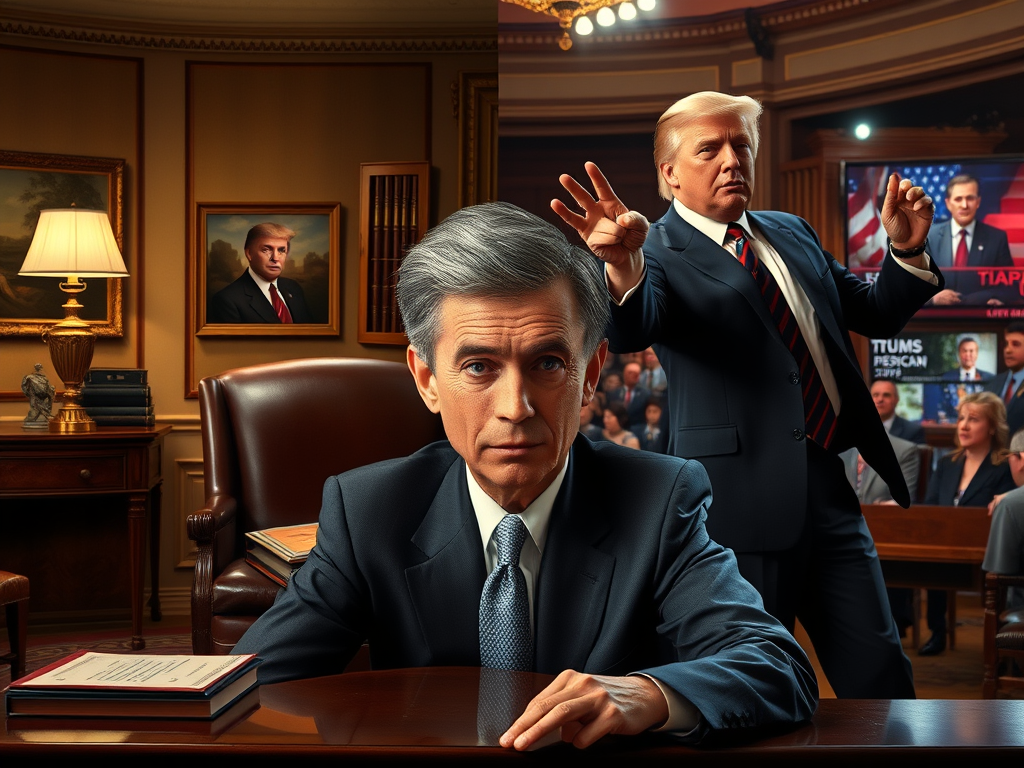

The Sudden Weirdness of TV Presidents

In Zero Day, former President George Mullen (Robert DeNiro) investigates the origins of a devastating cyberattack. Paradise features the hapless, nepotism-fueled President Cal Bradford (James Marsden), who is left to shoulder humanity’s fate after a catastrophic volcanic eruption—only to (minor spoiler) meet a grim end in his post-apocalyptic underground shelter. Meanwhile, in The Residence, a White House state dinner unexpectedly turns into a crime scene.
And yet, as I watch these political dramas unfold, I can’t shake a persistent thought: something feels off. Even when a show takes place in an immense subterranean city, it all seems too… ordinary.

It’s not just that real-world events have outpaced anything scripted for television. Increasingly, these shows seem to exist in an alternate dimension.
Traditionally, TV presidents—from Jed Bartlet in The West Wing to David Palmer in 24 and Fitzgerald Grant in Scandal—have adhered to a recognizable mold. They project stability and normalcy. They view federal agencies as tools for governance, not obstacles to be conquered. Their public statements are measured; they might raise their voices or even explode in anger, but only behind closed doors. Even their aesthetic—reserved, stately, understated—reflects quiet authority.
Now, compare that to reality. President Trump engages in a shouting match with Ukrainian President Volodymyr Zelensky—an allied leader—on live television, wrapping up the exchange by declaring, “This is going to be great television.” He arbitrarily renames the Gulf of Mexico, antagonizes Canada (mirroring a plotline straight out of South Park: Bigger, Longer & Uncut), and stages what is essentially a Tesla commercial on the White House lawn.

Watching fictional presidents today is like seeing the polarity reversed. The fundamental assumptions about how power operates and what it means to be president—about America’s role on the global stage—have shifted. The very details that once grounded political dramas in realism now make them feel like dispatches from an alternate timeline.
In television, presidents aren’t just vehicles for political commentary or symbols of moral leadership. They serve as structural elements of the narrative—key chess pieces that can move forcefully in many directions.
But they are also bound by rules. They represent a system that ensures every move follows a defined structure. Perhaps this is why presidents are rarely the central figures in political dramas; the real action belongs to the advisors, operatives, and power players orbiting them.

For example, Scandal—a show built around fixers who make political scandals disappear—relies on the premise that scandal itself is still a meaningful concept. Similarly, TV’s scheming presidents, like Charles Logan in 24 or Frank and Claire Underwood in House of Cards, operate in secrecy—driven by the now outdated notion that they fear consequences.
Corrupt, manipulative, or self-serving as they may be, fictional presidents remain institutionalists. They personify the structures they lead. Even when bending the rules, they acknowledge an overarching order.
But what happens when a real-life presidency wages war against the very institutions and conventions that define it? Suddenly, the long-standing assumptions underpinning political dramas feel as out-of-date as a pre-9/11 New York City skyline.

Take The Diplomat on Netflix. The show follows a U.S. ambassador (Keri Russell) navigating the fallout of a terrorist attack with suspected Russian involvement, all while managing the expected political calculations of the president (Michael McKean). While the series delivers plenty of twists, its most unrealistic element might be its foundational premise: a U.S. administration that still views Russia as an adversary and NATO allies as strategic partners. Similarly, The Residence revolves around a state dinner aimed at repairing relationships with Australia after a previous administration’s diplomatic blunders—again, assuming that such alliances still function within a predictable framework.
The dissonance extends to other genres, too. The espionage thriller The Agency assumes an America committed to postwar alliances. And in 3 Body Problem, the transatlantic collaboration between world powers seems more far-fetched than the concept of extraterrestrial invasion.
Has any show truly captured the essence of contemporary politics? Succession hinted at it, portraying an alt-right disruptor propelled to power by media influence—but it never depicted him governing. Paradise draws parallels to Elon Musk through the character of Sinatra (Julianne Nicholson), a tech mogul who constructs and ultimately controls an underground city. Yet, the show leans too much into fantasy and the redemptive power of empathy to fully mirror the present.
For something closer to reality, you have to look backward. HBO’s The Plot Against America, based on Philip Roth’s novel, envisions a U.S. presidency sympathetic to fascism in the early days of World War II. Charles Lindbergh, both in fiction and in real life, championed an “America First” movement and counted the openly antisemitic automaker Henry Ford among his advisors. More than most political dramas, the series captures the vertigo of a world where alliances flip, aggression is virtue, and empathy is weakness.

But perhaps the best reflection of our current presidency doesn’t come from political dramas at all. The Apprentice—with its boardroom eliminations and Trumpian brand of executive power—remains the most accurate depiction of his leadership style: a boss who thrives on unpredictability, pitting subordinates against one another to fuel competition.
And yet, watching the spectacle of a second Trump term—his cabinet meetings led by Elon Musk, billionaires in attendance at the inauguration—I was struck by an unexpected comparison: NBC’s short-lived 2009 drama Kings.
Unlike most political shows, Kings doesn’t revolve around a president but rather King Silas (played by Ian McShane), a modern-day monarch ruling the fictional land of Gilboa. (Fittingly, Trump himself has at times described his presidency in monarchical terms.) Silas claims divine favor, governs from a sleek corporate tower, and is propped up by a shadowy billionaire oligarch (Dylan Baker). Watching it now, it feels like an eerie dramatization of the CEO-led autocracy envisioned by right-wing thinkers like Curtis Yarvin.
Kings—which is now streaming on the Roku Channel—was an odd, offbeat series, too unconventional to last beyond one season. Yet in many ways, it feels more relevant than today’s so-called realistic political dramas.
For any future showrunner hoping to capture the dizzying instability of our current political moment, Kings offers a lesson: when the world turns upside down, sometimes the only way to capture it is to change the camera angle.




Leave a Reply