
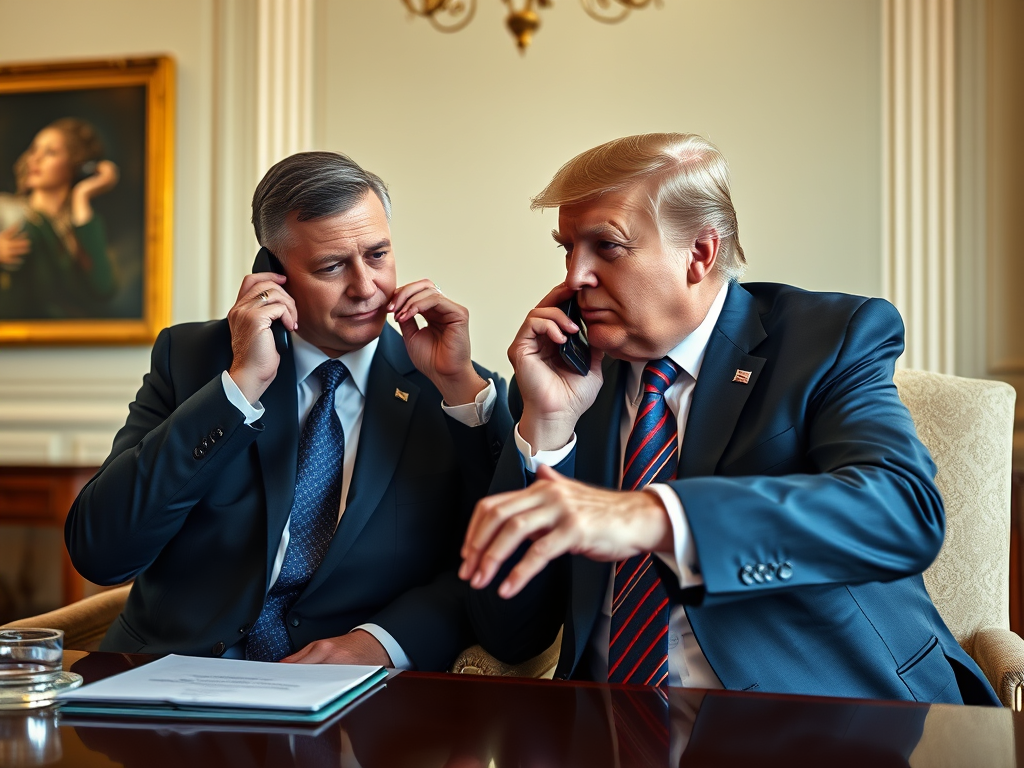

Ukrainian President Volodymyr Zelensky agreed during a phone call with former U.S. President Donald Trump on Wednesday to accept Russia’s proposal for a 30-day mutual pause in attacks on energy infrastructure, marking a step toward a broader cease-fire.
Zelensky Agrees to Halt Strikes on Russian Energy Targets in Call With Trump

However, the specifics of how and when this temporary halt in strikes would be implemented remained unclear. Later that day, during a press conference in Finland, Zelensky emphasized that “everything will continue to fly” until an official agreement was reached. He also noted that Russian drones were actively flying over Ukraine as he spoke.
During their conversation, Trump reportedly suggested the possibility of the United States assuming control over Ukraine’s power plants, according to an official U.S. statement. However, Ukrainian energy experts quickly dismissed the idea as likely unfeasible.
At the press conference, Zelensky clarified that he did not feel pressured by Trump regarding the proposal, which, he stated, concerned only a single power plant. He described the discussion with Trump as “the most substantive in recent times” and noted that the potential list of energy sites protected under the cease-fire could be extensive.

Despite this agreement on energy targets, a significant gap remains between Zelensky and Russian President Vladimir Putin regarding the broader terms for ending the war. Zelensky has previously criticized some of Putin’s proposals, viewing them as delay tactics aimed at securing a military advantage and extracting better terms from the U.S. president.
In a joint statement, U.S. National Security Adviser Michael Waltz and Secretary of State Marco Rubio announced that technical teams would convene in Saudi Arabia “in the coming days” to discuss expanding the cease-fire beyond energy infrastructure to include Black Sea operations, with the ultimate goal of a comprehensive cease-fire.
This marked the first direct conversation between Trump and Zelensky since a tense encounter in the Oval Office the previous month.
During that earlier meeting, Trump and Vice President JD Vance had criticized Zelensky for what they perceived as a lack of appreciation for U.S. assistance—most of which had been provided under President Joe Biden. Following the meeting, the Trump administration temporarily halted all military aid and intelligence-sharing with Ukraine. In the weeks since, Zelensky had been working to mend relations.
Wednesday’s remarks from Zelensky, Trump, and U.S. officials indicated that these reconciliation efforts had yielded some progress.
Trump described the hour-long call as “very good,” while Waltz and Rubio stated that it had played a key role in advancing the effort to end the war. Zelensky, too, characterized the conversation as “positive, very substantive, and frank,” and made sure to express gratitude for U.S. support.
However, the notion of the United States assuming ownership of Ukraine’s energy infrastructure presents a host of challenges. Both sides appeared to have differing interpretations of which facilities were under discussion.
Zelensky suggested the idea was limited to the Zaporizhzhia nuclear power plant—the largest in Europe—which is currently under Russian control.
“The discussion was solely about the facility under temporary occupation,” Zelensky clarified.

In contrast, the joint statement from Rubio and Waltz referred to “Ukraine’s electrical grid and nuclear power plants” more broadly, suggesting that the U.S. could provide operational expertise. They even implied that Ukraine might transfer ownership of these plants to the U.S., similar to how Washington has previously sought stakes in Ukraine’s mineral resources. Their argument was that U.S. ownership would deter Russian attacks on the infrastructure.
“American ownership of these plants would be the best safeguard for Ukraine’s critical infrastructure,” the statement read.
However, Ukrainian nuclear energy expert Olga Kosharna pointed out that privatizing such plants is prohibited under Ukrainian law. Other experts also voiced skepticism but acknowledged that U.S. involvement could improve operational management.
Putin had previously rejected a broader 30-day cease-fire proposal that would have covered land, sea, and air operations. Despite Kyiv’s reservations about negotiating with Putin, Ukraine agreed to this proposal under pressure from Trump during a recent meeting with U.S. officials in Saudi Arabia.
Nevertheless, Putin raised multiple objections and instead proposed a narrower agreement focusing solely on energy infrastructure.
Many analysts believe such a limited deal would primarily benefit Moscow, as Russian oil refineries have increasingly come under Ukrainian long-range attacks. While Russian strikes have significantly damaged Ukraine’s energy supply, Ukraine has learned to adapt over the course of the war and will soon have less reliance on heating as winter ends.
Maintaining that the broader negotiations remain on track, Trump wrote in a social media post that his discussion with Zelensky was a continuation of his prior call with Putin, aimed at aligning the demands of both Russia and Ukraine.
Trump’s diplomatic efforts, however, have put Zelensky in a difficult position. The Ukrainian leader fears that Trump, eager to secure a deal with Putin, could pressure Ukraine into making unwanted concessions. Additionally, some Trump officials and allies have accused Zelensky of obstructing peace efforts and have even hinted at seeking his removal from office.

Given Ukraine’s heavy dependence on U.S. military and financial support, Zelensky has little leverage and has attempted to accommodate Trump’s approach. On Wednesday, he stressed that any cease-fire agreement would require U.S. monitoring.
“Putin’s verbal promise not to attack energy sites is simply not enough,” Zelensky stated. “War has made us practical people.”
Speaking alongside Finnish President Alexander Stubb in Helsinki, Zelensky said Ukraine would compile a list of protected sites, adding that Ukraine would reciprocate only if independent monitoring confirmed that Russia was upholding its commitments.
The deep distrust between Ukraine and Russia was further evident on Wednesday, as both sides accused each other of targeting energy infrastructure.
Ukraine’s European allies cautiously welcomed the steps toward a cease-fire but remained wary of Russian conditions. They also reaffirmed their commitment to supporting Kyiv.
“There can be no half-measures: It’s a simple yes or no,” said Stubb. “Ukraine has accepted a cease-fire with no preconditions. If Russia refuses, we must intensify our efforts to strengthen Ukraine and increase pressure on Russia.”
By the end of the day, it was clear that intense diplomatic efforts concerning Ukraine’s future would continue.
Later in the evening, while participating in an online discussion from Finland, Zelensky briefly stepped away to take a call from another world leader—French President Emmanuel Macron. He promptly told Macron he was occupied and would call him back.



Leave a Reply