

Ellen Pompeo Leaves the Hospital

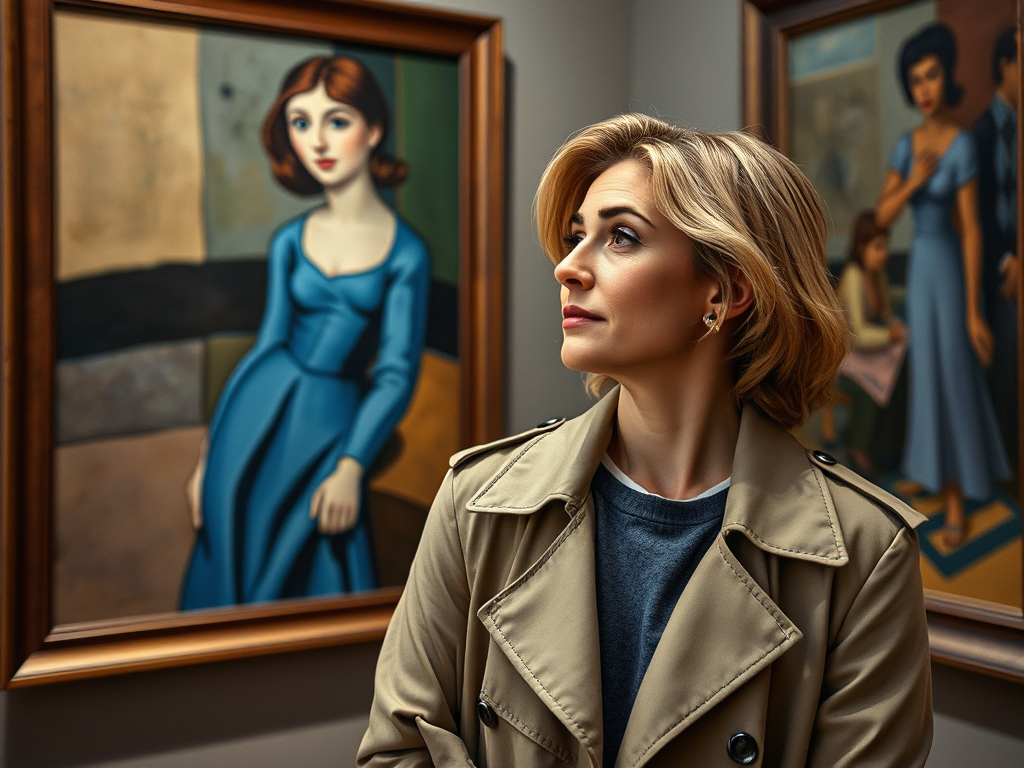
At the Los Angeles County Museum of Art, Ellen Pompeo stood surrounded by Picasso’s Cubist works. She lingered before a portrait of a woman in a blue dress—her eyes misaligned, her mouth skewed to one side, and her nose seemingly everywhere at once.
Tilting her head, Pompeo tried to piece the fragmented features into a single, cohesive face. Eventually, she gave up.
“There are three sides to every story,” she mused. “Or maybe six. Or nine. That’s what makes art so vital—it allows everyone to interpret it in their own way, to find their own meaning.”
For years, Pompeo’s Hollywood narrative seemed straightforward. She modeled sporadically in her twenties, landed a lead role in one film, and took on minor parts in others. Then, in 2005, she became the face of the most successful medical drama since ER—ABC’s Grey’s Anatomy. As Dr. Meredith Grey, she embodied a steady moral compass in a world of ethical ambiguity.
Beyond a few crossover episodes on Station 19, a guest voice role in Doc McStuffins, and a cameo in a Taylor Swift music video, Pompeo’s acting credits remained limited. It wasn’t a lack of ambition—rather, the grueling schedule of Grey’s left little room for other projects. When she became a mother, using her brief hiatuses to make films felt like an irresponsible choice. With her husband, Chris Ivery, working in marketing, she prioritized family life over additional roles.

In 2022, Pompeo renegotiated her Grey’s contract, scaling back her screen time. This opened the door to her first major role in nearly two decades: Kristine Barnett, a flawed suburban supermom in Good American Family, a Hulu limited series debuting Wednesday.
Based on a true adoption scandal gone wrong, Good American Family unfolds through multiple perspectives. In some, Kristine is a victim; in others, she’s the antagonist. Much like a Picasso, the audience is left to assemble their own version of the truth.
As she awaits the show’s premiere and the upcoming 20th anniversary of Grey’s Anatomy on March 27, Pompeo is reflecting on her career—the choices she’s made and the reasons behind them. Having played the same role for so long, she knows fans may struggle to see her as anything but Meredith Grey. Still, she felt compelled to try something new.
“I’ve been yearning for a fresh challenge for years,” she admitted. “I’ve always wanted another opportunity. Now that I finally have it, it’s terrifying. Maybe it’s reckless, maybe it’s foolish—but I’m trusting the universe.”

Pompeo, who suggested the LACMA visit, arrived in the early afternoon dressed in casual California chic—a trench coat over a sweatshirt, corduroy pants, and matching corduroy sneakers. Her lips gleamed with Rhode balm, a gift from Hailey Bieber herself.
It was January, and wildfires continued to rage, leaving the air thick with smoke. Pompeo’s Malibu home had been spared—for now. “For now,” she repeated, her tone resolute.
In person, Pompeo is sharp, wry, and coolly perceptive. She knows her worth and expects others to recognize it, too.
Her reputation for being outspoken, confident, and candid is well-earned. Katie Robbins, co-creator of Good American Family, affectionately described her as “salty, salty, salty.” Co-star Mark Duplass put it more bluntly: “A badass Boston bitch in all the best ways.” Shonda Rhimes, the creator of Grey’s Anatomy, praised her blend of warmth and quiet toughness.

Yet beneath her resilience, Pompeo has a reflective, almost philosophical side. Her mother died of an accidental overdose when she was just four, a loss that shaped her outlook. While she often contemplates why her life unfolded as it did, she rarely questions it.
“It’s my fate,” she repeated throughout our conversation. “It’s my fate.”
Her path was anything but predictable. Raised in a working-class Boston suburb, Pompeo had little exposure to the arts, though she adored movies—especially those starring Michelle Pfeiffer. Her aunt, for whom she was named, occasionally took her to Broadway musicals. After high school, she followed friends to Miami, working in bars before modeling gigs took her to New York. She knew she wasn’t built for the industry—too short, too opinionated.
“I had too much to say,” she recalled. “Too many opinions.” So, she turned to acting.
A sassy L’Oréal commercial landed her on casting directors’ radars. In 2002, she booked her first major film, Moonlight Mile. Her performance drew praise, but the film underperformed.

“And that was the best thing that never happened,” she said. “Because I probably would have become a complete [expletive].”
Other roles followed, some substantial (Old School, 2003), others cut down in editing. Television offers trickled in, but she resisted—she wanted to be a movie star, not a TV actress.
Then, a couple of years after Moonlight Mile, she was broke. Her agent urged her to take a TV pilot just to cover rent. Pilots rarely get picked up, he assured her.
Except this one did. “There’s your fate,” Pompeo told me.
For Rhimes, it was destiny as well. Envisioning Meredith, she asked casting to find someone like the girl from Moonlight Mile. The response? “We can get you the girl from Moonlight Mile.”
“There was a spirit about her,” Rhimes recalled. “A quality that made you want to watch.”
Grey’s quickly became a phenomenon. The pay was good, especially after Pompeo learned to negotiate. “Other women—Shonda included—taught me to ask for what I deserve.”
The hours were long but predictable, allowing her to stay in Los Angeles. Over time, she let go of her film ambitions. Then, she let go of hoping for an Emmy, even though she felt she deserved a nomination. “But that wasn’t my fate,” she shrugged.
Her feelings about Grey’s remain complicated. “Some seasons, I was motivated and excited. Other seasons, I wondered how I’d get through it.” She hid her exhaustion well.
“I love seeing her light up and have fun,” said Chandra Wilson, a fellow original cast member.
By the show’s tenth year, Pompeo no longer found it creatively fulfilling. “Not at all.” She started a production company, Calamity Jane, but struggled to sell projects. She feared she might never land another role.
The pandemic made her question everything. Secure yet uninspired, she contemplated leaving Grey’s for good.
“I couldn’t keep going,” she admitted. But she also couldn’t envision the show without her.

Dana Walden, then Disney’s entertainment chairwoman, proposed a compromise: Pompeo could scale back her episodes, freeing time for something new. She also suggested a Hulu project—Good American Family.
The series, inspired by the true story of a Midwestern couple who abandoned their adopted daughter, is told through conflicting perspectives. Initially, Pompeo was hesitant—she disliked true crime and feared the show might seem sensationalized. More concerning, Kristine was, in some versions, a neglectful mother. Would her own children understand?
Her agent convinced her. Kristine was so far from Meredith that it would prove Pompeo’s versatility.
At the same time, her Grey’s legacy worked in her favor.
“We needed someone viewers instinctively trust,” said Robbins. “Someone they want to believe in.” Pompeo fit the bill.
Duplass saw the advantage, too.
“What a weapon,” he marveled. “She knows the faith audiences place in her—and she wields it brilliantly.”
Pompeo’s approach to the role mirrored her work on Grey’s…




Leave a Reply