
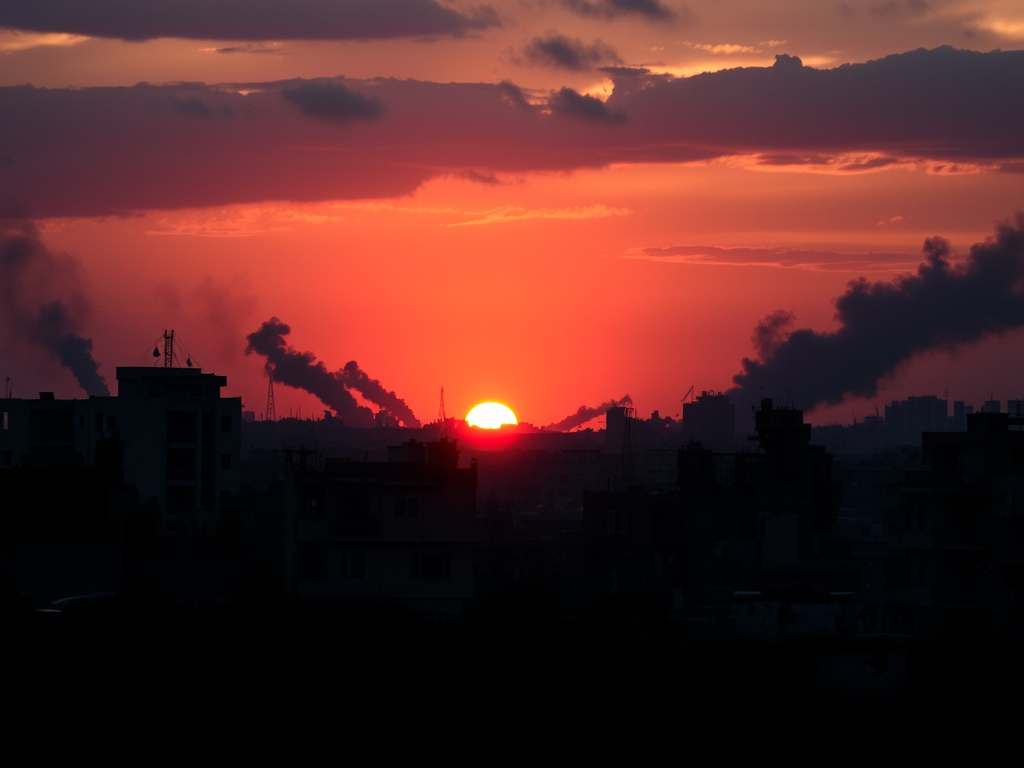

Israel Resumes Strikes on Gaza, Killing Hundreds, as Cease-Fire Breaks Down

Israeli forces launched a series of deadly airstrikes across the Gaza Strip on Tuesday, effectively ending a temporary cease-fire with Hamas that had been in place since January and raising the likelihood of a full-scale conflict resuming.
According to Gaza’s health ministry, more than 400 people, including children, lost their lives in the attacks. While the figures did not differentiate between civilians and combatants, the intense Israeli bombardment resulted in one of the highest single-day death tolls of the war.
The strikes followed weeks of unsuccessful negotiations aimed at extending the fragile cease-fire, which had temporarily halted 15 months of intense fighting. Although the truce’s initial phase expired in early March, diplomatic efforts had continued to push for an extension, with the goal of securing the release of Israeli hostages and bringing an end to the war.
Prime Minister Benjamin Netanyahu’s office stated that the military operation was launched in response to Hamas’s “repeated refusal” to release the remaining hostages captured during the October 7, 2023, attack on Israel, as well as the bodies of those who had died. Of the 59 hostages still in Gaza, fewer than half are believed to be alive.

In a speech on Tuesday, Mr. Netanyahu suggested that further Israeli military action in Gaza was imminent and would proceed alongside negotiations with Hamas.
“This is just the beginning,” he declared. “We will continue fighting until we achieve all of our war objectives.”
Hamas officials accused Israel of violating the cease-fire but did not immediately retaliate. It remained unclear whether the group—significantly weakened after more than a year of war—would launch a counterattack or return to negotiations.
Suhail al-Hindi, a member of Hamas’s political office, expressed hope for a renewed cease-fire but emphasized the group’s right to respond. “The decision on how to react is in the hands of those on the ground,” he said in a phone interview. “They know best how to confront the occupation.”
Israel’s foreign minister, Gideon Saar, revealed that the decision to carry out the strikes had been made days earlier after Hamas rejected two proposals from Steve Witkoff, President Trump’s Middle East envoy.
“This is not a one-day operation,” Mr. Saar stated in Jerusalem. “We will continue military action in the coming days. We reached a deadlock—no hostages were being released, and no military action was being taken. This situation could not continue.”

In Israel, families of the hostages expressed growing fears that their loved ones might never return alive. Some accused Mr. Netanyahu’s government of abandoning the captives, gathering in protests to demand an immediate agreement with Hamas for their release.
“Military action puts the hostages’ lives at risk and directly harms them,” said Alexander Troufanov, a former hostage freed during the recent truce, addressing a crowd in Tel Aviv. “Yet this morning, I was shocked to realize that the decision-makers are not listening.”
He added, “The hostages in Gaza are living through a nightmare because of the decision to resume fighting.”
The Trump administration, which has been involved in efforts to broker a deal between Israel and Hamas, appeared to support Israel’s decision to restart large-scale military operations in Gaza. White House Press Secretary Karoline Leavitt confirmed that Israel had consulted with the U.S. before launching its assault.

Brian Hughes, a spokesperson for the National Security Council, placed the blame on Hamas, stating that “Hamas could have prolonged the cease-fire by releasing the hostages but instead chose defiance and war.”
The Israeli airstrikes began just before 2:30 a.m. local time, with a level of intensity reminiscent of the war’s early days. Images from Gaza depicted widespread devastation—people searching through rubble by flashlight, bodies wrapped in makeshift coverings, and distraught families hastily evacuating their homes.
Ramez Souri, a resident of Gaza City, recalled waking up to explosions and the sound of ambulances.
Since the conflict began, more than 48,000 Gazans have been killed, and millions have been displaced, according to the Gaza health ministry.

During the cease-fire, many Gazans had returned to their shattered neighborhoods, seeking shelter in the few remaining buildings, said Mahmoud Basal, a spokesperson for the Palestinian Civil Defense.
“There are entire families buried under the rubble,” he stated.
UNICEF reported that at least 130 children were among those killed—the highest single-day child casualty count in Gaza in the past year. The airstrikes struck shelters where families had been sleeping, the organization said.
Suzanne Abu Daqqa, a resident of Abasan, near Khan Younis, described a sudden series of explosions in the middle of the night. She and her family rushed to check the news.
“Then we realized it wasn’t just our neighborhood—it was happening all across Gaza,” she said.
By Tuesday morning, Israeli forces had warned residents in parts of Gaza to evacuate, declaring them “dangerous combat zones.”
Israeli military spokesperson Lt. Col. Nadav Shoshani stated that the airstrikes had specifically targeted “Hamas military commanders, high-ranking leaders, and key terrorist infrastructure.”

Hamas later confirmed that two of its senior officials killed in the strikes were members of its political bureau, while others held senior security positions, including the director of its internal security agency. Palestinian Islamic Jihad, another militant group, also announced that its military wing’s spokesperson had been killed.
Before the airstrikes, Israel and Hamas had been engaged in discussions about implementing the second phase of the cease-fire. In the first phase, Hamas had released over 30 hostages and the remains of eight others in exchange for more than 1,000 Palestinian prisoners held in Israeli jails.
The next phase would have involved a full withdrawal of Israeli forces from Gaza in exchange for the release of the remaining hostages from the 2023 attack, during which Hamas militants killed approximately 1,200 people in Israel, abducted 251 others, and triggered the war.
However, negotiations stalled. Israel remained committed to dismantling Hamas and insisted on Gaza’s demilitarization, while Hamas refused to disband its armed forces.

Critics of Mr. Netanyahu argue that he has deliberately avoided striking a deal with Hamas to end the war and free more hostages, fearing it could undermine his political coalition, which includes far-right advocates of permanent Israeli control over Gaza.
On Tuesday, Itamar Ben-Gvir announced that his far-right Jewish Power party would rejoin Mr. Netanyahu’s government to support the renewed military campaign. Ben-Gvir had previously left the coalition in protest of the cease-fire with Hamas but is now set to strengthen Netanyahu’s parliamentary majority.
Daniel B. Shapiro, a former U.S. ambassador to Israel, assessed the situation, saying: “Hamas’s insistence on holding hostages as leverage, coupled with Netanyahu’s politically motivated refusal to proceed with Phase 2 of the cease-fire—meant to end the war and secure the release of all living captives—led to this escalation.”
Israel claims to have killed thousands of Hamas fighters and significantly damaged its tunnel network, which was used for weapon storage and movement. Hamas’s ability to launch rockets at Israel has also been severely diminished.

Foreign Minister Saar indicated that Israel might return to negotiations if Hamas made substantial concessions regarding Gaza’s future.
“If we could accomplish our objectives differently, we would,” he said. “But if that proves impossible, military action will continue.”
Hamas officials, however, rejected that notion.
“War and destruction will not bring the enemy what they failed to gain through negotiations,” said Hamas official Izzat al-Rishq.




Leave a Reply