

Art Seizures at the Met Caused Concern. His Job Is to Address It.

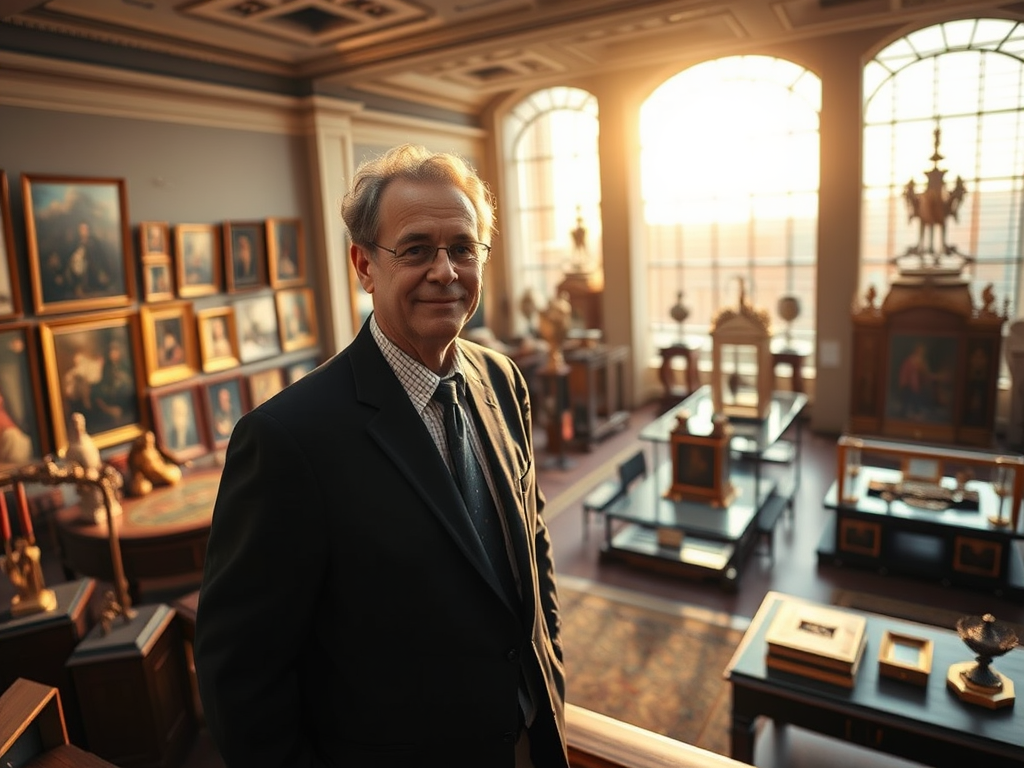
From his office on the top floor of the Metropolitan Museum of Art, Lucian Simmons has a clear view of the immense task before him. Below, in gallery after gallery, lie the countless artworks and artifacts amassed over the museum’s 155-year history.

Previously, as head of the restitution department at Sotheby’s, Simmons grappled with questions surrounding the provenance of dozens—perhaps hundreds—of pieces that the auction house sought to sell each year.
Now, in his new role as the Met’s head of provenance research—a position established in May last year—he oversees a collection of 1.5 million objects spanning 5,000 years of human history. His appointment comes at a time when the museum is under scrutiny regarding how many of these objects were acquired.
Since 2017, the Manhattan district attorney’s office has seized approximately 74 works of art, including 22 on loan, along with 55 Etruscan amber carvings and various other ancient artifacts from the Met, citing them as looted. These confiscations, along with others by federal authorities, have raised concerns among scholars and the public about the museum’s past collecting practices and whether more of its objects have questionable origins.

Simmons steps into this charged environment with the responsibility of rectifying past mistakes, preventing dubious acquisitions, and safeguarding the museum’s reputation for integrity and scholarship.
“My reception at the Met has been incredibly welcoming,” said Simmons, 62, in an interview at the museum. “People are open to discussing provenance and examining potential issues because they recognize that transparency is essential for an institution like this.”
In a demonstration of its commitment to provenance research, the Met now maintains two online inventories: one listing antiquities that have been restituted and another cataloging artworks removed from its collection after being identified as likely looted during World War II.
The museum has also expanded its provenance research team from six to eleven members. One of their latest initiatives is a targeted review of objects in the collection that have passed through the hands of dealers with controversial histories.

“We don’t want ‘lack of resources’ to be an excuse for inadequate provenance research anymore,” said Max Hollein, the Met’s director and chief executive. “That’s simply not an acceptable answer.”
Last month, under Simmons’ tenure, the Met repatriated its first antiquity—a bronze griffin head from ancient Greece—after determining that it was likely stolen from an archaeological museum in Olympia during the 1930s.
Simmons has also fostered a more rigorous approach to evaluating potential acquisitions. “I’m paid to be paranoid,” he admitted. He has urged curators to go further in their research, challenging them to ask more questions and dig deeper before acquiring new pieces.
Since his arrival, the museum has blocked the acquisition of works with unclear or problematic provenance, including an antiquity and several items from the 17th, 18th, and 19th centuries. However, officials declined to disclose specific details, citing confidentiality agreements with dealers and collectors.
For the Met and other institutions, recent years have prompted a reckoning with past collecting habits, which often prioritized securing remarkable objects over ensuring their legitimacy. In earlier decades, the art market had fewer restrictions, countries were less rigorous in enforcing patrimony laws, and museums, despite adopting provenance protocols, frequently failed to adhere to them.
However, attitudes have shifted. Many nations are now enforcing their laws more strictly, demanding the return of looted cultural heritage, and highlighting the damage caused by illicit trade in antiquities.
In response, the Met has joined institutions like the Museum of Fine Arts, Boston—which appointed a provenance curator in 2010—by creating a senior-level position to address these concerns.

“They have really made significant progress,” said Leila A. Amineddoleh, an art and cultural heritage lawyer. “All institutions are stepping up, and the standards for collecting have evolved.”
Simmons brings extensive experience in provenance research, albeit from a commercial background. A graduate of the London School of Economics, he practiced law in London before joining Sotheby’s in 1995.
His passion for art dates back to childhood—he traded old master prints and drawings as a student and worked for American collector Stanley J. Seeger, developing a particular interest in Modern art, including Francis Bacon and late Picasso. “At Sotheby’s, I found a way to merge my legal expertise with my love for the arts,” he said.
During his tenure at Sotheby’s, Simmons served as vice chairman and global head of restitution, leading a team dedicated to preventing dealings in looted art. He also played a senior role in the Impressionist, Modern, and Global Fine Art departments.
Despite his experience, some experts question whether Simmons, coming from a commercial auction house, can fully adapt to the ethical and transparency standards required in a public museum setting.
Elizabeth Marlowe, a professor of art and director of the museum studies program at Colgate University, pointed out the difference in moral obligations between private auction houses and public institutions.
“Museums operate in a completely different ethical landscape,” she said. “It’s not just about due diligence—it’s about actively investigating and addressing unresolved questions.”
However, Carla Shapreau, an expert on looted musical instruments, praised Simmons’ openness and thoroughness in handling provenance issues.

“When I consulted him for my research, he was generous with his time and knowledge,” said Shapreau, a senior fellow at the University of California, Berkeley. “He was transparent and genuinely committed to reconstructing the histories of these objects.”
In his role at the Met, Simmons will inevitably work with Matthew Bogdanos, head of the Manhattan district attorney’s Antiquities Trafficking Unit. While Bogdanos was diplomatic in his comments on Simmons’ appointment, past court filings suggest a more critical view.
In a 2005 Sotheby’s case, Bogdanos criticized the auction house’s reliance on questionable sources when selling an Egon Schiele painting suspected of Nazi-era looting. The Swiss dealer who had vouched for the work’s legitimacy, Bogdanos argued, had ties to the Nazi art trade, making Sotheby’s due diligence inadequate.
A museum spokeswoman stated that Simmons declined to comment on the matter.
At Sotheby’s, Simmons primarily dealt with Nazi-looted art rather than antiquity repatriation, and this focus will continue in his Met role. He is currently reviewing archives, including the Rosenberg & Stiebel gallery records at the Frick Art Reference Library and the Rothschild family archives in Britain, to research works seized during World War II that later entered the Met’s collection. His efforts have already led to updates in hundreds of provenance records.
Recently, Simmons updated the labels of an 18th-century British tea casket and a 14th-century terra-cotta sculpture to accurately reflect that both had once been confiscated by the Nazis and subsequently restituted before reaching the Met.
Beyond internal investigations, the Met is also making its research more visible. The museum has hosted discussions on provenance research, including a recent panel on its loaned collection of ancient Cycladic art. Simmons has also traveled internationally, speaking at conferences in France and the Netherlands, to highlight the Met’s renewed commitment to transparency.
In addition to investigating Nazi-looted art, Simmons is scrutinizing antiquities acquired after the 1970 UNESCO convention—a time when collecting standards were more relaxed. The Met is prioritizing the examination of objects sourced from dealers later linked to looted art, such as Robert Hecht, a notorious international art dealer.




Leave a Reply